Repair and Maintenance: Rejuvenate Your Topsides
If your boat’s more than a few years old, it probably has lots of dings and scratches in the topsides, mostly around the bow where the anchor has whacked into it and amidships thanks to docking misadventures. (If your boat doesn’t have this kind of damage, you should be using it more.) Chances are there are also dull areas where the fenders have rubbed the gelcoat. Can this damage be fixed? How hard is it to match the color? Or is it time to paint the hull? You have two choices: Read on find out more, or forget about cosmetics and go boating. It’s your call.
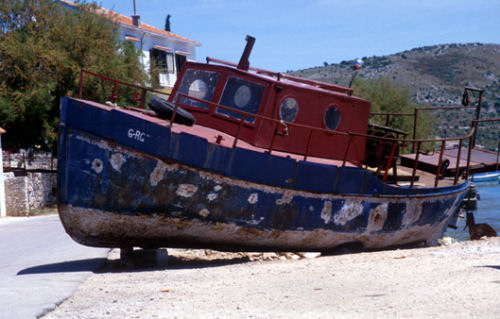 It’ll take more than paint to bring this boat back to its youthful glory. (Actually, the gel coat is still in pretty good shape.) Chances are your boat doesn’t need such radical therapy. |
Jon Ballard has more than 15 years experience in paints and finishes, starting as a teenager when he worked on projects with his father. Today he is the paint-shop foreman and a project manager at Rybovich (www.rybovich.com) in West Palm Beach, FL. Rybovich is to yachts what Rolls-Royce is to automobiles, so if anyone knows what it takes to make a boat look like a million, it’s Ballard. Here’s his advice:
“My recommendation is to prime and paint,” said Ballard. “Gelcoat is not an easy color match. There’s a lot of tinting and toning; you almost never get it right.” Even if you match the color, you’ll always get “halos” around the repairs, he added. But painting your boat probably isn’t as complicated as you think: In most cases, gelcoat topsides can just be cleaned, sanded and primed; it’s rare that the gelcoat has to be stripped off, although sometimes the painter will have to use a high-build primer to fill surface imperfections. “Let the paint shop know what wax or polish you’ve used on the boat,” advised Ballard. “Teflon and silicone demand different kinds of cleaners.”
Ballard prefers not to comment on which brands of paint are best, although “I have my preferences,” he said. However, he recommends using a two-part polyurethane on smaller boats – “under 80 feet” – because the coating is repairable, an important consideration when the owner might be doing his own work. “Cross-linked polyesters are difficult to repair,” he said. “Leave them to the pros.”
Beware of changing the color of your fiberglass boat, especially from light to dark, Ballard said. The dark color will absorb more heat from the sun, often post-curing the resin and causing print-through and other problems. Otherwise, how long your boat looks new again depends on how you care for it. “Some crews wash like crazy, but if you let the salt sit there and cook in, you’re not going to get the life out of it.” Maintain the surface as recommended by the paint manufacturer; most of them offer a “care package” of products. When it’s finally time to repaint, the new topcoat will go on easily over the old. Most paint manufacturers recommend priming first, but “it depends on the length of time between coats,” said Ballard. “Many jobs are simply ‘scratch and reshoot.’”
What if you just want to repair the damaged areas -- can you hire a spray gun and do it yourself? “It’s hard today to just pull into a place and start to spray,” said Ballard. There are environmental as well as technical issues to consider. “These chemicals aren’t safe. They have to be disposed of properly. The disposal fees can almost equal the cost of having the repair done professionally.” And when you’re ready for a proper topsides job, the time the paint crew spends undoing amateur repairs can make the cost even higher, Ballard concluded.
So if you’re boat’s looking the worse for wear, bite the bullet and let the experts spray on a shiny new topcoat. Then be more careful with the anchor.