How to Target the Right Boat For You
As you begin to evaluate your many boating options, you may feel overwhelmed by the selection -- there are literally dozens of types of boats available, hundreds of brands, and thousands of models to choose from. How can you possibly select the appropriate type, brand and model that is absolutely the best boat for you? If you are a veteran boat owner, have you analyzed why you want a new boat and what it will take to keep you happy for more than the first season? If you are a first time powerboat buyer, you might wonder if you should start with a small boat, then get a bigger one in a year or two? Or, can you start with a boat the size of the one you would eventually like to end up with? In order to get some sage advice from someone who has helped boat buyers find their dream boat for over 20 years, we went to a respected West Coast yacht broker and author of The Boat-Buying Handbook, Martha Comfort. This is the first article in a series designed for both veterans and first time boat buyers to help them get their next boat purchase right! (Pay attention, there will be a quiz at the end.)
By Martha Comfort
First, you'll need to determine the type of boating you will be doing. This may seem an obvious starting point, but you'd be surprised how many buyers purchase a boat that doesn't fit their needs. Every boat is a compromise, between the fastest, largest, sleekest features and the realities of your planned use and budget. To find out what boat is suitable for your needs, you must know what you need. Sounds obvious, right?
The trouble is that many buyers forget this simple concept and end up with a boat which does not fit even their most basic requirements. By “type” of boat, we mean express cruiser, center console, motoryacht, ski boat, convertible, sportfisherman, trawler, sportboat, sedan, etc. Most boats can serve more than one purpose which is one of the things that causes the confusion among many buyers. But nearly every boat will fall into a particular “type” and that description indicates what its primary mission is and what it does best, even though it can do other things as well.
How Much is Enough?
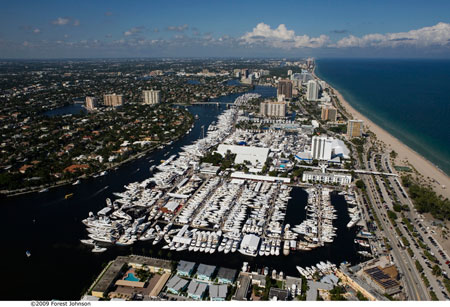 The Ft. Lauderdale Boat the last week of October has hundreds of boats that stretch over a mile on the ICW. One of them could be right for you, the trouble is knowing it when you see it. |
Second, look at how much boat you can use, rather than how much boat you can
afford. A boat may be able to accommodate a family of 10 for the week, but if you
simply want to go out for an evening cruise, or to catch a few fish on a weekend
morning, the larger boat is not the most practical use of your time or funds.
 Historically, the Seattle Boat Show on Lake Union is a Mecca for serious West Coast boat buyers. They all look good, but finding the right one for your specific mission is the trick. |
Do you honestly plan to stay aboard overnight? Having bunks for 2 couples plus the grandkids may be what you need, but if it is not, keep it simple. As you go
through your boat research exercise, make notes in your Boat Buying Notebook. You will be developing a list of features for your ideal boat and putting these into three lists:
1) Those features that are necessary attributes of your boat,
2)Those items and details that you would like to have, and
3) Those features that you might be able to do without, at least for the first boat!
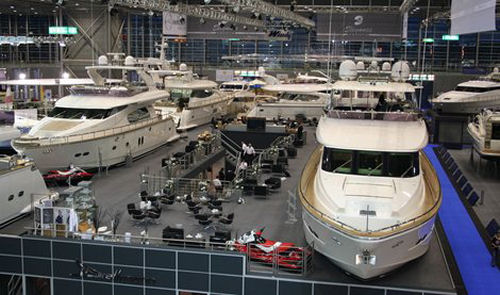 In January 2011 over 1700 exhibitors from 57 countries will occupy 18 halls and over 2.1 million square feet of exhibition space at the annual Dusseldorf Boat Show, Boot Dusseldorf. It takes days to see it all. |
Your Passenger List
Consider who you will be boating with. Will it be mostly only with your significant other? Will your usual crew be with your whole family, another couple, just the guys, your children and grandchildren, etc? Match the interior, the sleeping accommodations, and the deck space to the number of people you plan to have aboard.
For example, if your guests will be elderly or very young, you might think about how well they will be able to negotiate a flying bridge. If you are only going to have fishing buddies aboard, do you really want a queen berth in the forward cabin? How many times a year will you have a crowd aboard, and will they be staying overnight?
When thinking about who will be using your boat give serious consideration to what kind of head and shower compartment you plan to have, how many and where they are placed. If you are planning on buying a 17’ freshwater open fishing boat, where will you stow the five-gallon bucket? (Every boat of any size should have one for emergencies!)
Make sure there are seats for everyone you plan to have aboard. Be advised that the “Capacity” plate on smaller boats simply means that there is a place for that many people to sit or stand and hold on! It does not mean that the boat can actually seat that many people. Also, on small boats, note that the weight capacity, including all gear placed aboard, should never be exceeded. This can be particularly critical for boats under 20’.
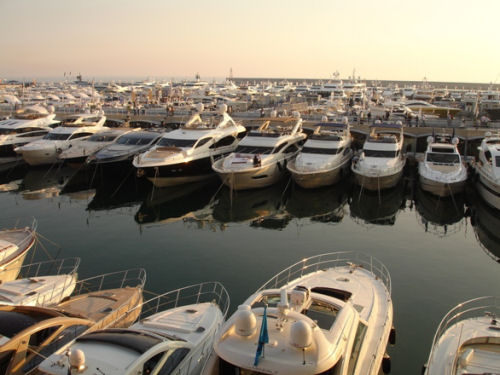 The 50th annual Genoa Boat Show, Salone Nautico, will have over 2500 boats to chose from, say the shows promoters. It is always the most elegant boat show of the year and is worth visiting, if only for the ambiance.
|
The Boat’s Mission
What activities do you want to do with your boat? An open dory or center console may be great for outings with your fishing buddies, but will the family really wish to spend time aboard on a regular basis? If members of your family want to wakeboard or waterski, is the boat designed for those sports?
Entertaining is an important aspect of many boats and you should carefully consider what kind of entertaining you will be doing. Will it be informal with friends, or will you be having business clients aboard for whom you might want to have a few more amenities?
Evaluate the type of water where you will be boating and the local climate. Simple, flat-bottomed boats are fine on inland or sheltered bodies of water, but higher freeboard and more deadrise will be needed if those boats are to be used on open water where you will encounter bigger waves and rougher conditions.
In a warmer climate, an open boat with a Bimini top for shade may be a good
choice. The cabin may require more opening ports for ventilation or maybe air
conditioning for use in the summer. In colder climates where the boating season
is relatively short, a boat which offers more protection from the elements will
prolong the season.
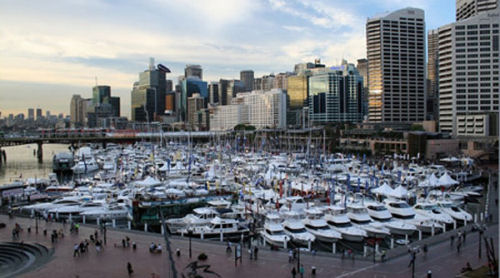 The Sydney Boat Show held last month had over 300 boats to chose from. A serious boat buyer could travel the world around visiting shows every month and still not find the right boat, unless he knows what he's really looking for. With so many choices, it isn't easy. |
The Great Compromise
Each activity requires specific features in your boat. Decide which you truly need and which are secondary or tertiary considerations. Remember, it is all about compromise. Use the following questions to help you determine what your boating needs are. Write down your requirements in your Boat Buyer’s Notebook. Take note of which features you might be willing to give up in order to get what is really required. The import questions you must answer are--
a) How will I most often use the boat?
b) Do I really want to buy, or would renting/chartering be better for me?
c) Do I plan to fish from the boat, is so, how much of the time?
d) Does a new or used boat best service my temperament and purse?
e) Will I keep the boat in the water or will it be trailer it?
f) I trailer, can my vehicle handle the weight of the tow?
g) Do I want to stay overnight aboard the boat?
h) Do I want to live aboard, and for how many months a year?
i) Do I dream of setting off for extended cruising?
j) How many people to do I plan to have aboard most of the time?
These are by no means all of the questions you must answer before zeroing-in on the right model for you, but it is a start. And, perhaps, most important it will get you past the pretty pictures in the ads designed to beguile you into one brand or another that may be totally wrong for your needs, once you discover what they really are, and get you thinking along more practical lines.
(Next week -- Martha Comfort plays 20 Questions about your hidden boating psyche in the second installment of “How to Buy the Right Boat.”)
About the Author
 Martha Comfort |
(Martha Comfort has been boating since she was a young girl, has cruised extensively in the Caribbean, has been a USCG-licensed captain and has crossed the Pacific Ocean in a 36’ sailboat. She has been in the marine business for over 30 years, was Director of the Pacific Seacraft Yachting Center and Keppel Marina for 5 years in Singapore, has founded and sold two successful international marine dealerships. She serves on numerous marine committees and currently chairs the Government Affairs Committee of Northwest Marine Trade Association. She has helped hundreds of new and experienced boaters select, buy and re-sell their yachts and is currently a broker for Chuck Hovey Yachts in Seattle, where she has been the last 12 years. Martha is the author of The Boat-Buying Handbook, which has been in print for eight years.)