How to Find a Boat Designed for Your Mission
Probably the most basic, and most important, question you must answer when in embarking on buying a new boat is what will its “mission” be. Will it be fishing, cruising or some sort of watersports, or just a little bit of everything? Every builder designs each boat in its line for a specific “mission.” Some boats are designed to go around the world while others are designed simply to look like they could go around the world. Small trailerable boats have missions, too, and they are just as specialized as are big boats. Matching one’s personal mission with the mission the builder intended for a specific model sounds simple, but like many things in boating, it’s often harder than it appears.
 Planet Solar has a special mission: circumnavigation by means of solar power only. What is your mission, and do you have the right boat for it? |
After you have answered the questions in last week’s
Boat Buying Installment #2 now ask your spouse and family to discuss them and compare your answers. You may be surprised! It is important that you share your boating dreams at this time, not so that you can agree but so that you can each understand the mindset of the other people – your crew!
Remember, buying a boat involves compromise. You should be working to establish a list of what features must be aboard, what features you'd like to have aboard, and what you can live without at this time. Above all, you should agree on what is the primary activity for the boat. Let’s explore a few of the most common--
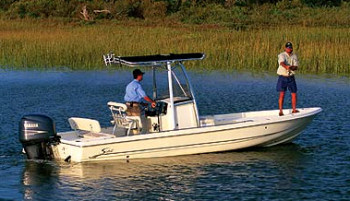 Bay boats, skiffs, or flats boats such as the one above are designed for protected, shallow water fishing. They are not intended for offshore work. |
Fishing
Some fishing boats are so specialized that they have a category that has taken on the name of the specie, such as bass boats. Other boats are designed to be operated in skinny water like flats boats or bay boats which are ideal for chasing bonefish or other inshore species. Center console and walkaround boats were designed for nimble, lightning-fast game fish in saltwater that will dart around the boat and under it. Anglers in the hunt for big game billfish will want to look at several different types of boats from large open boats to huge convertibles that are capable of going hundreds of miles offshore in almost any kind of condition and keep a party of anglers comfortable in the process.
Knowing that you want a boat to fish from is simply not enough. You must also know what species you want to go after, what sea conditions they are found in, how many people you want to have along, and what sort of range you will need, among many other things. Once you have identified those things, then you can start looking for the boat that has a “mission” similar to yours.
 It is important to match the boat to the sea conditions you are likely to encounter, along with the size of the fish you plan to catch. |
Some Things to Look for in All Fishing Boats
A stable platform should be at the top of the list of a fishboat’s characteristics, no matter what size the boat. In a small boat you want to be able to stand up without worrying about the boat capsizing in a seaway or at rest. When you sea-trial the boat, test its stability in different conditions.
A clean cockpit and the ability to walk around the entire boat is probably next on the list of great fishboat features. You'll want a big, open cockpit without any deck hardware or rail-mounted equipment to snag lines as you fight the fish. On small boat you’ll want to be able to move around the boat quickly to play the fish.
All-round visibility from the helm is critical and some anglers forget to think about it when buying. There is more to a good fighting machine than just a well-equipped, large clutter-free cockpit. When fishing offshore it helps to have some altitude to help the skipper spot the clues to where bait fish might be. That’s why fishermen invented the flying bridge, and later the tuna tower. Make sure you’ve got good sight lines all around from the helm. On the flying bridge make sure you can stand at the helm and see the action in the cockpit and be able to reach the controls at the same time behind your back – and be able to see the bow when you look forward.
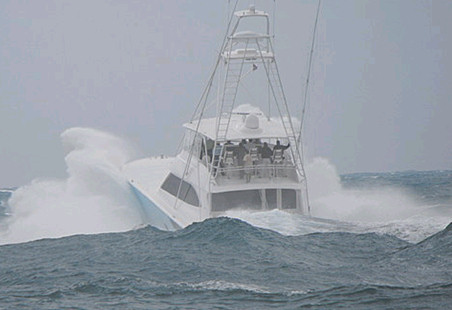 This Viking 82 is designed to make long-distance passages offshore in rough conditions to reach prime fishing destinations all over the world. |
The boat’s ergonomics must fit you. On a small fishing boat, make sure the helm seat, wheel and instrument panel are ergonomically correct for you. Before you buy, get in the boat, move around, stand in the ends and on the side. On large boats, make sure you have good visibility. If you are short and things are too high for you, either have the builder or dealer modify those items, or move on down the road.
These days most fishing boats are pretty well equipped and virtually all have the basic features you will want. Where they differ is in the details – even in small, aluminum freshwater multi-specie boats close inspection can reveal a world of difference. Make a list of the details and features you must have so when you do you research you can discard models that don’t have the basics that you want.
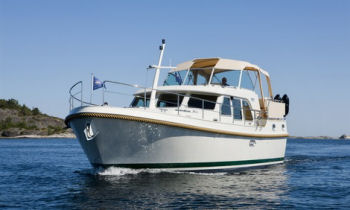 This displacement cruiser is designed for Europe's rivers and canals as well as some coastal work in the Blatic. |
Cruising
Most boats sold today are used for some type of cruising, whether it be just motoring slowly around the lake for the day, spending a short weekend aboard, or taking an extended cruise.
If your idea of cruising is to get in and go to the next port where you will check into the local resort, the boat you want will be different from the one you plan to spend a month living aboard. What works for you and your family in terms of comfort vs. "roughing it" will depend on many factors such as age and your need for creature comforts like a large and comfortable mattress, supply of gourmet hot meals, and lengthy showers. Your budget, geography and time constraints will also determine your type and style of cruising boat.
In my youth, I spent some time living aboard small boats, exploring far-flung places. I often slept on deck on a sailbag, as this was preferable to my cramped and lumpy bunk. It did not matter that there were few amenities aboard. The adventure (and my youthful exuberance!) overruled any discomfort.
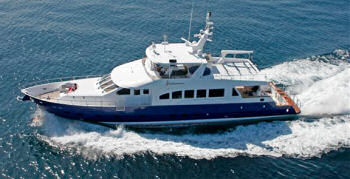 This large cruising yacht is designed for offshore cruising with an emphasis on water sports once the boat has arrived at it destination. |
In a more advanced stage of life, these things have changed, and today I would not be a happy boater without a soft mattress and pillow. Be realistic about what creature comforts you, and your partner, expect to have aboard. For some people this is 24 hour 30-channel TV, microwave and freezer convenience. For others, more simple living will do well when aboard.
Most boat owners go day cruising. Day boats are the practical, economical, and a convenient way to enjoy the water, sun, and the great outdoors with good friends. Day cruising boats don’t need a number of cabins, a full galley, air conditioning and many other amenities. They also don’t need large, expensive engines and big fuel tanks for prodigious range. Zero-in specifically on your cruising “mission” and you may be able to save yourself a lot of money by getting the right boat on your first try.
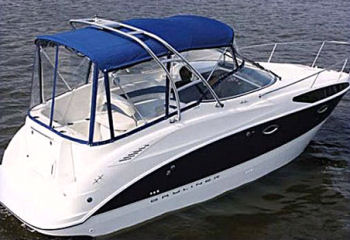 This cruising boat is trailerable and is suitable for large lakes and semi-protected coastal work. Clearly part of its mission is to cruise in cool, sometimes wet locations. |
There are many other activities that boats are made for, but since nearly every boat no matter what it’s primary “mission” will also be used at some point for cruising and casual fishing, it is good to make sure your boat is not a one-trick pony. We’ll discuss other activity missions in a future issue.
About the Author—
 Martha Comfort |
(Martha Comfort has been boating since she was a young girl, has cruised extensively in the Caribbean, has been a USCG-licensed captain and has crossed the Pacific Ocean in a 36’ sailboat. She has been in the marine business for over 30 years, was Director of the Pacific Seacraft Yachting Center and Keppel Marina for 5 years in Singapore, has founded and sold two successful international marine dealerships. She holds the Certified Professional Yacht Broker C.P.Y.B. rating. She serves on numerous marine committees and currently chairs the Government Affairs Committee of Northwest Marine Trade Association. She has helped hundreds of new and experienced boaters select, buy and re-sell their yachts and is currently a broker for Chuck Hovey Yachts in Seattle, where she has been the last 12 years. Martha is the author of The Boat-Buying Handbook, which has been in print for eight years.)