How to Buy a Boat Ready for Watersports
There are a lot of activities that are best done from boats in some of the most beautiful locations on earth. Probably the most basic is simply swimming and using the boat as a practical platform upon which to reach an ideal spot. After a refreshing dip, then there is nothing more delightful than climbing back aboard that handy floating transportation for a day in the sun (or shade.) But not all boats are designed, equipped or even intended to carry out this most basic of boating missions. If you intend to use your new boat for watersports -- where people are actually in the water -- then make sure you are getting the right boat, and one equipped the right way.
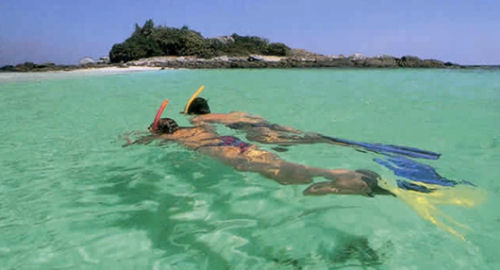 In this day-and-age boats are designed and built especially for individual watersports. The trick as a buyer is to find the best boat for your specific activity, agility and location. |
Swimming
The Swim Ladder
While it is obvious that swimming is one of the primary activities that many people use a boat for, it is amazing how ill-equipped some boats are for this basic function. As a boat buyer, you must assume nothing. If you haven't guessed by now, nothing is all that simple when buying a boat.
A sturdy swim ladder is an important feature for your boat. Even if all you have on is a bathing suit, clambering aboard a boat can be difficult without a good ladder, and many boats on the market leave a lot to be desired when it comes to a swim ladder. A proper swim ladder is also an important item of safety equipment.
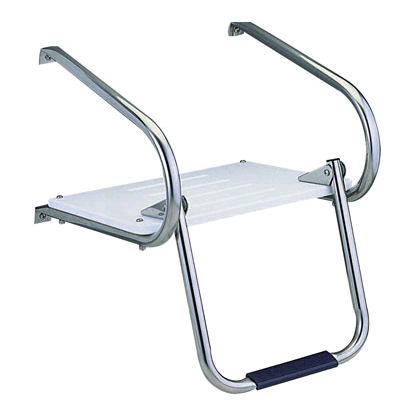 A single-step ladder that has a step at least 12" (.30 m) below the waterline of the boat is the minimum ladder permitted by ABYC standards. It is not easy to use. |
Required for Safety
All boats built to ABYC (American Boat and Yacht Council) standards (which includes most boats built or sold in the U.S.) are required to have a method whereby a person can easily get back aboard a boat from the water.
On boats that are not intended to be used for swimming, these re-boarding ladders can be quite rudimentary (such as on many bass boats), and are designed more to meet the standard than they are to be easily and comfortably used. The standards (H-41.9.1 and 41.9.3) require that the device be reachable by a person in the water and the height of the highest step be at least 12" below the waterline when the boat is floating on its lines.
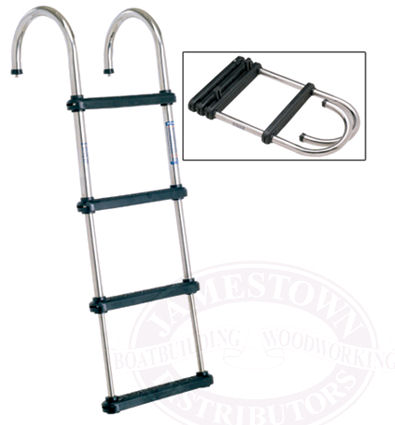 A few boat companies install four-step telescoping boarding ladders. Now that's a ladder! |
Most builders put only three steps on their swim ladders. If you are over 21 years old, then perhaps you know how difficult these can be to negotiate. Builders of premium boats usually equip their boats with four-step swim ladders, and that is what I recommend if you are planning on using your boat extensively for swimming. If the boat you are buying does not come with a four-step ladder, talk to your dealer about substituting one for the standard equipment.
 Swim platforms on all sizes of boats have been growing the last 20 years. Some are now used for carrying tenders when under way and a teak beach when at anchor. |
A Proper Swim Platform
Swim platforms have come a long way in the last 20 years of boat building, and the concept is still evolving. Today nearly all powerboats, except fishing machines, come with them in one form or another. Generally, swim platforms are getting longer and lower to the water, and increasingly they are combined with a transom door. All of this is to make egress and entry into the boat easier from both a floating dock or the water.
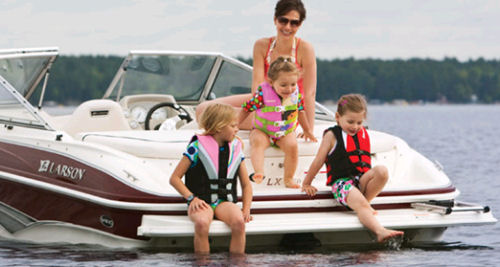 Kids love to sit on the swim platform and dangle their feet in the water. Note how low to the water the platform is on this Larson and also the fact that it extend beyond the lower unit. |
Generally in smaller boats the swim platform is made of fiberglass and bolted on, or it is part of the hull molding. Since this is a design concept that is still in evolution, some builders have simply added a fiberglass swim platform to the transom of a boat that was not designed for it in the first place. Most new designs include a swim platform molded into the hull or designed to be bolted on low to the water.
Astute boat buyers will make sure before buying a boat that the platform extends beyond the sterndive's lower unit. In this way, swimmers can slip into the water and not worry about cutting their foot on a prop or lower unit appendage.
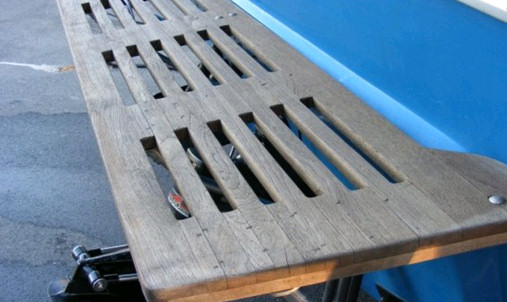 A teak swim platform is the traditional material and this one will not be damaged by waves when drifting due to the grid pattern, whereas solid fiberglass platforms are problematical offshore. Note that the sterndrive lower unit extends beyond the swim platform which means that a swimmer can get cut when sliding off the platform into the water. |
Swim platforms are getting longer and lower and to the traditionalist's eye may look awkward or out of proportion at first. Our advice is to go with the new design trends and let your eye get used to it because the large swim platforms are adding lots of functionality as well as added safety to modern boats.
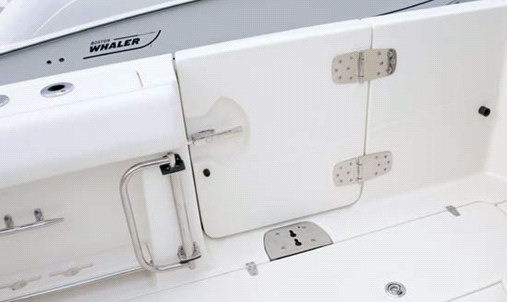 This is a door in the gunwale of a 37' outboard-powered center console. The side door can make re-boarding easier for scuba divers and swimmers, too. |
Deck Boats and Doors
In some respect deck boats are the ultimate swim platform. They are low to the water, can be entered from both ends and have big open spaces inside. All deck boats and some sportboats have ladders on the bow, but in most cases these are not designed as swim ladders, but rather are intended to be re-boarding ladders from the beach. Usually they have three of four steps, but not enough to reach far below the water's surface. These ladders are a good idea and are ideal for people who don't want to put their feet in the water to get ashore.
 All deck boats have ladders on their bow to make it possible to enter and exit on a beach without getting one's feet wet. They are not swim ladders. |
Some new offshore center console and other types of boats have doors in their gunwales. This design is increasing in popularity and this location allows the manufacturer to make the door wider. Currently these boats all have ladders that stow below and are only affixed after the door is open. If you like this arrangement, make sure the ladder is lightweight, sturdy, easy to install and has a dedicated stowage location.
Scuba Diving
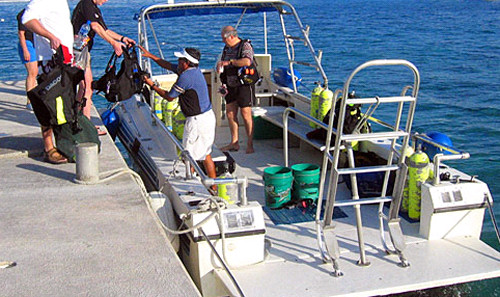 Boats designed expressly for scuba diving have a large open cockpit, a huge swim platform and a wide, five-step ladder. |
For scuba divers a large swim platform with a deep and wide ladder makes re-boarding a boat a joy instead of an ordeal. The platform puts you within inches of the water while you don or doff your snorkel or dive gear, making this process that much simpler and easier. A large swim platform combined with a wide and deep ladder is the best of all worlds for scuba diving.
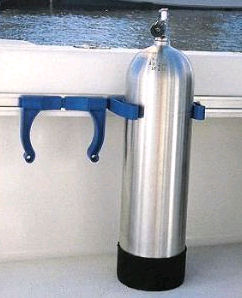 Most large inboard boats going offshore these days carry at least a minimum of scuba gear, and aftermarket racks are now available to easily stow the heavy tanks. |
Specialized Stowage
Racks for dive tanks are highly recommended because shifting or sliding tanks can have unexpected, and explosive, results; Proper storage for dive equipment is a basic safety issue. (It can be sort of like a lose cannon in a seaway.) More and more, boats are coming equipped with built-in racks for scuba tanks. If the boat you are looking at does not have such racks, investigate aftermarket racks on the Internet and make sure they will fit into the boat you plan to buy.
If you are a more serious scuba diver, then you will also want to have an air compressor aboard. These can be quite small, but again you will need to carefully take measurements and have it installed by your boat dealer or an expert boat yard. There are several issues involved with compressors, not the least of which is the handling of the potentially toxic emissions.
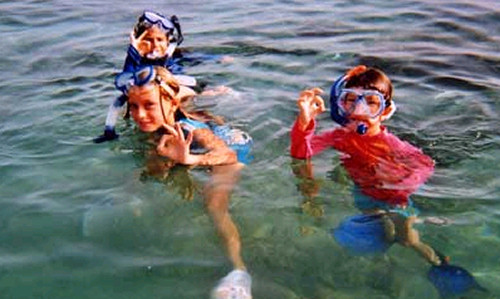 Nothing is more fun for parents that seeing their children enjoy the water around the boat. Everything seems to be A-OK here. |
Snorkeling
As a watersport activity snorkeling falls roughly between swimming and scuba diving. It is a great way to see underwater without all of the paraphernalia and training required for scuba. All one needs is a mask, snorkel, swim fins and some reasonably clear water in which to swim.
Kids love to snorkel because they are discovering a new world, but where the water is clear and there are small fish, one is never too old to enjoy scenes below the waterline. Boat buyers planning on adding snorkeling to their list of watersport activities should make sure there is adequate stowage for the gear. If there is not, you will have to invest in a large tote bag. Just as important is the size and nature of the transom door, swim platform and the ladder -- the easier it is to re-board the boat, the more people will partake in the activity.
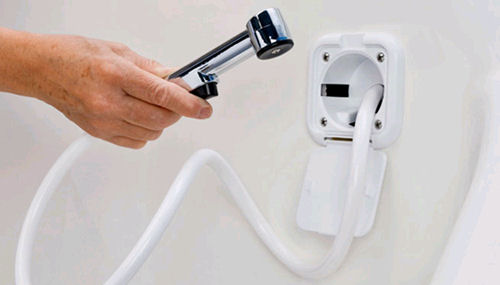 Transom showers are now ubiquitous as standard or at least optional equipment. If you are going in the water you'll want to have one. |
Fresh Water Shower
After taking a swim and re-boarding the boat, nothing feels quite so good as a freshwater shower. Most boats these days come equipped with telephone showers located at the transom. If you are planning on making in-water activities part of your boating fun, then you will want to make sure that your boat is equipped with a freshwater shower.
Adding hot water to that shower adds another level of complexity to the boat, of course. Our experience is that if you can only have a cold water shower, it is better than nothing. Many cruising yachtsmen find it a bracing way to start the day after a short swim around the boat.
None of the above tips about boat design and equipment are earth-shaking, nevertheless it is easy to buy a boat that was really not intended for simple watersports. In today's world more and more boaters are trying to maximize their boat's utility, not only for themselves, but also for the next owner.
Next Installment of Boat Buying Tips: Entertaining Aboard
About the Author—
 Martha Comfort |
(Martha Comfort has been boating since she was a young girl, has cruised extensively in the Caribbean, has been a USCG-licensed captain and has crossed the Pacific Ocean in a 36’ sailboat. She has been in the marine business for over 30 years, was Director of the Pacific Seacraft Yachting Center and Keppel Marina for 5 years in Singapore, has founded and sold two successful international marine dealerships. She holds the Certified Professional Yacht Broker C.P.Y.B. rating. She serves on numerous marine committees and currently chairs the Government Affairs Committee of Northwest Marine Trade Association. She has helped hundreds of new and experienced boaters select, buy and re-sell their yachts and is currently a broker for Chuck Hovey Yachts in Seattle, where she has been the last 12 years. Martha is the author of The Boat-Buying Handbook, which has been in print for eight years.)