Engine Selection for Express Cruisers and Fishboats
Engines are the most important component in your boat. In some cases your engines can be more important than the brand of boat itself. Engine selection requires the buyer to get serious about exactly how he plans to use the boat. The decisions can be doubly perplexing because like all boats the one you buy now will be put up for sale one day, and the engine could be a determining factor as to how fast it sells and for what price. This week we will look at some considerations that buyers should be aware of in express fishboats and express cruisers.
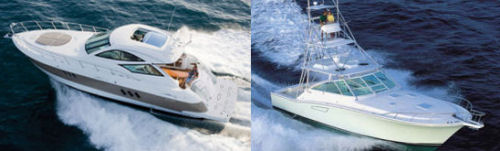 Both of these boats are express models. The Cruisers Yachts 520 at the left is an express cruiser and the Cabo Yachts 45' at the right is an express fishboat. Both have some things in common, but are as different as night and day. |
Gas or Diesel?
Many boats from roughly the 32’ to 40’ range are offered with a choice of either gas or diesel engines. In Europe, where the price of gasoline is high, the decision is easy to make, but in the U.S., where the fuels cost about the same, new boat buyers are faced with their first major dilemma after selecting the model boat for their mission. Even twenty years ago when diesel fuel was considerably less in the U.S., most boaters would not have saved enough in diesel fuel to pay for the added cost of the engines themselves.
For Americans, the reasons to buy diesel have more to do with the torque and horsepower required to move the boat, as well as the obvious relative safety of diesel fuel because of its higher flash point. The flash point of a fuel is the lowest temperature at which it will begin to vaporize, mix with air and ignite from an external heat source. (The autoignition temperature is when the vapor will combust without an external ignition source.)
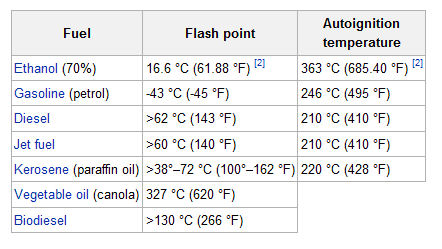 These figures are approximate and vary depending on several factors including the testing method. |
Gas engines are less expensive to buy, they are generally lighter than diesels, and they also can usually propel the boat faster than will a diesel engine in its approximate horsepower range. However, the horsepower of gasoline engines is limited to those blocks commercially available, which is to say, light truck engines. Although there are a few larger gasoline engines, they are only used for exotic applications. Commercial diesel engines, on the other hand, range from just a few horsepower all the way up to 100,000-hp or more. Large boats are heavy and must push a lot of water out of the way and the best way to do it is with diesel power.
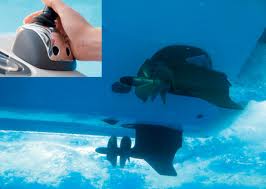 Volvo Penta revolutionized recreational boat propulsion by introducing the joystick and pod concept to the mass market. |
Joysticks and Pods
Hinckley Yachts introduced the joystick concept on some of its jet drive powerboats nearly 15 years ago, but since Hinckleys were beyond the price point of most buyers, and their Picnic Boats had limited utility, they did not catch the imagination of many buyers. It was not until Volvo Penta introduced its pod drives with joystick about five years ago that the concept got real traction. There was a two-year period of time when the only joystick controls available to the recreational boating public were the Volvo Penta IPS diesel pod drive system and boat builders all over the world flocked to it.
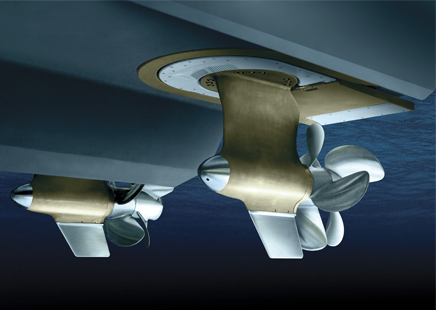 A collaboration among ZF, CMD Cummins diesel and MerCruiser resulted in the first Zeus drive that was fitted to CMD engines. |
That exclusivity did not last long, and now joystick controls are available for both diesel and gas sterndrive twin-engine applications from nearly all of the major engine makers including Cummins MerCruiser (CMD), Yanmar, and Cat using ZF Zeus pods and joystick software (or their own software) . Just recently, ZF announced a new single pod joystick system (with bow thruster).
ZF also offers a system for twin straight-shaft inboard applications that -- with the addition of a bow thruster -- also takes advantage of joystick technology. So now, all three types of propulsion -- straight inboard, sterndrive, and pod drive -- can be married to joystick docking software systems.
Now, let’s take a look at the different types of boats to see what the options are—
1. Express Fishboats
Well over 30 builders offer an express fishboat in one size or another. In the smaller sizes (22’ to 26’) they come powered with single-engine gasoline, single-diesel inboard engines, or outboard engines. Historically, express fishboats in the 28 to 35' range have been powered by twin gas or diesel engines. Over 32' or so, most of these express fishboats are powered with twin diesels.
 This 38' Rampage is a good example of the express fishboat type. |
The advent of Yamaha’s 300-hp and 350-hp engines and later 300-hp outboards by Evinrude, Suzuki and Mercury (which also has a 350 on the market) have made it possible for builders to design ever-larger outboard-powered express fishboats. Several builders have 33' to 38' models on the market with outboard power.
The Mission Dictates Power
Once a buyer has decided that he wants an express fishboat, before selecting a specific model and brand he should examine his fishing plans. Where will most of the fishing be done, how far will the runs be, and what is his desired engine system? For example, if a buyer wants to go with gas inboard engines because of price, he should make sure the fuel capacity of the boat will get him to the fishing grounds and back at the speed you will want to go. And, as with all range calculations, allow for a minimum of 10% reserve fuel.
Pod drives have not yet been embraced by many express fishboat builders. The first builder, as far as we know, was Rampage a few years ago in its Rampage 34, which has been successful and has sold all over the world. Builders of fishing boats are notoriously conservative and putting pods in a boat that needs a cockpit low to the waterline is not easy with engines underneath.
ZF's new inboard joystick control system is also available for straight and V-drive inboard application with the addition of a bow thruster, and a ZF marine gear, of course. (Read more below.)
How Fast?
By and large anglers like to go fast in order to get out to the fishing grounds offshore as soon after daybreak as possible, and be able to dash back before sunset after getting in a full day of trolling. Forty knots is the magic number for these anglers, although there is no reason why this needs to be your magic number. It all depends on your boat's mission, your pocket book, and whether your ego needs the juice. I would say that in any case the boat should cruise in the low to mid 30 mph range to optimize re-sale opportunities, if nothing else.
[To see the express fishboats that BoatTEST.com has tested…]
2. Express Cruisers
Since express cruisers typically travel along the coast or island hop, they are never too far from a marina and fuel. For that reason, range is less of an issue with this type of boat, which tends to be larger than express fishboats, but often carries less fuel. Generally buyers of these boats are more concerned about the ease of docking, safety, speed and creature comforts.
Single and Twin Engine Options
Typically express cruisers are powered by a single sterndrive engine up to about 28 feet in North America. Beyond that size, the weight of the boat demands more power and the beam is wide enough to handle twins. In Europe and elsewhere, where speed is not so important, single engine express cruisers may range as large as 50’. Almost without exception these single engine applications are diesel and are used mostly in rivers and canals.
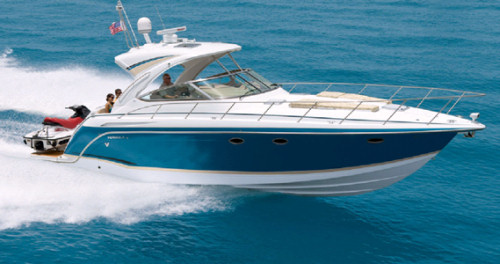 Express cruisers such as the 40' Formula seen above have dominated American waterways for over 30 years. |
Depending on where the boat is used and how fast the owner wants to go, diesel engines typically start to be installed about 33’ as an option in most brands in the U.S. In boats over 40' diesels are virtually mandatory because of the weight of the boat and the speed required.
For a long time there were only two sterndrive brand choices, Volvo Penta and MerCruiser, and engine size ranged from 5.0L blocks up the 8.2L marinized truck engines that go in the largest gas-powered sterndrives which are, say, from 35' to 40’. Brunswick-owned builders such as Sea Ray offer only MerCruiser engines in gas, but the independent builders usually offer consumers a choice of either MerCruiser or Volvo Penta.
More recently Yamaha outside of the U.S. has been offering sterndrive lower units for its diesel engine applications, and last year Yanmar announced its own stern drive lower unit expressly made for diesels. Our understanding is that Yanmar will sell these to OEMs which may install the drives on other brands of engine as well as on Yanmar engines. MerCruiser heavy-duty Bravo III drives have been used with diesel engines in one-off applications for years.
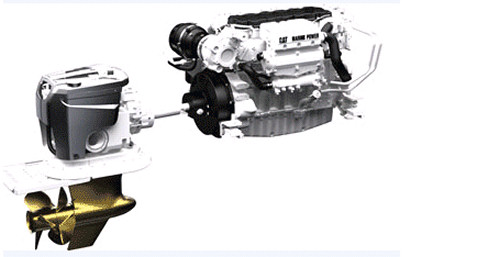 Now Cat and Yanmar offer their products married to ZF (Zeus) pod drive systems. |
Typically, builders offer two or three diesel brands, with the most common being Yanmar, Volvo Penta, CMD and Cat. In the very large European-style express cruisers virtually all brands of diesels are available from one builder or another.
Pod Drives & Joysticks
Pod drives with joysticks were introduced specifically for express cruisers because their sales numbers were robust, and most new boat buyers have more bucks than boating experience. Today many builders offer gas-powered stern drives with joystick docking controls. Volvo Penta has a IPS pod system for both its gas and diesel engines, and Yanmar, CMD and Cat diesel makers mate their engines to ZF pod drives.
Tests run by BoatTEST.com confirm claims by the engine makers that the pod drives are 30%+ more fuel efficient at best cruise compared to straight shaft inboard engines. Top speeds are also greater with pod drives, but BoatTEST.com has found that at WOT speed and fuel efficiency improvements are not so easily predictable.
Now--The Joystick-Only Option
The pod and joystick systems are an expensive upgrade, which is why ZF’s joystick system for inboard boats has gotten so much attention since it was first introduced last year. While straight inboards do not have the fuel efficiency produced by pod drives, even with the installation of a bow thruster, this joystick docking system is a lot less expensive than are pod drives with a joystick.
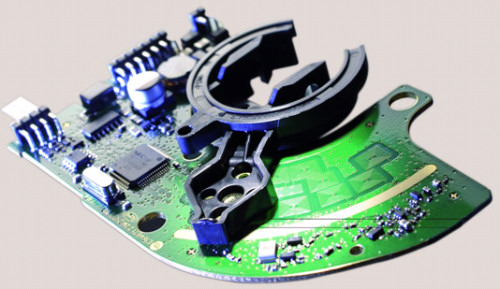 ZF is making its control software and hardware (transmissions, pods and bow thrusters) available to partners. |
However, one of the big advantages of pod drive express cruisers over straight inboards is the room created forward for accommodations because the engines are moved aft in the boat and are just forward of the props. This is an important consideration when choosing a propulsion system. People who want the accommodation room afforded by the pod drives but who do not want the added expense, should investigate inboard V-drives. ZF can provide a joystick solution for them as well.
The Old Fashioned Way
Many experienced boaters will continue to specify their boats with conventional sterndrive or inboard drive systems, both straight and V-drives, and save the money that otherwise they would have spent for expensive pods and joystick technology. After all, people have been docking boats for 100 years without joysticks and pods.
Since these products are so new, it remains to be seen what will happen in the used boat market with the relative pricing of the upgraded systems. Will these boats hold their new-boat price differential as they do for diesel boats and premium brand boats, or will they "melt down" as do electronics loaded onto a new boat which raise the used boat price very little several years later? My guess is that it will be the former.
The Speed Hurdle
As to the question of speed, there is a far wider spread than we see among express fishboats. For example, traditional-looking Downeast express cruisers will usually keep their owners happy with cruising speeds in the mid-20-knot range, but owners of Euro-styled boats will typically want to cruise far faster -- and their hulls will be designed for the extra speed.
Euro-styled express cruisers will generally cruise in the low to mid-30-knot range. The larger versions built for places like the Med will carry huge diesel engines that will propel them at 50-knots plus. At that speed these large express cruisers will burn lots of fuel per hour, but because destinations are so close by, they generally will not burn any more fuel in total than a smaller boat with more ambitious cruising plans.
 This 88' Pershing shows how big express cruisers have become -- and how luxurious. |
Evolution of the Species
For the last five years or so express cruisers have been offered in sport coupe or hardtop configurations in greater numbers than ever before. This evolution is changing the nature of the express cruiser, making it more comfortable in the shoulder months of the season as well as dryer offshore when things get sloppy. As a result, not only are the boats a bit heavier because of the hardtop and additional cabinetry in the main deck cabin, but they can now be used farther from home than before. As a result, diesel power is becoming more popular even in the smaller express cruisers.
The larger the express cruiser one buys the more he should think about the international possibilities when it comes time to put the boat on the market. Express cruisers 40’ or larger cost a lot of money and buyers all over the world become a potential market for such a boat if the price is right and the engines fit a broad spectrum of applications.
[To see the diversity of engines available in express cruisers, visit BoatTEST.com boat tests…]
In the next issue of Offshore Motoryacht we will explore the engine considerations for sedans and convertibles.
About the Author—
 Martha Comfort |
(Martha Comfort has been boating since she was a young girl, has cruised extensively in the Caribbean, has been a USCG-licensed captain and has crossed the Pacific Ocean in a 36’ sailboat. She has been in the marine business for over 30 years, was Director of the Pacific Seacraft Yachting Center and Keppel Marina for 5 years in Singapore, has founded and sold two successful international marine dealerships. She holds the Certified Professional Yacht Broker C.P.Y.B. rating. She serves on numerous marine committees and currently chairs the Government Affairs Committee of Northwest Marine Trade Association. She has helped hundreds of new and experienced boaters select, buy and re-sell their yachts and is currently a broker for Chuck Hovey Yachts in Seattle, where she has been the last 12 years. Martha is the author of The Boat-Buying Handbook, which has been in print for eight years.)