Now: Godzilla vs. The Whale Killers
Jeff Hansen's fleet of whaler interdiction vessels has just increased by one -- the 115' (35 m) trimaran pictured above that has a striking resemblance to Ady Gil (nee Earthrace) which reportedly was scuttled after a collision with a Japanese whale research vessel. A New Zealand maritime agency ruled that both vessels were at fault for the accident. We note that the new version, reportedly costing $4 million, has improved significantly on Ady Gil which had very poor visibility and was stiflingly hot below.
 Sea Shepherd's new interception vessel called "Gojira", which in English means Godzilla, is seen here heading for Hobart, Tasmania. Next stop: the first "wale research" vessels it finds. |
Daily Mail Reporter and Pete Thomas of GrindTV.com--
The anti-whaling brigade has a gleaming new flagship - the Gojira.
The new state-of-the-art interceptor vessel has taken to the sea with a promise that it has the potential to stop the Japanese in their tracks.The director of the Sea Shepherd Conservation Society, Jeff Hansen, hailed the $4m (£2.57m) craft today and promised it wouldn't suffer the same fate as its predecessor, which lost its bow in a confrontation with whalers.
Mr Hansen insists Gojira is the fastest and strongest Sea Shepherd ship ever built. 'This vessel can outrun any Japanese vessel which means that we will have the element of surprise,' he said.
'We can find the factory ship and the factory ship is the one we're after. If we can find the factory ship we can shut down whaling.' Mr Hansen says Sea Shepherd is aiming to stop Japanese whalers from reaching their quota of 1,000 whales this summer in the Southern Ocean.
'If there's any issues down there, we hope [the Australian  will step up and defend a vessel that's named and berthed and has a home port in Australia and has Australian citizens on board,' he said.
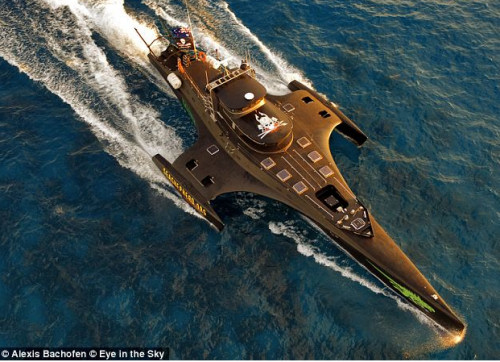 Slick: The crew of the 115-foot boat will embark upon their annual journey, trying to stop Japanese whaling next week. |
'We hope the Australian Government will really step up and have the guts to take on the whalers.'
Gojira will join the rest of Sea Shepherd's fleet and on Thursday captain Paul Watson and his crew will embark upon their annual journey aboard three ships Steve Irwin, Bob Barker, and Gojira, on an annual mission against Japanese whaling in Antarctic Sea.
In January this year their group's last boat had its bow sheared off and was taking on water after it collided with a Japanese whaling ship in the frigid waters of Antarctica.
The clash was the most serious in years, during which the Sea Shepherd Conservation Society has sent vessels into far-southern waters to try to harass the Japanese fleet into ceasing its annual whale hunt.
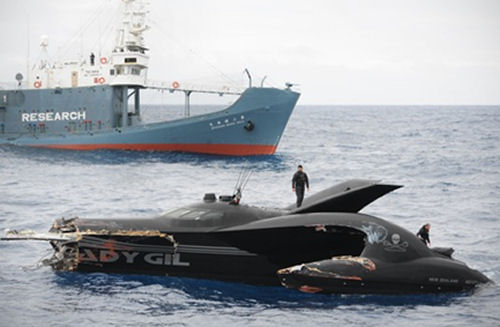
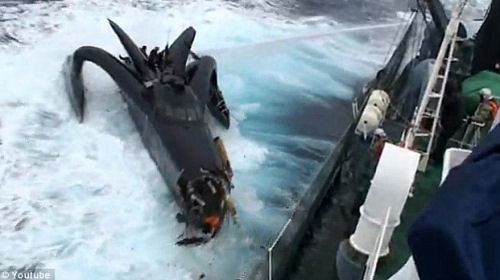 High seas drama: The Ady Gil seconds after it collided with the Japanese whaler, Shonan Maru, in the Southern Ocean. |
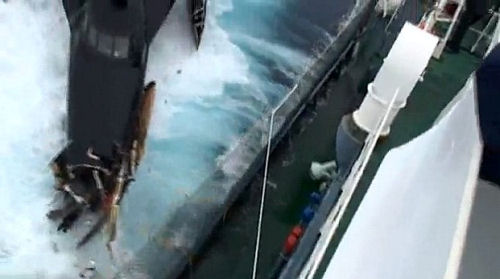 The bow Ady Gil was sheared off after the carbon fiber boat collided with the Japanese ship. |
Clashes using hand-thrown stink bombs, ropes meant to tangle propellers and high-tech sound equipment have been common and collisions between ships have sometimes occurred.
The society said its vessel Ady Gil - a high-tech speedboat that resembles a stealth bomber - was hit by the Japanese ship the Shonan Maru No.2 near Commonwealth Bay and had about 10 feet of its bow knocked off.
Locky Maclean, the first mate of the society's lead ship, said one crewman from New Zealand appeared to have suffered two cracked ribs but the others were uninjured.
The crew was safely transferred to the group's third vessel, though the Ady Gil's captain remained on board to see what could be salvaged, he said.
'The original prognostic was that it was sinking, but at this point it is flooded with water but it seems to still have a bit of buoyancy,' Maclean told reporters by satellite phone from the ship, the Steve Irwin.
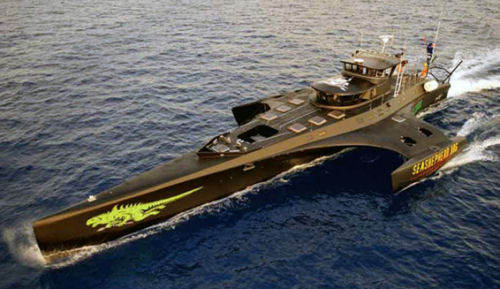 Note forward cockpit from which sink bombs can be fired at whalers. |
The 115-foot boat was launched by the Sea Shepherd Conservation Society on Monday in Fremantle, Australia, and has joined the larger vessels, Steve Irwin and Bob Barker, in Hobart. At midweek all three will begin their journey to Antarctic waters, where their crews will await the arrival of the Japanese whaling fleet.
Japan also means business. The whaling ships will carry armed members of the Japan Coast Guard to help prevent sabotage by the activists, according to the Japan Times.
These seasonal confrontations in the remote Southern Ocean have become increasingly tense, with occasional collisions underscoring the danger and controversial nature of some methods employed by Sea Shepherd, which has been criticized for risking human lives in its effort to save minke whales, which are not an endangered species.
Last season Sea Shepherd scuttled its interceptor vessel, the Ady Gil, after claiming it had been rammed and irreparably damaged by a whaling vessel. New Zealand investigators found both crews to have been at fault.
Japan annually targets about 900 whales -- mostly minkes but also a handful of endangered fin whales -- during a three-month season that generally begins in early December.
 In its first life as Earthrace, this vessel set the record for a circumnavigation by a powerboat. |
Japan gets around a longstanding International Whaling Commission ban against commercial whaling by using a "research" loophole and designating the hunts -- which are considered an important part of Japanese culture and tradition -- scientific missions.
However, pressure to persuade the country to curtail whaling is mounting. The IWC last spring submitted a proposal calling for Japan to reduce its quota to about 200 over a 10-year period. Australia has used an international court to try to halt whaling in the Antarctic, where killing occurs within a designated whale sanctuary.
Last season the Japanese fleet killed 506 minke whales and one fin whale. Officials with Japan's Fisheries Agency and the Institute of Cetacean Research regard Sea Shepherd as an eco-terrorist organization that has successfully obstructed hunting. Though the whaling effort is termed scientific, whale meat is sold commercially throughout Japan.