Yacht Sinks 80 Miles North of Kodiak Island
Thanks to proper preparation, modern electronics, and the USCG five men were saved recently when their 60’ motoryacht went down in the Gulf of Alaska on May 22. This sad event was kept from being a tragic one thanks to the owner/skipper Tom Alexander who not only had aboard survival gear, but the night before the sinking had run an emergency orientation session that included his crew and passengers practicing putting on survival suits and launching the life raft. It is unusual that we learn of the cause of the sinking, but it becomes pretty clear what happened as the story unfolds.
 The 60-foot Nordic Mistress slips beneath the waves of the Gulf of Alaska May 22, 2011, 80 miles north of Kodiak. A Coast Guard rescue helicopter crew from Air Station Kodiak rescued the five members of the crew from a life raft after they abandoned ship. |
A combination of two reports from the Anchorage Daily News, May 25, 2011--
By MIKE CAMPBEL and By DAN JOLING
North of Marmot Island in the Gulf of Alaska, the fortunes of the five men aboard the ill-fated 60-foot Nordic Mistress, a luxury motor yacht bound for Prince William Sound, began to turn Sunday morning.
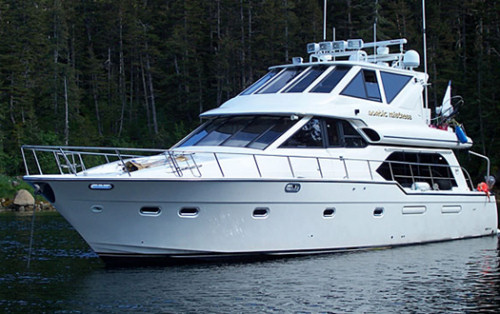 Nordic Mistress had been in the charter trade in Alaska. |
Tom Alexander, the owner/skipper of Nordic Mistress is an Anchorage real estate agent. He kept the Nordic Mistress in Kodiak in winter and in Whittier in summer. The trip Sunday was planned to move the boat to Whittier, about 40 miles south of Anchorage. Alexander estimates he has made the trip 20 times, including 15 in the doomed vessel.
The group flew to Kodiak on Thursday, and after final maintenance on the boat, including changes of filters and checks of fittings, they received a weather forecast of 15-knot winds and 6-foot waves. They planned a Sunday morning departure.
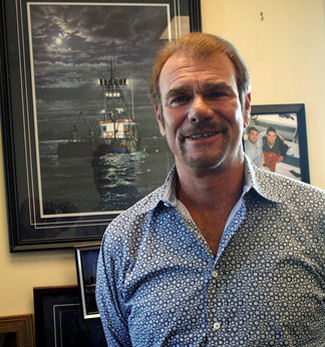 In this photo taken May 24, 2011, Tom Alexander poses for a photo in his real estate office in Anchorage, Alaska. Alexander and four others survived the sinking of a pleasure boat on Sunday, May 22, 2011, near Kodiak Island, Alaska. (AP Photo/Mark Thiessen) |
A Critical Safety Meeting
Before leaving, Alexander said, he conducted a safety meeting on Saturday night. The passengers tried on immersions suits, reviewed how to call for help and give coordinates if something happened to Alexander, and checked out how to launch the life raft.
"I think that safety briefing that we had the night before made a huge difference," Alexander said. "A few of those guys had never seen a survival suit in their life, much less knew how to get it on."
When they had left port in Kodiak early Sunday morning, the seas were six feet. Eighty-eight miles out, they were now twice that size. "(Waves) were stacked close together with the wind," said Tom Alexander, 55, the captain and owner of the boat. "But I've been in a lot higher seas. Not fun."
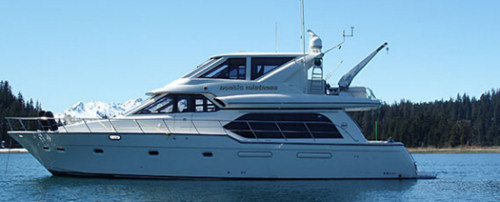 The 60’ Nordic Mistress was well-equipped, including having a life raft and survival suits. |
Be Prepared
For the three days before leaving Kodiak, Alexander performed maintenance from bow to stern. Then, a day before setting sail, he gathered everyone in the wheelhouse for a safety briefing. They all tried on survival suits. They went over how the life raft deploys and how the EPERB (emergency personal beacon) works.
"And if something happens to me,' Alexander told them. ‘Here's how to send a mayday out. Odds are pretty slim you'll every have to, but you need to know.' "Those survival suits and rafts cost a lot of money, and a lot of people don't think they're going to need them, but they're going to save lives.”
Alexander said he has made the 280-mile run between Kodiak and Whittier more than 20 times during 30 years at sea.
On Sunday, they found the weather a bit worse than predicted - 20-25-knot winds and waves up to 12 feet - leading to a bumpy ride.
"The water wasn't fun, but it wasn't life-threatening," he said.
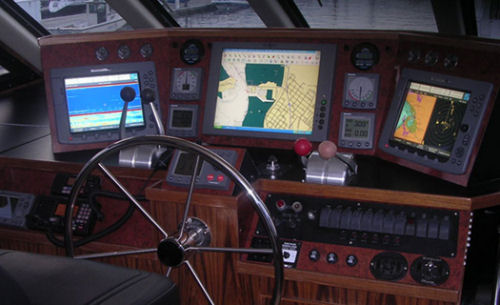 Electrical problems with the instruments was the first tip-off that something was wrong below. |
First Sign of Trouble
About 60 miles west of Seward, the boat lost its inverter, the device that converts 24-volt battery power to the 110 volts needed to run the main navigation system. Alexander turned over the helm to friend Brian Broderick, 46, and headed five steps down from the pilot house to the wheelhouse, hoping to fix it.
As he descended, a rogue wave that Alexander estimated at 15 feet rolled in.
"I lost my footing and flew up in the air," Alexander recalled. "As I was coming down, the boat hit the trough and was coming back up when I smacked down. I thought I broke my back."
On his hands and knees, in excruciating pain, he crawled to the wheelhouse.
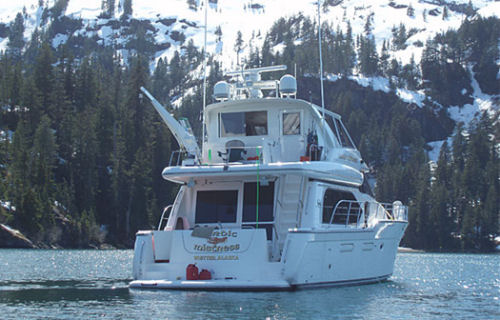 Nordic Mistress was used to conditions in Alaskan waters. |
Failure of Thru-hull Fitting or Hose
Alexander dispatched Broderick, who Alexander calls “first mate”, to the engine room. He saw water sloshing up to the bottom of the engines… Water was coming in fast. Broderick guesses the water was coming in through a fitting or a failed coupler. "There was so much water in there, we couldn't find the source," he said. One engine started to fluctuate.
"We had already started taking on water," Alexander said. "Something cut loose in the engine room. I had to keep the bow pointed into the swell or we'd capsize."
The Boat Becomes Slugish
As water filled the boat, steering became sluggish and Alexander worried about getting hit broadside by a big wave. He maneuvered instead by manipulating the twin 800-hp engines.
"As time went by it became harder and harder, because she was taking on water and starting to list," Alexander said.
Broderick, a former commercial fisherman, got the others in immersion suits and launched the raft.
That meant his immersion suit, often called a "Gumby" suit because of its bulkiness, was zipped up only to his waist, and he was aware his life was in danger.
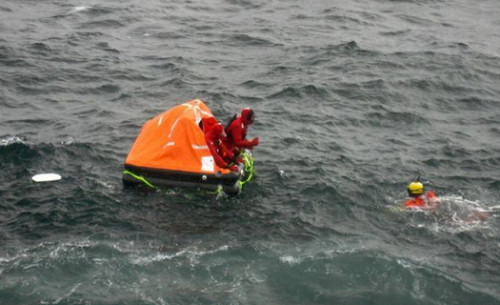 The life raft was crowded but served its purpose well. At right is the USCG rescue swimmer making his way to the raft. |
Time For A MADAY Call
Alexander got on the radio and made a mayday call, relaying a description of the boat, the position and the number on board. "I knew then that this boat was going to sink," he said.
Alexander relayed a description of the boat, the position and the number on board. "Something's really gone wrong," Alexander said. The helm was responding sluggishly. Nordic Mistress listed strongly to port. Ten bilge pumps weren't enough to empty the water.
A mayday to the U.S. Coast Guard went out about 11 a.m. "By then," Alexander said, "30 years at sea came in handy -- big time."
His steering wheel not working, Alexander piloted with the throttle as Broderick made sure everyone donned survival suits. To turn to starboard, Alexander would throttle up the port engine, and vice versa. His other hand was on the marine radio, giving the Coast Guard precise coordinates.
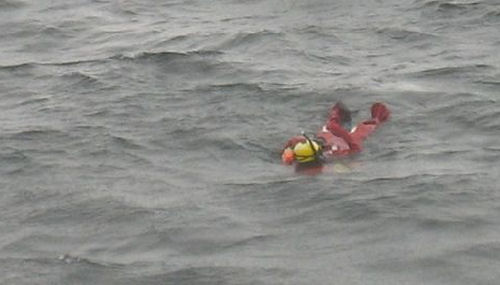 The Coast Guard rescue swimmer is pulling one of the ship’s crew to a basket nearby to be hoisted to the chopper overhead. |
Survival Suits Make The Difference
"Hey Tom," Broderick soon yelled, "you gotta get your suit on."
"Yeah, I know," Alexander answered.
But he could only yank it halfway to his hips. “Better to have it half on for now,” he thought. The survival suit's mittens would prevent him from depressing his microphone button.
Meanwhile, Broderick and the others deployed an 8-foot-by-8-foot self-inflating life raft. Alexander's 14-year-old son Jacob was the first to jump off the boat toward the raft. "I didn't know it got deployed," Tom Alexander said. "But we got everybody off pretty quick."
Normally, the wheelhouse sits 25 feet above the water, but the listing Nordic Mistress had taken on so much water that by the time Broderick leaped into the Gulf of Alaska, the distance was only eight feet.
Moments later, another rogue wave slammed into the port side of the crippled boat.
"I got up and put my survival suit on the rest of the way," Tom Alexander said. "By the time I jumped off the boat, the wheelhouse deck was one foot off the water."
About an hour had passed from the loss of the inverter.
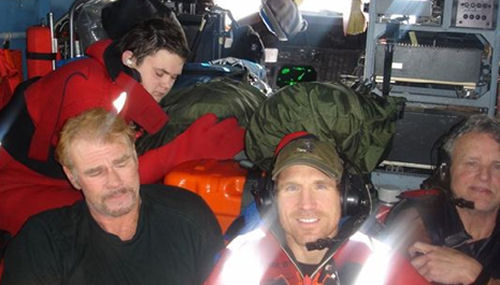 Inside the rescue chopper on their way back to the Coast Guard station. |
Moment of Reckoning
"The most unnerving part is when you jump into the Gulf of Alaska," Alexander said. "It's kind of cold, you know? Even though you have a survival suit, you get a little water in them right way. The water's cold." The boat rolled a moment later, and eventually sank.
The raft was crowded.
"Five guys, a little bit of water in there," Alexander said. "But for me, as the skipper, I was feeling pretty good. I knew the chopper was on its way. I had everybody in the raft, I had everybody in a survival suit, and I had flares. I was feeling just fine."
The helicopter arrived 45 minutes after the mayday call. They heard it before they saw it. They fired a flare as the helicopter approached and the pilot, Lt. Jon Bartel, maneuvered the chopper close.
Moment of Relief
Fortunately, Alexander and Broderick are athletes who competed in the Lavaman, an Olympic distance triathlon, in Hawaii just a month earlier. "I'm a real strong swimmer," Alexander said, "and we'd been swimming in the ocean off Hawaii the last six months." The boat slipped below the swells.
Everyone was in the raft. Nobody was warm, but nobody was hypothermic, either. "Everybody's gonna live," Alexander told his mates. "The Coast Guard chopper is on the way. Relax. Don't use up body heat."
The Air Cavalry Is on the Way
Flying in low clouds at about 600 feet, Coast Guard pilot Lt. Jon Bartel reached Alexander's mayday position in just 45 minutes. By then, though, the vessel had drifted. Once the thwock-thwock-thwock of chopper blades came over the horizon, the men grabbed a flare out of pouch in the raft. Coast Guard flight mechanic Devin Lloyd, also the hoist operator, first spotted red flare.
By now, the seas had calmed a little and blue sky appeared on the horizon. Winds were down, too. Bartel lowered the helicopter to within a dozen feet of the water. Rescue swimmer Petty Officer Rafael Aguero jumped in.
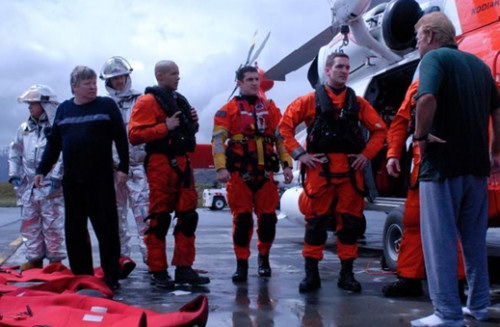 Back on terra firma the rescue squad debriefs with the rescued on Kodiak Island. |
The Rescue is Underway
"It's the most expeditious deployment we have," Bartel said, and only allowed during daylight rescues. Aguero swam to the raft. The plan was to swim each survivor away from the raft and into a rescue basket dangling from the helicopter.
The first to go, 6-foot-2 Jacob Alexander, was the most challenging, he said. "He was definitely making our rescue swimmer work to get away from the raft and into that basket," Bartel said. Finally, it came down to longtime friends Tom Alexander and Broderick.
" ‘Brian, don't argue with me,' Alexander told his pal. " ‘You're next.' "
Finally, Aguero swam back to Tom Alexander. "The rescue swimmer did phenomenal," Alexander said. "He puts you on his back and helps you swim over to the basket.
Warm embraces followed when everyone set foot on solid ground in Kodiak, but tender feelings might never have been possible without conscientious preparations before the Nordic Mistress set sail.
The Perfect Rescue
"You couldn't ask for better survivors, to be honest," Bartel said of the two Alexanders, Broderick, Charles Blalock and James Sims, all of Anchorage. Tom Alexander, Blalock and Broderick have worked at Prudential Jack White Vista Real Estate for about two decades. Sims is a local contractor.
"They were prepared to make a mayday call by VHF radio, they gave an exact location, they donned immersion suits and they signaled their final location with a flare gun, he said.
"It was just perfect," Bartel said. "There was no searching. We went right to them."