Sportboat Buying Check Points No. 8: Helm Seat
In our “Owner’s Reports” on boat models one of the largest areas of complaint has to do with the helm seat in sportboats. Nothing on a sportboat is more annoying than a helm seat that is uncomfortable or not made for your personal ergonomics. When examining boat models to add to your short list of boats to consider buying, make sure you spend adequate time sitting in, and operating, the helm seat. They are not all the same and, in fact, many builders manufacturer their own.
 One of the nicest helm seats we have seen on sport and ski boats is the one pictured above on the Tigé RZ2 Platinum. Note the mesh screen in both the seat bottom and the seat back that lets a wet bathing suit drain to the deck and provides ventilation on a hot, sticky day. See our test of the Tigé RZ2… |
The helm seat is probably the #1 trouble area for many sportboats on the market, and the reason is obvious: boaters come in all different sizes and weights. For example, skippers can range all the way from about 5’ (1.5 m) or less (remember women are skippers, too) to 7’ (2.1 m) or more. Longer or shorter torsos cause problems with visibility through the windshield, and longer or shorter legs can cause problems under the steering wheel. When standing at the helm these problems can be magnified.
The Helm Seat MUST Fit YOU
The average European and North American male according to Wikipedia ranges from 5’9” to 5’10” (1.76 to 1.79 m) and the average female ranges from 5’3” to 5’5” (1.61 to 1.66 m). Asians, South Americans, Africans and Middle Easterners are all a couple of inches shorter, on average, according to this source. Since the major markets for sportboat sales are in North America and Europe, it follows that most builders design helms and helm seats for men who are 5’9” to 5’10” – let’s call it 5’9.5” (1.76 m) on average.
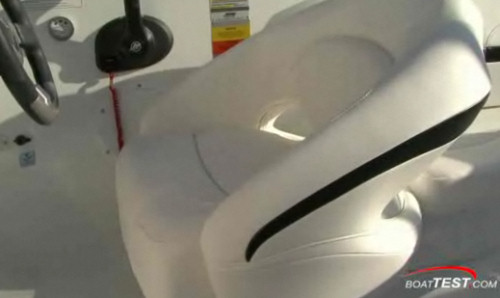 Helm seat of the Formula 240. Note the bolster fits snuggly into the seat bottom and is well-fitted. The seat back is cut away to permit air in to cool the driver's back and the sides of the seat wrap around to add a feeling of security when cranking and banking. See the Formula 240 Bowrider... |
With that ergonomic model as a given, buyers who differ significantly from the 5’9.5” average need to make sure that the helm “fits.” Here are some questions to ask yourself when visiting boats at a boat show or in a dealer showroom—
*When sitting does my horizontal line of sight go under the top of the windshield frame?
*When sitting can I see over the wheel and instrument panel?
*When sitting can I stretch out my legs comfortably forward?
*When sitting do my legs or knees hit the steering wheel?
*When sitting is the angle made by my lower legs and upper legs comfortable?
Good Visibility Is Key
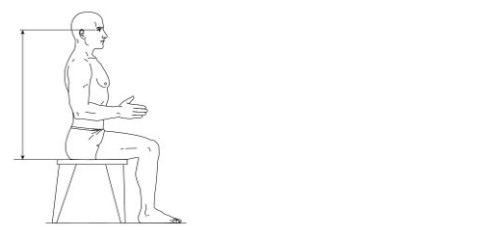 The average U.S. military male has a height of eye 31.6” (79 cm) above his seat. |
One of the most frequent complaints owners of sportboats report to us is that when sitting at the helm their height of eye is on a plane with the upper frame of the windshield. Few things are more annoying than having to be constantly stretching to look over, or hunching down to look under, a sportboat windshield frame when going 40 miles an hour. Many owners who have helm seats and windshields that don’t “fit” often sit on their seat bolster in order to see over the windshield. While this is a temporary solution, one should not buy a boat knowing that it can only be run with good visibility by sitting on the bolster.
In checking several anthropometry (body geometry) authorities we find that there is a variation of average body measurements depending on the on the group being surveyed. For example, the Anthropometry Department at Penn State reports that the sitting height of eye for the 50th percentile of male U.S. military personnel is 31.6” (79.2 cm). Other measured groups of Americans we checked measured 30.5” (76.2 cm). Our suggestion is that you simply sit in the boat and discover if you can see under the windshield frame and over the wheel and dash.
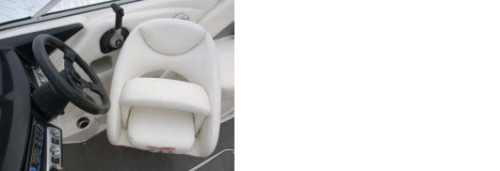 Sportboats don't have to be expensive to have the basics done right. Note the helm seat on the Bayliner 225 bowrider has a bolster, cut-out back for air circulation, and raised sides for added security. See the Bayliner 225 bowrider... |
Proper Seat Height For Comfort
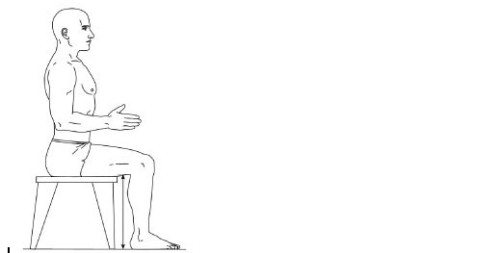 The average male in the U.S. military has a floor to popliteal (back of the knee) distance of 17.3” (43 cm). |
Sportboats that are at the low end of the range, say 16’ to 17’, are fairly small boats, with relatively low freeboard and a somewhat shallow cockpit depth. These boats generally must have helm seat bottoms which are less than 17” (42 cm) height off the deck. Likewise, most automobiles built today have driver's seats that are far less than 17" off the floorboards. In automobiles the low styling of the cars necessitates lower seats, and in sportboats the length of the boat, height of the freeboard and depth of the cockpit all dictate to the designer how far off the deck the seat bottom can be.
For that reason, buyers should make sure that there is adequate clearance between their knees and the steering wheel and that there is enough room forward to stretch out their legs. Further, the prospective buyer must also make sure that visibility through the windshield is unrestricted. (More on that next week.)
 This 215 Tahoe has a large, comfortable bolster in the up position. The back is cut out and the sides wrap around for added comfort and security. Note that there are 6 bolts holding the pedestal to the deck. See the Tahoe 215... |
However in larger sportboats the freeboards are higher and the cockpit depth is deeper, allowing the builder to raise the seats somewhat to be more comfortable. Nevertheless, buyers should not expect helm seats to be 17” off the deck until the boat is about 21’ 6.5 m) or longer. In smaller boats simply make sure there is enough leg room and leg clearance.
Don’t Crowd The Helm
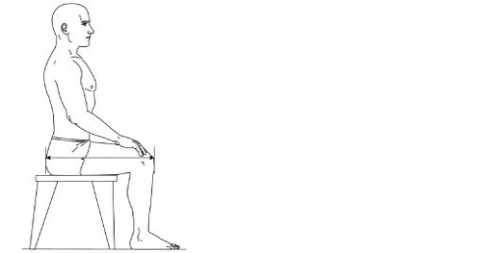 Our typical male U.S. military member has a distance from the back of his buttocks to his knee of 24.6” (61 cm). The distance from the back to his popliteal is 20” (50 cm). |
A third area to check is knee clearance for the wheel and for the bottom of the instrument panel. Again, it makes little difference what the average ergonomic measurements are, all you care about are your own and anyone else who will be driving your boat. The steering wheel should be comfortable and not touch your knees. Some sportboats have standard tilt steering and virtually all list tilt steering as an option.
Even if the steering wheel is comfortable in is standard position, we always recommend that this option be purchased by new boat buyers not only to accommodate alternative drivers, but also to make the boat appeal to more people when the boat is put up for sale.
 The average American male has an elbow to fingertip extension of about 18.5" (46.3 cm). Throttle and gear controls should be no farther forward from the seat back than 14" (35 cm) when in full reverse. Again, every body is different, so try before you buy. |
Finally, do your hands fall comfortably onto the wheel? If they don’t this is perhaps the easiest problem to solve simply by moving the seat back or forward. If the seat does not move far enough for you then an alternative solution must be found. When driving a boat your body should not be crowding the helm and you should have free and comfortable arm movement.
Once the seat is in the proper fore and aft position, now check to see if your hand falls comfortably onto the throttle and shift controls. If you have moved your seat forward, make sure that you can comfortably move the controls to their aft-most position.
 The Rinker 216 Captiva has an attractive helm seat with a large cut-out back for coolness and three tones in the vinyl upholstery. See the Rinker 216 Captiva... |
Adjustable Seats – A Weighty Matter
According to the U.S. CDC (Center for Disease Control) 34% of the American population is “obese” and another 34% are “overweight.” If you fall into that 68% of Americans then don’t be surprised if the helm and the seat of a sportboat don’t feel quite right to you. The CDC says the weight of the average adult male is 194 lbs. (88 kg.) and he has a 39.7” (99 cm) waist. The average American adult woman, says the CDC, weighs 164 lbs. (74.5 kgs.) and has a 37” (92 cm) waist.
All of this puts a premium on seats that can be adjustable. These days most sportboat seats can swivel from side to side and can be adjusted fore and aft. Very few sportboat seats, or seats on any boat for that matter, can be adjusted up and down. Before buying any boat make sure that the mechanisms to adjust your helm seat are easy to use and are handy.
Seats that are too low can often be fixed simply by asking the dealer to cut a new aluminum pedestal that is a bit longer. If that is not possible, possibly a block can be put under the base itself. No matter what solution you come up with, DO NOT MAKE THE MODIFICATION YOURSELF. This is a job for the dealer or the boat builder and involves serious safety issues. (There is nothing more dangerous than having a seat or pedestal which breaks while underway. If you modify your boat, warranties will be void, and you could have a serous accident.)
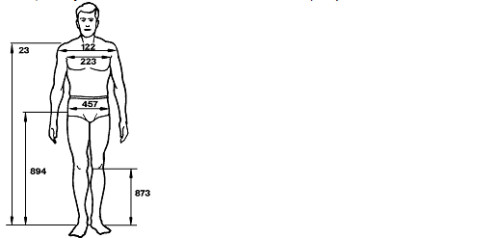 The breadth of hips of the average American 40-year-old male in 2000, according to NASA, was 18" (45.7 cm). How do you measure up? |
Finding a Seat That Fits
Most boat builders do not build for the 34% of the American public who are obese. If you are overweight, do everyone a favor by making sure that not only can you comfortably get into the seat, but also that its pedestal base and seat back will hold your weight. Even though the ABYC (American Boat and Yacht Council) has standards for the strength of seats, we advise boat buyers to make their own judgment as to whether or not a helm seat base and seat back are strong enough.
If the pedestal base has only three bolts into the deck, we would advise that you not buy the boat until something more substantial is installed. Seat bases that have five or six bolts do the best job. Try to wiggle the base when you sit in the seat. If the deck flexes or the base moves more than a bit, you are too heavy for this installation. If in doubt, speak frankly with your boat dealer and ask for his guidance. Remember, while he would like to sell you the boat, he also has a stake in your satisfaction and pleasurable boating experience.
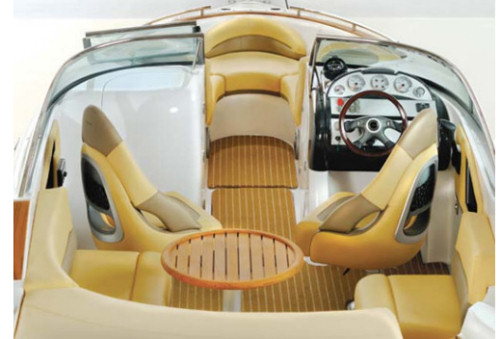 The Doral 235 BR has one of the most attractive and functional helm seats in class. Note the cutouts on the back and the hand holds on the arm rest. We also like the fact that the companion seat is the same. Doral fabricates its own seats. See the Doral 235 BR... |
Can You Stand At The Helm?
There are times when you will want to stand at the helm and it is important that you be able to do it comfortably. Make sure that the back of your legs are not restricted by the seat when the bolster is up. If the seat does restrict your legs, make sure that you can slide the seat back so that you have plenty of clearance. If you cannot stand comfortably, then ask the dealer if he can reinstall the pedestal base and move it aft the required distance.
If a helm seat with a bolster does not come standard, we would order one if the option is available. No matter how comfortable your seat is, a bolster always comes in handy.
Next, while standing, reach for the rim of the steering wheel. Do you have to bend over? If so, that is the position you will be in when standing at the helm. Likewise, can you reach the throttle and shift controls while standing? In most boats you will have to stoop slightly to reach them, otherwise they would be too high to use when sitting.
There are many different seat designs and the boat dealer can point out their attributes. Once you have carefully looked at a number of different helm seats, you will know which one is right for you.
See video
on how Doral Boats makes its seats...
See video
on how Formula Boats makes its seats...