How To Buy A Sport Boat --No. 9: Visibility From the Helm
Perhaps the most important aspect of piloting a small boat is "visibility" from the helm. Because sportboats can go so fast the early spotting of potential trouble is of prime importance. That means that the skipper must have an unobstructed view forward and to the sides and he must be paying attention. "Improper lookout" is a leading cause of boating accidents, according to the USCG's annual boating safety report. This week we take a look the American Boat and Yacht Council's (ABYC) standards for visibility forward.
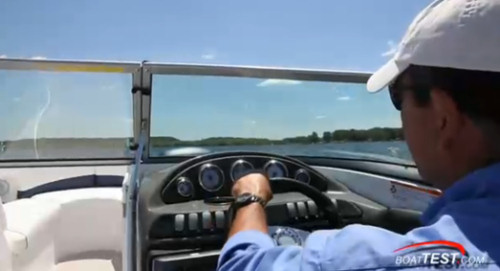 One of the most important things to check when buying a sportboat is visibility from t he helm. Don't assume that it will be ideal. To see our report on this Rinker 216... |
Because sportboats go so fast, and when that speed is multiplied by 2, it is quite possible that two boats could be closing on each other at 100 mph or more. And while drivers are used to those closing speeds on highways, boats on the water are another matter. Boaters generally consider boat travel slower, easier, less crowded, and less apt to result in harmful accidents. And, generally that is true.
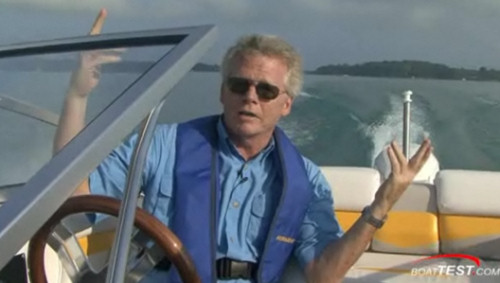 "Look, Mom, no hands!" Note that Capt. Steve's eyes are below the top of the windshield when he is sitting with the bolster is down. With the bolster up, he can see over the windshield without trouble. See our test on the Glastron GT 180 BR... |
The USCG 2010 Accident Report for the recorded only 62 accidents the result of "restricted visibility" resulting in 7 deaths and 39 injuries. That means just 1% of the accidents and deaths were the cause of visibility problems of all kinds. That is good news and it means that the visibility of most boats is not an issue in 99% of the accidents.
A far larger problem was "improper lookout" which accounted for 375 accidents, or 8% of the total, resulting in 17 deaths, 2.5% of the total.
The Operator's Responsibility
One of the reasons that "restricted vision" plays a role in so few accidents is because most boat builders go to some lengths to make sure that they have optimized visibility on the boats they manufacturer. Helping them in that effort is the American Boat and Yacht Council (ABYC) which promulgates standards for many aspects of recreational boat design and construction.
ABYC standards are strictly voluntary. (The only standards that are mandatory are those issued by the USCG which have the force of federal law.) ABYC standards cover a number of areas of construction and equipment and relate mostly to fuel and electrical systems. There are no federal requirements for visibility other than the requirement to post a proper 360-degree lookout when under way. That means the burden of seeing an impending danger is the sole responsibility of the operator of the vessel.
 Capt. John has no visibility problems on his MasterCraft ProStar 214V when under way. See the MasterCraft ProStar 214V... |
Horizontal Range of Visibility
So, what are the ABYC standards? There are just a couple of basic concepts. The first one is that when the operator is looking straight forward there will be a "clear sector of visibility that extends 15-degrees to the right and 15-degrees to the left of the operator's "eye positions." "Fixed obstructions to vision within this 30-degree sector of  visibility shall be limited to hardware such as but not limited to cleats, deck stanchions, navigation lights, and windshield wiper(s)."
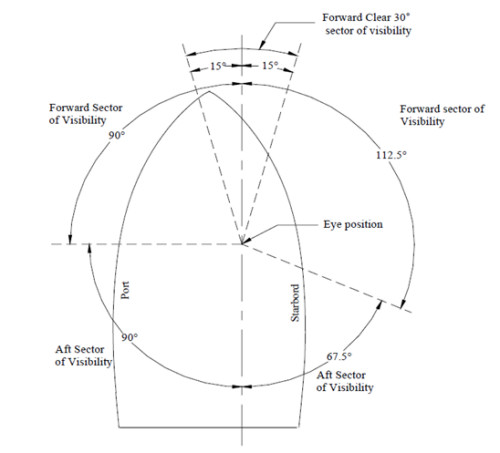 This figure illustrates only one possible location of the helm and is intended to show the concept of 30-degrees of forward unobstructed horizontal visibility from the eye positions, when the skipper is seated. |
Minimum Obstructions Forward
Outside of the 30-degree "clear sector of visibility" ABYC standards state that "obstructions shall be kept to a minimum" 90-degrees to the left of the eye positions and 112.5 degrees to the right, "...such that normal movements of the operators head will permit unobstructed visibility."
In sportboats this is not a particularly onerous standard and is met in most boats that we see. The standards go on to say that if permanent obstructions to vision exist in the aft sectors of vision, the normal movement of the operator while controlling the boat or mirrors should render visibility.
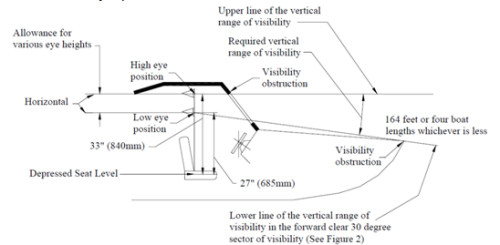 The ABYC standards on vertical visibility is for the operator to be able to see an object in front of the boat no farther away than 164' (50 m) or four boat lengths ahead as measured from the bow, whichever is less -- from the seated position. |
Vertical Range of Visibility
In the drawing above, which has been reprinted from the ABYC standards, note that there is a low position and a high position of eye. The low position is 27" (68.5 cm) from the depressed seat level and the high eye position is 33" (84.0 cm) above the depressed seat. These parameters coincide quite nicely with the ergonomic data that we discussed in Check Point #8 covering helm seats.
According to he Georgia Tech Research Institute only 5% of American adult males have a sitting height of eye less that 28.7" (79.9 cm) the mean height of eye is 31.3" (110.3 cm) and 5% have greater than a 33.5" ( 85.1 cm) sitting height of eye. Because people slump about 1.2" (3.0 cm), most males can see below a windshield frame that is 33" (84.0 cm) above the depressed seat bottom.
American adult women have a sitting height of eye of 27.4" (69.5 cm) and 31.0" (78.7 cm).
 This factoid from the Georgia Tech Research Institute tells the story -- most American adults have a height of eye when sitting of between 27.4" (69.5 cm) and 33.5" (85.0 cm). |
Little wonder, then, when the ABYC set its standards it chose a vertical range that would enable over 90% of the American adult population to be able to sit in a boat and have clear visibility to an object at least four boats lengths ahead or 164,' whichever is less.
Bear in mind that the vertical clear view "window" of visibility need only be 6" (15.2 cm) high from the top of instrument panel or steering wheel to the bottom of the windshield frame. Of course, the vertical visibility can be greater than the minimums proscribed.
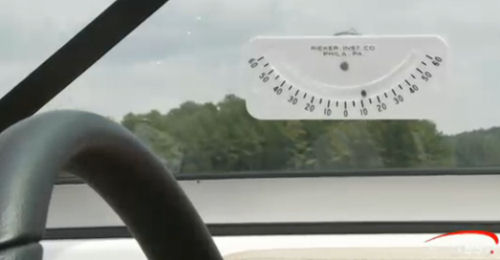 When getting on plane, as this boat is as demonstrated by the inclinometer, the bow may be as high as 15-degrees up which can restrict visibility briefly. ABYC exempts from its standards a brief period of visibility reduction while the boat gets on plane. |
What Does All of This Mean?
It means you must sit in the seat of the boat you plan to buy, or in its sistership, and make sure that you can see over the wheel, instrument console, and bow to an object four boat lengths ahead. Likewise for tall people it means that you should be able to see that same object in your normal sitting position -- without staring at the inside of the windshield frame.
There is nothing more annoying than having to slump down to peer under a windshield frame or to set on a bolster to look over it when you don't really want to. Do not assume that the sportboat you buy from any builder will fit your ergonomics.
If you find that the vertical visibility is not as prescribed by ABYC, then you should ask the boat dealer what he can do to modify the seat or the pedestal. Do not make any modification yourself as that may void your warranty as well as to be unsafe.