Jet Sportboats 21'-25': We Compare 4 Jet Boats For Boarders
The four boats in this roundup vary in LOA, but are otherwise similar. Each has a pair of waterjets for power, either Rotax or Yamaha; in-floor stowage for wakeboards or waterskis; a wakeboard arch; a powerful sound system; and comfortable seating for a big crowd. Waterjets are ideal for beach trips -- no worries about dinging the props. Add a few options -- not all have ballast systems as standard -- and any of these four boats will make an ideal watersports platform. Find full info on each one in our Captain's Reports, and contact BoatTEST.com if you have questions.
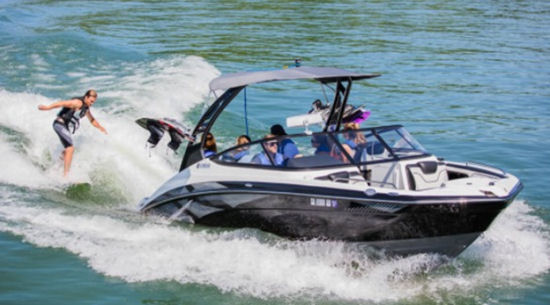
The Yamaha 212X is one of three boats in the builder's 212 line, and the most watersports-oriented. Her three ballast tanks can add up to 1,100 lbs. (499 kg) of weight to create just the right wake for boarding or wake surfing. Pump them dry, and the boat's twin Yamaha 1.8L HO waterjets will push her faster than 44 knots, according to our test. An articulated keel (basically a rudder) improves low-speed handling. Our test captain found the boat exhilarating to drive, fast to accelerate, and quick to respond to the helm.
At the helm, Yamaha's Connext controller provides the skipper full control of the towing parameters, boat data, and sound system. It can be controlled by either the joystick knob or touch screen. Towing data can be saved for individual riders and recalled easily.
Yamaha equips the 212X with a folding wakeboard tower with racks, a tow hook, a stainless steel reboarding ladder aft (a second ladder is forward), wet stowage handy to the stern platform, and an aluminum rear-view mirror that lets the helmsman see what's going on in the wake; it doesn't take the place of an observer. A Bimini top is also standard, as is a premium sound system with a tower-mounted sound bar and six speakers. Yes, a trailer is also included.
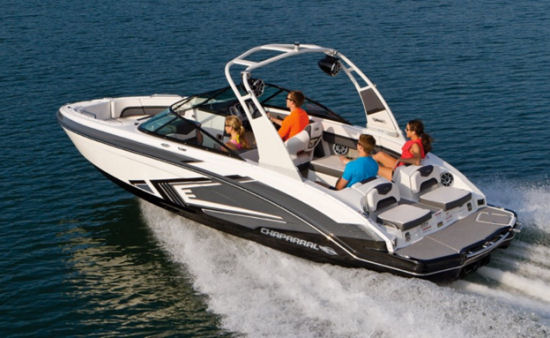
Chaparral's 223 VRX combines Chaparral DNA with twin waterjets and luxury appointments to create a watersports boat that our test captain found "not only comfortable, but a heck of a lot of fun to drive." Power comes from twin Rotax 1.5L 4-TEC jets, rated at 150, 200, or 250 hp. Our test boat had the 200s, which produced 52.9 mph at WOT, with brisk acceleration and solid handling.
It's at low speed that traditional waterjet boats were often difficult to maneuver, but Chaparral has something completely different to solve this problem: The 223 Vortex VRS's waterjet drives use the company's Lateral Thrust Control. Instead of diverting the thrust downwards at low speed, which results in so-so maneuverability, Lateral Thrust Control shoots thrust to either side, making the jet act more like a pod drive. Our test captain said the system gives the 223 VRX "amazing maneuverability." Read about the system in detail in our Captain's Report.
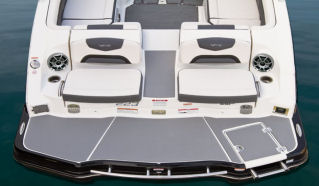
Aside from the tech aspects, the 223 VRX has a lot of standard features for both watersports and just plain boating. There's cool graphics, created in three colors of gelcoat. The arch has a color-coordinated Sunbrella folding top, and a GoPro mount for recording acrobatics in the wake. There's a digital helm package with control settings for cruise, ski, eco and docking modes. A cockpit table with a second base on the swim platform is standard. And the boat comes standard with a tandem-axle trailer with disc brakes and a swing-away tongue, so maybe it'll fit in the garage.

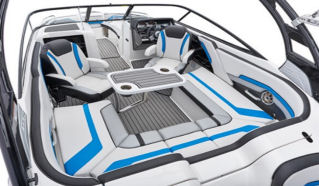
The Yamaha 242X E-Series is the bigger sister to the 212X, with similar features and standard equipment. With almost 3' (.91 m) more LOA, the 242X E-Series has more room for crew, more water ballast (1,400 lbs. (635 kg)) for wake control, and an upgraded Connext helm control system. At about 450 lbs. (204 kg) more displacement, but with the same twin 1.8L HO waterjets, the 242X is a bit slower than the 212X. Our test results show a top speed of 43.7 knots, vs. 44.2 knots for the smaller boat.
The tower and Bimini top are standard, but the Bimini has a twist: There are two solar panels atop the Bimini, providing continuous recharging to the batteries (as long as the sun is out). The current from the panels extends the battery life between charges by about 30%, meaning more time to enjoy tunes from the 10-speaker sound system without having to start the engines.
The forward cockpit is long enough for two folks to stretch out on the lounges, or for six to sit around the removable table. There's a second table mount in the aft cockpit, with wraparound seating. Finally, there's an enclosed head compartment with padded interior and a light; the head isn't included, but any portable unit should fit.

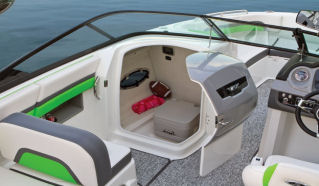
Chaparral's 243 Vortex VRX isn't just a jet boat, or just a watersports boat: She's a full-fledged family bowrider that happens to have a pair of Rotax waterjets under the hood, instead of stern drives. She rides on a 20-degree deadrise V-hull, has Kevlar reinforcement in her hull, has boarding ladders fore and aft for both beaching and watersports, and is roomy enough for an enclosed head compartment in one console.
Along with the standard wakeboard tower and folding Sunbrella top, the 243 Vortex VRX has a transom shower to keep salt where it belongs, and a ski mirror for the helmsman to watch astern. Access to the swim platform is via a walk-through passage, flanked by aft-facing seats. Two stereo speakers and a remote control ensure no lack of tunes, and a wide grabrail along the aft edge of the platform will help more agile folks hop back aboard without using the three-step ladder. A ballast control system, important to wakeboarders and wakesurfers, is optional, however.
We tested the 243 Vortex VRX with the 250-hp Rotax jets. Our captain saw 47.2 knots at full throttle, but was also impressed by her agility at high and low speeds, and with her seakeeping qualities. In his opinion, the 243 Vortex is the equal of Chaparral's similar-sized sterndrive and outboard sportboats. "Whether at idle or high speeds, this is a well-mannered boat."
In addition to everything else, her strong suit is her attention to detail in the interior where she is more like an up-scale non-jet sportboat.
Yamaha 212X
- LOA: 21'3" (6.48 m)
- Beam: 8'5'' (2.57 m)
- Draft: 16" (.41 m)
- Displacement: 3,605 lbs. (1,635 kg)
- Deadrise at Transom: 20 degrees
- Fuel Capacity: 50 gal. (189 L)
- Maximum Power: 2 x 1.8L HO Yamaha jets
 Have A Question About This Boat?
Chaparral 223 VRX
- LOA: 22'3" (6.78 m)
- Beam: 8'6'' (2.59 m)
- Draft: 16" (.41 m)
- Displacement: 3,100 lbs. (1,406 kg)
- Deadrise at the Transom: 20 degrees
- Fuel Capacity: 52 gal. (197 L)
- Maximum Power: 2 x 250-hp Rotax jets
Yamaha 242X E-Series
- LOA: 24'0" (7.32 m)
- Beam: 8'5'' (2.57 m)
- Draft: 18.5" (.47 m)
- Displacement: 4,032 lbs. (1,829 kg)
- Deadrise at Transom: 20 degrees
- Fuel Capacity: 50 gal. (189 L)
- Maximum Power: 2 x 1.8L HO Yamaha jets
Chaparral 243 Vortex VRX
- LOA: 24'3" (7.39 m)
- Beam: 8'6'' (2.59 m)
- Draft: 15" (.38 m)
- Displacement: 4,000 lbs. (1,814 kg)
- Deadrise at Transom: 20 degrees
- Fuel Capacity: 52 gal. (197 L)
- Maximum Power: 2 x 250-hp Rotax jets