Why Didn’t the Emergency Safety Device Activate In Time
Accident Reports
The U.K. has a division called the Marine Accident Investigation Branch. It investigates nearly all vessel sinking, or serious accidents, even when there is no loss of life. Fortunately in regards to case #20, what we are examining today, the occupants of the boat responded with most of the correct emergency protocols. But why did the emergency safety device fail to activate before the sinking?
The MAIB Official Report reads as follows:
On a winter’s afternoon, the skipper and a crewman on board a wooden potter spent an hour on deck hauling a string of creels. As soon as the hauling was completed, the skipper returned to the wheelhouse and heard the engine room bilge alarms sounding. He alerted the crewman, who was still on deck, who lifted the engine room escape hatch and saw that the water level was half-way up the side of the engine casing.
The Response and Rescue
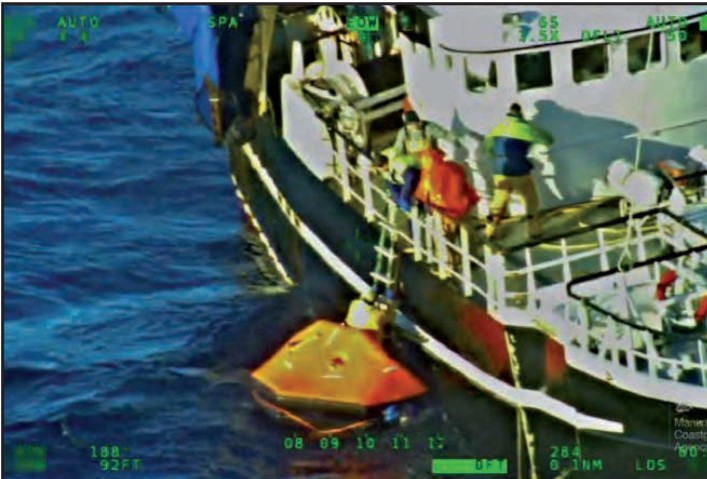
The two men immediately launched the liferaft and the skipper also pressed the DSC distress alert and broadcast a “Mayday” on the VHF from the wheelhouse. A few minutes later, the men boarded the liferaft, but neither had donned a lifejacket. A rescue helicopter and a nearby fishing vessel quickly arrived at the scene and rescued the potter’s crew (see figure).
The Sinking
The abandoned vessel sank 4½ hours later having spent much of that time upright and on an even keel. As it sank, the vessel’s float-free EPIRB released and activated.
The Lessons
1. A wheelhouse is not just the place from where a fishing vessel is driven and navigated, it is also where safety critical DSC, fire and bilge alarms are located. Therefore, if a wheelhouse is left unattended, there is a good chance that these alarms will not be heard above the noise of deck machinery, and that valuable time will be lost.
2. The decision to abandon ship is never easy. It should not be delayed, but also should not be taken too quickly. Abandonment is usually a measure of last resort when it is clear that it is the only action remaining to safeguard the lives of the crew.
3. Rapid flooding is an emergency that requires a rapid and effective response. Crews who have not ‘drilled’ or even discussed the different scenarios or the capabilities of the equipment available will not be anywhere near as well-placed to cope in such situations as those who have.
4. Liferafts, sea survival training, emergency communications and EPIRBs are proven lifesavers. So too are lifejackets. Regardless of how close assistance might be, water is water - and not donning a lifejacket when abandoning ship is pushing your luck a step too far.