Why the RHIBs Collided En Route
Accident Reports
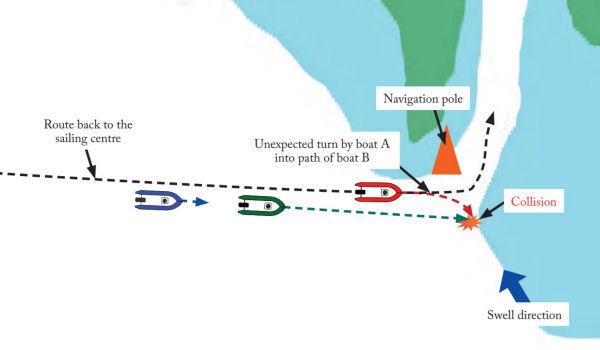
The U.K. has a division called the Marine Accident Investigation Branch. It investigates nearly all vessel sinking, or serious accidents, even when there is no loss of life. Referring to case #23, what we are reviewing today, each boat was en route on their planned passage home when they, unfortunately, collided with each other. If it was a planned passage, why did the collision happen?
The MAIB Official Report reads as follows:
A military sail training center was hosting a windsurfing event. The center was located inside a sheltered harbor and the windsurfing was taking place on the open sea outside (Figure 1). For the 2 days prior to the event, three officer cadets had successfully undertaken an RYA powerboat level 2 training course. These cadets were then tasked to helm three RHIBs as support boats for the windsurfing racing; laying and recovering marks and operating under the direction of the event’s safety officer.
Danger Strikes On the Way Home
On the second day of the event and after the racing had finished, all three RHIBs were heading back to the sailing center. There were 10 officer cadets in the three boats; all were wearing buoyancy aids and the helms had their kill cords attached. Although the sea was relatively calm, there was a swell from the south-east of about 1.5m and 15kts of wind from the south-west.
The three RHIBs (A, B and C) headed home in a line about 400m apart at a speed of about 30kts (Figure 1). On the way towards the navigation pole marking the harbor entrance, the helm of the lead boat noticed that a paddle had come loose, so slowed down to sort it out; this significantly reduced the distance between boats A and B. As the day’s events had finished earlier than planned, there was spare time available for planing practice, so when boat A reached the pole, the helm decided to turn to starboard into the swell, rather than turn to port into the harbor.
The Collision
Boat A’s maneuver brought it directly into the path of boat B, which was still planing at full speed. When the helm of boat B realized what had happened, it was too late to avoid collision (Figure 2) so he pulled the kill cord to stop the engine. Boat B struck boat A violently on its starboard side then rode right over boat A into the sea beyond; all of boat A’s four crew were thrown into the water and three were injured, one seriously.
Getting Help
The helm of boat B made a “Mayday” call on VHF radio and then the crew of boat B recovered boat A’s crew members out of the water. All three boats then headed back towards the harbor, where they were met at the harbor entrance by the harbormaster’s launch and the local lifeboat that had responded to the “Mayday”. The boats then headed to a nearby marina, where an ambulance was waiting; the casualties were attended by the ambulance paramedic and then transferred to the nearest hospital for further assessment and treatment.
The Lessons
1. When the collision happened, everyone who was thrown overboard was wearing a buoyancy aid and both boats’ helmsmen were wearing their kill cords. These actions probably prevented loss of life. Had the kill cords not been connected, at least one - maybe both - boats would have continued underway and out of control, presenting a serious threat to those in the water. Cold water immersion can lead to a shock response and rapid loss of muscle function with risk of drowning. Wearing a lifejacket or buoyancy aid greatly assists casualties in this situation, keeping them at the surface until rescued.
2. Prior to the collision, the RHIBs were planing at high speed and in company on the open sea. The RYA powerboat level 2 course focuses on low speed boat handling with only an introduction to planing speeds. Although operating as event support boats was intended to consolidate their training, the cadet helms’ operation of their boats went well beyond their taught skill level or experience and resulted in the serious risk of collision. This could have been prevented by a higher level of supervision from the sailing center’s staff and clearer direction about how the boats were to be handled and operated.
3. Whatever the size of vessel or the task, every passage needs a plan. Although it had not been discussed, the plan on this occasion was to return to the sailing center; a route taken by all the boats several times over the preceding days. The decision by the helm of boat A to turn to starboard at the navigation pole was a deviation from this route. The helm of boat A did not communicate his intentions beforehand and the maneuver placed boat A directly in the path of boat B. The close proximity of boat B prevented its helm from taking effective avoiding action. To minimize the risk of collision, high speed planing in company requires absolute clarity of the plan, a ‘shared mental model’ and good communications to maintain situational awareness and understand other boats’ intentions.
4. Although a VHF “Mayday” was called, the boats were fitted with digital selective calling (DSC) radios and the distress button function could have been used to raise the alarm. The key benefit of using the DSC distress function is that the coastguard will automatically receive the casualty vessel’s position. In this case, the boats were so close to shore that the casualties were probably transferred to hospital by the fastest means.