Why Carbon Monoxide Developed in a Cruiser
Accident Reports
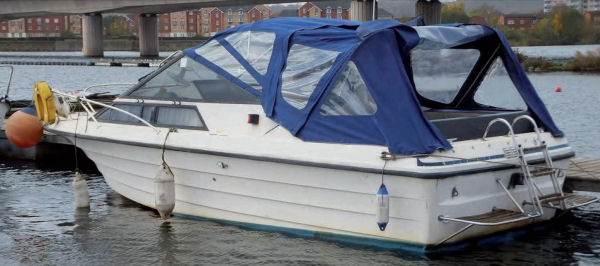
The U.K. has a division called the Marine Accident Investigation Branch. It investigates nearly all vessel sinking, or serious accidents, even when there is no loss of life. Sadly in case #24, what we are looking at today, tragedy occurred due to carbon monoxide being present in the boat owner’s cruiser. But how did this poisonous gas develop in the boat?
The MAIB Official Report reads as follows:
The owner of a small motor cruiser boarded his vessel at its marina mooring, unzipping one side of the cockpit canopy to gain access (Figure 1). His plan was to start and run the inboard petrol engine. Before starting the engine, however, he noticed a significant amount of water in the engine compartment bilge, which stretched into the cabin area. He started the boat’s electric bilge pump to clear the water. Once the water was below the level of the starter motor he started the engine.
To assist with pumping out the water, the owner engaged slow ahead while still moored, to force the boat’s bow up and cause the water to flow aft into the engine compartment. Approximately an hour later a friend called the owner, but there was no answer. He called another friend who was a berth holder in the marina and asked him to check if the owner was okay.
The Owner Was Discovered
The owner was found face-down in the cabin by two berth holders, with the engine still running. One raised the alarm while the other commenced CPR on the owner. Another person arrived and assisted with the CPR. The first rescuer felt dizzy 10-15 minutes later, and developed a headache. Shortly afterwards, he was helped out of the boat into fresh air.
The Rescue for Those Who Could Be Helped
Paramedics arrived and were directed to the first rescuer initially. After quickly examining him, the paramedics rapidly removed the cockpit canopy and took over first-aid of the boat owner. He was transferred ashore and taken to hospital, but never recovered consciousness.
The two rescuers were also taken to hospital suffering from carbon monoxide (CO) poisoning; both made full recoveries.
Why It Happened
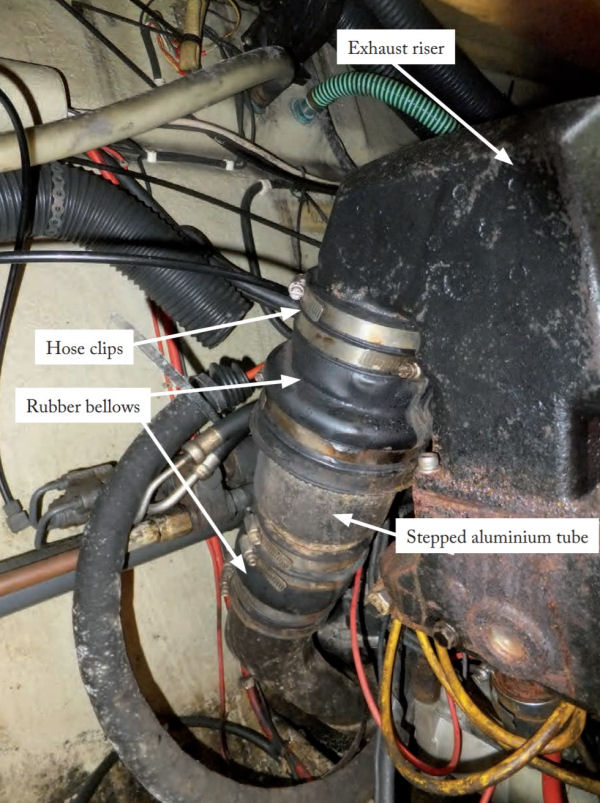
On examination, it was determined that at least two of the flexible rubber bellows of the boat’s wet exhaust system were leaking, allowing water and exhaust gas into the boat. (Figure 2).
The Lessons
1. CO is a highly poisonous gas and weighs the same as air. It cannot be seen, smelled, tasted or felt. When breathed in, CO readily replaces oxygen in the human bloodstream and prevents oxygen being supplied to the heart, brain and other vital organs. The gas is produced as a result of incomplete combustion and is commonly found on recreational craft. CO detectors/ alarms are widely available and will provide an early warning of the presence of the deadly gas. Make sure you have one fitted in your boat and, when it sounds, ventilate the space and move into fresh air.
2. The inboard petrol engine had not been regularly serviced during the previous 5 years of ownership. However, during the boat’s life the wet exhaust system had been modified, adding further flexible joints. Flexible rubber bellows are an important part of an inboard engine’s wet exhaust system as they allow for the vibration and motion of the engine. But they also maintain the boat’s watertight integrity. The couplings do deteriorate and generally require replacement every 2-3 years. Ensure your boat’s engine is regularly serviced by a competent technician.