Is It Time to Upgrade Your Electronics?
Have you upgraded your computer or cell phone in the past 10 years? Of course, you have—in fact, you’ve probably done so several times. So, why do people think that it’s just fine to use that same old fishfinder that they got a decade ago? Truth be told marine electronics evolve just as quickly as any other form of consumer electronics.
Yes, we know that it’s painful to upgrade those electronics too often. That unit works just fine and a new one may be expensive and won’t work with many of the other existing components, so why the heck should you replace it? Here are three types of ground-breaking systems that out-navigate and out-fish-find their predecessors. Each of them provides clear reasons why you should probably upgrade your electronics if you haven’t in the past few years.
Fishfinders –
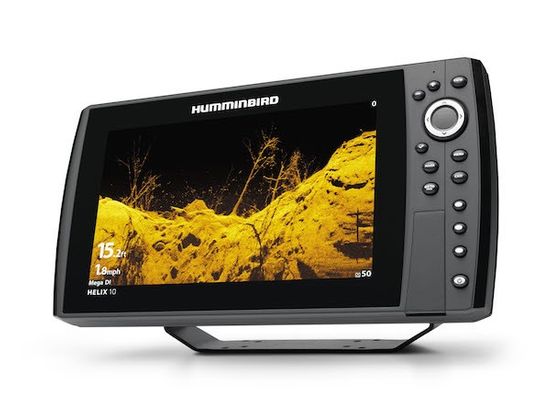
The advent of high-frequency, high-resolution units has completely revolutionized your fish-finding views at the helm. By utilizing frequencies in the 400 kHz to 800 kHz range, (instead of those in the neighborhood of 200 kHz) these units get a serious sensitivity boost. Think of them as giving you an MRI-like picture of what lies beneath the surface, compared to the cross-sectional view of a traditional fishfinder. The down-side may be a reduction of depth range, but they still easily probe depths of 100’ and more—waters where most of us fish in—so it’s a relatively unimportant limitation to the majority of anglers. Now, consider the fact that that most of today’s units can also send out traditional lower-frequency fish-finding pings, with the stroke of a key or a swipe of the screen. Now, the range limitation becomes irrelevant. Compared to traditional fishfinders, these new units offer a detail level that is 10 times better and you can easily tell the difference between a sprig of weeds, a rockpile, and the fish swimming around them.
Wait a sec. Won’t this be an uber-expensive upgrade? Not necessarily. In fact, you can get a good scanner/imager from a number of manufacturers for just a few hundred dollars. And a combined fishfinder/chartplotter with a screen big enough to consistently operate in a split-screen mode is only a few hundred dollars more.
You say you already have one of these units with scanning sonar? If it’s an early version, it’s probably already out of date. In the past couple of years, a new twist has been added: CHIRP multi-frequency scanning. Sure, this is a scaled-down version of big-dollar CHIRP units, but you still get a form of CHIRP with a shorter bandwidth. That gets you a detail boost over old-school scanners. The bottom line? Even if you upgraded to a new fishfinder two or three years ago, your unit is likely already technologically dated.
MFDs –
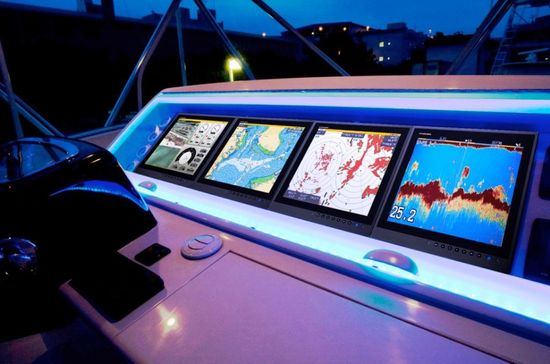
If you run a boat with a multifunction display at the helm and it’s more than a few years old, it may be out of date. Sure, we’ve seen these units become more and more capable over the past decade, incorporating some features internally that used to require black-box add-ons. And if you upgraded three or four years ago, you may have a do-everything box at the helm with no add-ons needed at all. Except for one, and it’s a biggie: Wi-Fi.
Many of us will say we don’t need and don’t want Wi-Fi on the boat, it’s actually an awesome addition. Cartography is one big reason why. Thanks to developments, such as the latest app from Navionics, a unit with onboard Wi-Fi will let your phone and your boat talk to each other. You don’t even have to tell them to do so; just set up the system to do it automatically, and when you step aboard and open the app, your phone will feed the latest cartography updates directly into your MFD’s brain. It can also grab your fishfinder’s pings, match them up with your GPS coordinates, and use the info to replace pre-existing mapping data already in the unit. Yes, you can “build” your own digital charts without lifting a finger. Wi-Fi also allows you to potentially use your phone as a repeater, get software downloads and updates automatically when the unit’s fired up and in range of a hotspot, and in some cases even it will even let the phone control some of the boat’s functions.
But… built-in Wi-Fi just started popping up in MFDs a couple of years ago. Not all manufacturers offer it (though add-ons are available), and no manufacturer offers it on all of the units in their line-up. So yes, that means that the unit currently sitting at your helm is, once again, probably obsolete.
VHF Radios –
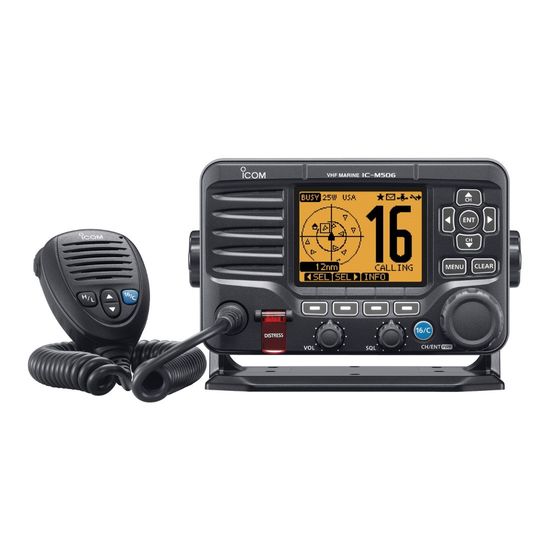
Remember when the USCG mandated that all new VHFs produced for use in America would be required to have DSC capabilities? That happened all the way back in 1999. Yet as of 2010, the best estimates put the proportion of VHFs with active DSC at a mere 10 percent. Why? Because going from “capable” to “active” requires a bit of extra work. In many cases, boaters have to connect the VHF to a source for GPS positioning data via a wire connection, and register to obtain an MMSI number, then program that number into your radio.
Having active DSC allows the USCG to immediately know your current GPS position, as well as vital data about your boat, if you call them on the VHF in an emergency or use the red “distress” button. Compared to all other gear it’s probably the number-one way to increase safety substantially on a boat. Yet that little bit of extra work (or perhaps the confusion related to wiring connections) prevents 90 percent of the boaters out there from taking advantage of it. Luckily, as is often true with all sorts of electronics, the cost of GPS receivers has plummeted and the GPS receiver is incorporated to other equipment now. The really good news: Both fixed-mount and handheld VHF are now available with GPS built in. Boaters don’t have to wire a thing and can get DSC at the press of a button. Do you still have a DSC-capable VHF on your boat, that is not actually DSC-active? If ever there was a reason to upgrade, this is it.
The advancements of these three systems in the last few years make it clear that most of us are running our boats with outdated electronics. Unless you fitted out your boat with a brand-new electronics system in the very recent past, it most certainly is time for an upgrade. And on the flip-side, this bad news is actually really, really good news—because once you upgrade your electronics, boating will become a whole lot better.