Two Weeks of Time Travel: Getting Lost in the Greek Cyclades Islands
Looking at the charts spread out on the nav desk was intimidating. There was so much to see in the southern Aegean Sea with more than 200 islands in 1,000 square miles of water. Our challenge was to guess how many places we could explore in just two weeks. We settled on trying for a dozen – an ambitious goal given the distances and amount to see and do on the spectacular Cyclades Islands of Greece where it seems, time has stood still for millennia.
We headed south out of Lavrion just as the northerly winds picked up. Med mooring in 35 knots, we learned just what a treat a Meltemi wind can be. As if it’s not hard enough to reverse into a gap that looks half the needed size, the wicked Greek Meltemi added to the fun of our arrival at Mykonos Island. Facing down some Croatian charterers for the last quay space, we tied up and waited for the Meltemi to blow itself out.
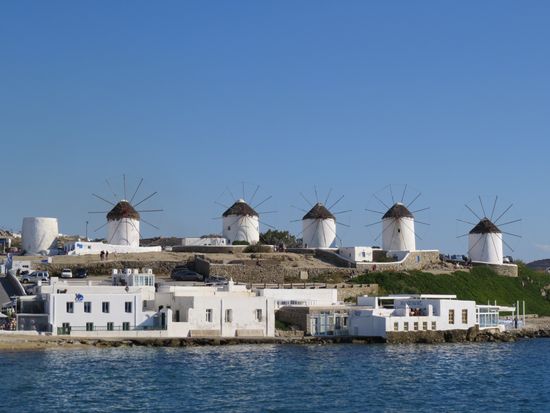
The windmills of Mykonos are a picturesque backdrop for an island that’s glitzy and glamorous.
Mykonos
Mykonos is where the beautiful people come to party, some on the superyachts that dot the large bay. The island seems to burst out of the sea, spilling chic eateries, artsy galleries, decorated staircases and classic Greek island architecture in every direction. The town is made up of narrow alleys where tiny restaurants are shoehorned into every corner. Fashion boutiques carry everything from designer dresses to handmade flip-flops that are so beautifully arrayed, it nearly made a shopper out of even me. Souvlaki wafts on the breeze that curls around alley corners, olive oil, and honey purveyors are chockablock and every door is a work of art.
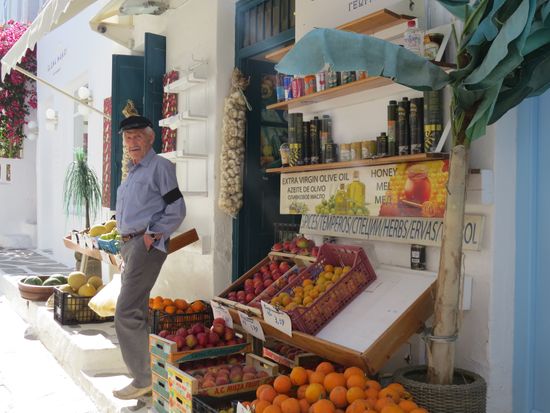
If needed, you can pretty much provision every day so don’t overbuy at the beginning of a Greek charter.
The Meltemi wasn’t letting up so we booked ferry tickets to Delos, the neighboring island, all of which is an active archeological dig. There are no taverans, no discos, no shops, and most importantly, no anchoring – which is why you take a ferry.
Delos is the antithesis to Mykonos. It’s the birthplace of the twin gods Artemis and Apollo and it was a hopping place back in 1500-1200 BC. Today, however, it’s a place to contemplate the ages and how even hearty civilizations disappear. The island’s ancient homes, shops, and temples are amazingly well preserved.
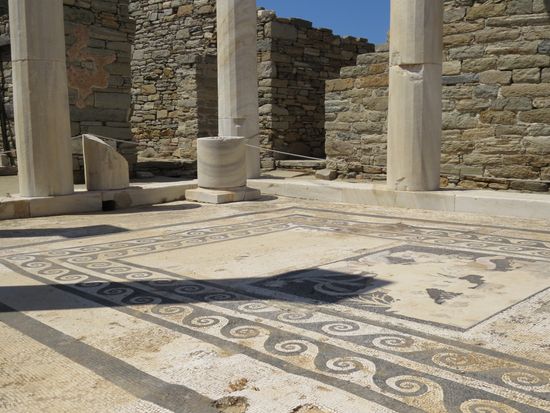
Marble columns and mosaic floors are open to the public and the elements on the ancient island of Delos.
Terrace of Lions
Walking along the Terrace of Lions that looks out over the Sacred Lake (drained in 1926 by anthropologists trying to eradicate mosquitos) is downright otherworldly. Ambling along the site is stepping back a few centuries and you’ll want to dust off memories of high school mythology classes to take it all in. Much of the once-colorful mosaics are left exposed to the elements, which must give museum curators around the world nightmares.
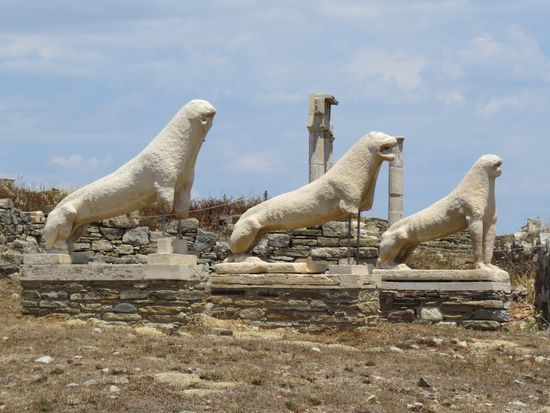
The lions of Delos stand guard over the Sacred Lake that was drained in 1926.
After three days, we dislodged the anchor from an underwater cable and said goodbye to Mykonos just in time to ride the last of the Meltemi to Milos, an island made famous by the discovery of the Venus de Milo, which was unearthed there by a farmer in 1820.
Adamas
We tied up in the town of Adamas and strolled the circular quay lined with captains hawking the next day’s excursions. They’re all gorgeous Zorba-the-Greek types and they promise an unforgettable cruise to the western island sites, which are chock full of caves, rock formations, and sheer cliffs. I walked from one handsome sunburnt salesman to the next, eyeing their vessels and learning about the must-see stops.
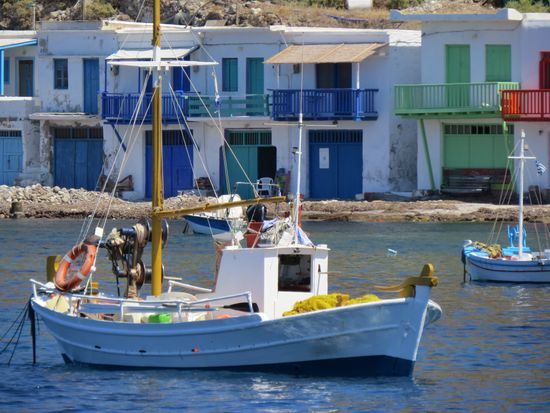
The colorful fishing boats of Milos may look like they’re from Disneyland but they’re actually hardworking vessels that go out every day to make a living.
The Greeks have a bit of a flirtation with the definition of vessel capacity limits and owners of 45-foot sailboats were promising full-day tours “with room for at least 20 people.” We were seven in 56 feet and that was plenty. The highlight of every vendor’s Oscar-worthy presentation was a photo of the amazing lunch that would be served. I poured over their brochures and maps and realized we could do it on our own.
The next morning, we waited two hours and then followed the tourist boats on their trek to visit the highlights. The delay was a stroke of genius as we arrived at each stop just as the local boats were pulling anchor to move on, leaving us to enjoy the peace and quiet. Dinghying alone into the topless Sykia cave was a treat, especially with nobody but our own echo for company. And lunch? Well, our morning’s visit to a small grocery store put together a brochure-worthy feast.
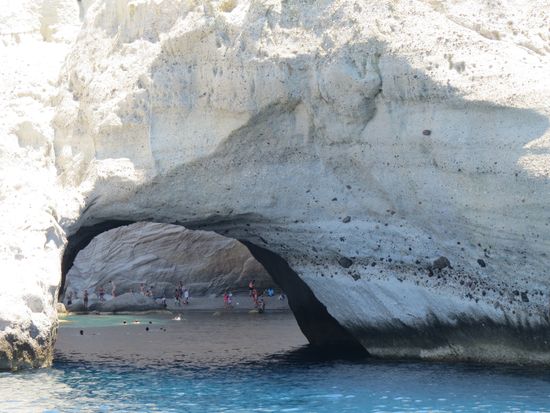
You can dinghy into the topless cave of Sykia and if you’re lucky, it will be just you and your echo.
Kleftiko
Following the trail south, we turned the corner to Kleftiko, an unreal playground ringed with caves and arches that can only be visited by boat and explored by dinghy. There wasn’t a bad place to point the camera so we lost track of time and decided to stay the night. Protected from the northern wind by steep cliffs, we had the peaceful anchorage to ourselves after all the tourist boats headed back to town.
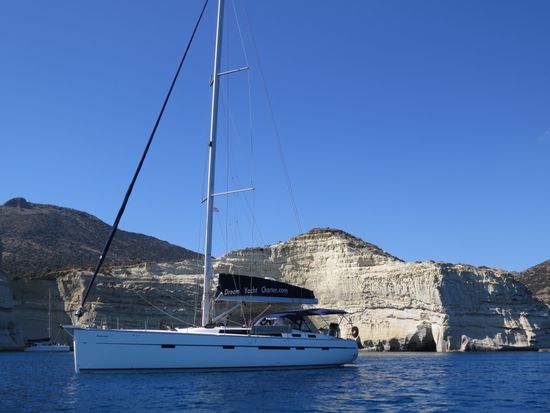
The white cliffs of Klaftiko make a great windbreak in the northerlies so an afternoon at anchor is blissfully calm.
The next morning, we continued on our circumnavigation of Milos and found Sarakiniko Beach. Made up of white sand, tall cliffs and hundreds of caves, the moonscape of Sarakiniko can be visited by land as well as by boat. Sheer white cliffs fall into the blue-green water, dotted by pink caves that lure you in for a swim. We had a unique vantage point as we were the only boat anchored out and were often-photographed by the visitors deposited on the beach by tourist buses from Adamas.
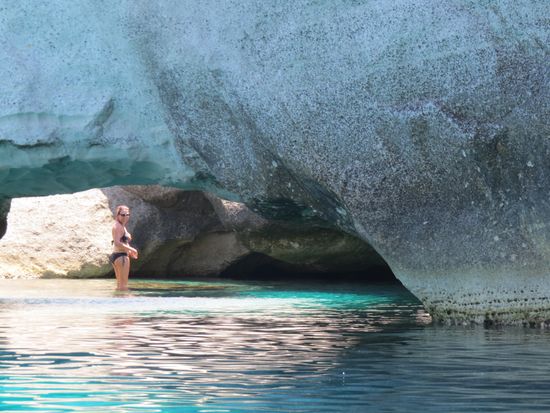
Sarakiniko on Milos Island is a swimmer’s paradise with white sand and plenty of shady caves to explore.
Young guys and gals were daring each other to jump off the 60-foot cliffs above but we opted for a long swim instead, wondering if Odysseus himself may have been lured here by sirens. That afternoon, we circled back to town, finding one more space on the quay for another Med moor, this one executed in wind-less bliss.
Time to Head Back North
The islands and days flowed by and too soon it was time to head back north so we scoured the charts to find one more island before returning to Athens. We settled on Kea, which turned out to be a great find. A weekend destination for Athenian yachties, Kea is often overlooked by charter boats and that’s a mistake.
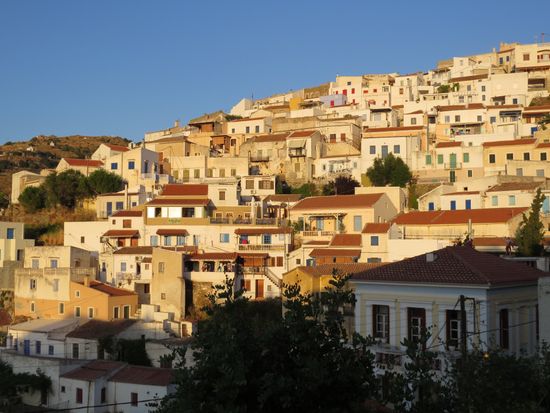
The vertical town of Ioulida on Kea Island looks like it was carved into the hillside.
The island benefits from frequent rainfall (by Greek standards) so it’s more verdant than the rest of the Cyclades and is covered by row upon row of olive tree terraces and beautiful vineyards. Touring the countryside is more akin to ambling through Italy. Like most villages in the Cyclades, Kea’s town of Ioulida is practically vertical, built into a mountainside, which creates unbeatable views and memorable sunsets. We hiked to the famous Stone Lion of Kea and its weird and enigmatic smile.
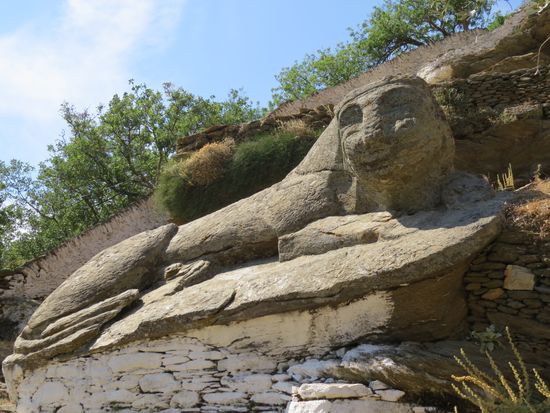
You have to hike a little bit to find the Stone Lion of Kea but that crazy smile is worth it.
During our somewhat irregular and incomplete circumnavigation of the Cyclades, we learned that there are at least three different ways to spell every island and town name, which makes sailing and driving rental cars interesting. The old town on every island is all called Hora or Chora, which doesn’t help. Greek names are a mystery, even when written in an alphabet we could recognize. Otherwise, it was literally, all Greek to us.
In the end, we visited seven of the thirty islands. We had barely scratched the surface. Our choice of anchorages often involved keeping a distance from the thumping discos that in Greece can go on until dawn. Otherwise, we were immersed in history that we can’t even ponder on this side of the Atlantic, and we reveled in the natural beauty of the water, the beaches the countryside and the people.
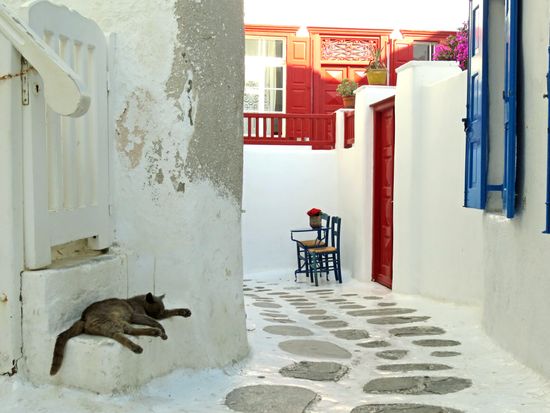
The Greek doors and cats: they could fill a book and most likely have done so.
Friendly and helpful, the villagers outside the main towns seem genuinely unfazed by tourism. They just go about their lives, less hurried and harried, and only the advertising of free WiFi in every taverna suggests that it is not still 1200 BC in the Cyclades where you can time travel on a charter vacation.
We tied up in the town of Adamas and strolled the circular quay lined with captains hawking the next day’s excursions. They’re all gorgeous Zorba-the-Greek types and they promise an unforgettable cruise to the western island sites, which are chock full of caves, rock formations, and sheer cliffs. I walked from one handsome sunburnt salesman to the next, eyeing their vessels and learning about the must-see stops.
The colorful fishing boats of Milos may look like they’re from Disneyland but they’re actually hardworking vessels that go out every day to make a living.
The Greeks have a bit of a flirtation with the definition of vessel capacity limits and owners of 45-foot sailboats were promising full-day tours “with room for at least 20 people.” We were seven in 56 feet and that was plenty. The highlight of every vendor’s Oscar-worthy presentation was a photo of the amazing lunch that would be served. I poured over their brochures and maps and realized we could do it on our own.
The next morning, we waited two hours and then followed the tourist boats on their trek to visit the highlights. The delay was a stroke of genius as we arrived at each stop just as the local boats were pulling anchor to move on, leaving us to enjoy the peace and quiet. Dinghying alone into the topless Sykia cave was a treat, especially with nobody but our own echo for company. And lunch? Well, our morning’s visit to a small grocery store put together a brochure-worthy feast.
You can dinghy into the topless cave of Sykia and if you’re lucky, it will be just you and your echo.
Kleftiko
Following the trail south, we turned the corner to Kleftiko, an unreal playground ringed with caves and arches that can only be visited by boat and explored by dinghy. There wasn’t a bad place to point the camera so we lost track of time and decided to stay the night. Protected from the northern wind by steep cliffs, we had the peaceful anchorage to ourselves after all the tourist boats headed back to town.
The next morning, we continued on our circumnavigation of Milos and found Sarakiniko Beach. Made up of white sand, tall cliffs and hundreds of caves, the moonscape of Sarakiniko can be visited by land as well as by boat. Sheer white cliffs fall into the blue-green water, dotted by pink caves that lure you in for a swim. We had a unique vantage point as we were the only boat anchored out and were often-photographed by the visitors deposited on the beach by tourist buses from Adamas.
Sarakiniko on Milos Island is a swimmer’s paradise with white sand and plenty of shady caves to explore.
Young guys and gals were daring each other to jump off the 60-foot cliffs above but we opted for a long swim instead, wondering if Odysseus himself may have been lured here by sirens. That afternoon, we circled back to town, finding one more space on the quay for another Med moor, this one executed in wind-less bliss.
Time to Head Back North
The islands and days flowed by and too soon it was time to head back north so we scoured the charts to find one more island before returning to Athens. We settled on Kea, which turned out to be a great find. A weekend destination for Athenian yachties, Kea is often overlooked by charter boats and that’s a mistake.
The vertical town of Ioulida on Kea Island looks like it was carved into the hillside.
The island benefits from frequent rainfall (by Greek standards) so it’s more verdant than the rest of the Cyclades and is covered by row upon row of olive tree terraces and beautiful vineyards. Touring the countryside is more akin to ambling through Italy. Like most villages in the Cyclades, Kea’s town of Ioulida is practically vertical, built into a mountainside, which creates unbeatable views and memorable sunsets. We hiked to the famous Stone Lion of Kea and its weird and enigmatic smile.
You have to hike a little bit to find the Stone Lion of Kea but that crazy smile is worth it.
During our somewhat irregular and incomplete circumnavigation of the Cyclades, we learned that there are at least three different ways to spell every island and town name, which makes sailing and driving rental cars interesting. The old town on every island is all called Hora or Chora, which doesn’t help. Greek names are a mystery, even when written in an alphabet we could recognize. Otherwise, it was literally, all Greek to us.
In the end, we visited seven of the thirty islands. We had barely scratched the surface. Our choice of anchorages often involved keeping a distance from the thumping discos that in Greece can go on until dawn. Otherwise, we were immersed in history that we can’t even ponder on this side of the Atlantic, and we reveled in the natural beauty of the water, the beaches the countryside and the people.
Friendly and helpful, the villagers outside the main towns seem genuinely unfazed by tourism. They just go about their lives, less hurried and harried, and only the advertising of free WiFi in every taverna suggests that it is not still 1200 BC in the Cyclades where you can time travel on a charter vacation.