Why Boat Prices are Going Up, Up and Away
This fall, boat prices will begin to go up. Slowly at first, but by this time next year they will be at full throttle. 2025, we think, will go down in the history of the boating industry as an “inflection point” where boat prices simply hopped off the rails into no-man’s land.
There is a small window of opportunity for savvy and courageous boat buyers to get their dream boat, but it will be closing soon. Boat prices are about to take a very big jump – for greater than those we saw during the Covid-19 buying frenzy. Even if new tariffs imposed by the U.S. are only 10%, when the dust settles, the disruption in supply chain sourcing, high tariffs on Chinese parts, the weakening U.S. dollar and the current reduction in production, will – and are – conspiring to create a perfect storm that will hit boat prices this fall.
Act Now, If You Plan to Buy
Hope springs eternal, but when it comes to hoping boat prices will stay the same or only go up 10%, we have some bad news. Everything, from the smallest widget to the largest megayacht will cost you more next year than it does RIGHT NOW.
Boat-price inflation will be much more than U.S. core inflation (CPI without food and costs), because that is only a starting point for boats. Let’s take a look at the impending train-wreck in boat prices --
1. The Devaluation of the U.S. Dollar
Vis-a-vis the Euro and a basket of currencies of countries that have major trade with the U.S., the “almighty dollar” is losing its strength. On Jan. 1, 2025, it took $1.03 to buy one Euro. Today it takes $1.18 to buy one Euro. That is a 14.5% drop in just 6 months.
The drop in the dollar compared to a basket of currencies from America’s major trading partners during the first 6 months of 2025 is between 10% and 11%. But don’t take our word for it --
- Reuters: “In the first half of 2025, ... a dramatic drop in the U.S. dollar — its steepest first-half decline since the 1970s.”
- Business Insider: Described it as the “worst first-half [U.S. dollar] performance since 1973.”
- The Guardian: [the U.S. dollar], “worst performance in over 50 years.”
- Financial Times: Noted it’s the “sharpest decline since 1973.”
All of these news outlets independently confirm the six-month drop—around 10–15% on the U.S. Dollar Index—as the most significant since the early 1970s, following the end of the Bretton Woods system in 1973. (When the U.S. had to go off the “gold standard” of a dollar being worth $35 for an ounce of gold. Today it is $3,350 an ounce.)
(Pssst – How do you think the U.S. will pay off its $36 trillion debt? It starts with devalued dollars.)
2. New Import Tariffs
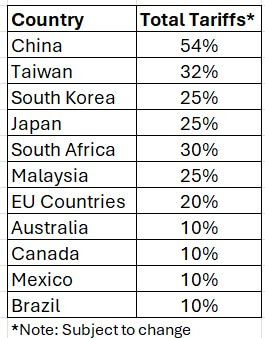
According to ReedSmith, import/export tariff experts, the U.S. tariffs on goods as of June 27, 2025, coming from the following countries were — with updates from Trump’s announcement July 7th --
3. What is Sourced Overseas in U.S.-Built Boats
Clearly, the tariffs, whatever they might finally end up being, will hit boats built offshore the hardest. But those tariffs will also hit all boats Made in America, as well. Take a look --
Raw Materials: copper (45% is imported -- and due to get 50% more expensive), aluminum (44% imported -- with different tariffs for different countries), steel (30% imported -- depending from where it comes), fiberglass cloth (no figures exist, but most comes from China -- 54%). The tariffs on commodities change from day to day, so don't take this as gospel, but you get the idea.)
Electronics: Garmin products are from Taiwan (+32%), Simrad from Mexico, (+10%) and Raymarine from the U.K. (+10%, generally; 25% for steel and aluminum, +25% for cars an auto parts.)
Engines: Volvo Penta (Sweden), MAN and MTU diesels (Germany), bothe from the EU, +20% as of now, Yanmar and Kubota diesels (Japan), Honda, Yamaha, Suzuki, and Tohatsu outboards (all Japanese) -- all +25%.
Bow Thrusters: Side Power (Norway) +15% possible, Vetus (Netherlands) +20%, Lemar (Sweden) +20%, Quick (Italy) +20%.
Bilge Pumps: Rule (China and Mexico), Johnson (Sweden), Attwood (Asia), Whale (U.K.), SeaFlo (China), Jabsco (Mexico and China). +20% to 54%.
Windlasses: Lewmar (UK and China), Maxwell (New Zealand and China), Quick (Italy), Lofrans (Italy), Muir (Australia). +10% to 54%.
Cleats and Deck Hardware: Mostly made in China, Taiwan and South Korea. (A big exception here are parts made by the 100-year-old American hardware company Perko, in Miami, Florida.) +25% to 54%
4. The “Stacking Effect”
When consumers go to the fall boat shows they are going to see prices that will reflect the 15% drop in the value of the dollar, plus the import duty of from 10% to 54%. For example, the fiberglass cloth used in the boat, and the material giving composite-hulls their remarkable strength, could cost the builder as much as 69% more, we're told. Happly, most resins used in boat construction are made in the U.S. Resin typically makes up from 40% to 50% of a GRP molding.
Small items like bilge pumps or power thrusters, could cost 30% more. Even polyester resin, which is virtually all made in the U.S., has increased 3% in price since Jan. 1, 2023.
5. Inflation Opportunity Price Creep.
In addition to the weak dollar, the tariffs and the normal rise of inflation, there is what we call “inflation-opportunity-price-creep” whereby companies up and down the supply chain put their thumb on the scale, round up, and add an extra 2-3% “for good measure,” to the cost of everything. It’s almost like a VAT up and down the supply chain.
6. Rising Allocation of Overhead.
American boat builders trimmed down their overhead costs during the Great Recession of 2008-2013 to the bone. Wisely, most have been stingy about adding personnel, or overhead since that time – those building new plants, or expanding old ones, during the Covid-frenzy notwithstanding.
For the last 12 months, new boat sales have been down 20% to 40%, or even more in many brands. Since the overhead is already at the bone, fewer units have to take on a greater load of the overhead burden, thus adding to the cost of boats that has nothing to do with inflation or tariffs. This will obviously vary with every brand and company.
5. Pricing Estimation Inflation
Traditionally, American boat builders meet with their dealers in July, August and September to take orders for the following model year. Dealers want to know how much they will have to pay for the boats. With component pricing in flux, builders are forced to guess what they will have to pay, and our experience indicates that they will spit-ball it at 10% for the overall cost of the boat. If this ends up being too much, they can always dial back the prices, through discounts and dealer rebates. This is different than "inflation-opportunity-price-creep" because it is one big shot in the dark, which may be adjusted downward later.
All of this and more, will be hitting the sticker price of boats this fall.
For more insight as to what is going on this year, be sure to read “The New Boating Paradigm” which was published earlier this week.
What You Can Do Now
There are currently many pre-tariff boats on dealers’ lots all over the country – with components that were purchased before Jan.1, 2025 with a strong U.S. dollars. These boats, no matter which brand, represent the most value, and the lowest price you will ever see in a comparably-equipped boat.
We are talking about both Made in America boats and imported ones. Don’t be put off if there are non-current 2023, 2024 or 2025 models. If they haven’t been sold, they are new boats and the thing that matters is the price. Don’t get confused by the nuance of are “older” new boats worth less than the newer “old boats” – they will all be your last chance to participate in the best buying opportunity you’ll ever have in boating.
Think of it as an investment in a boat for your kids.