Access More Boat Tests
Already have an account? Login
Boston Whaler 360 Outrage (2022-)
2 x 600-hp Mercury V12 Verado

Brief Summary
The latest generation of the 360 Outrage takes the line in a new direction with several design styling cues that will define the lineup moving forward.
Test Results
| RPM | MPH | Knots | GPH | MPG | NMPG | SM | NM | dBa |
|---|---|---|---|---|---|---|---|---|
| 700 | 3.8 | 3.3 | 2.9 | 1.3 | 1.2 | 495 | 430 | 65 |
| 1000 | 5.2 | 4.5 | 3.8 | 1.4 | 1.2 | 506 | 439.8 | 61.6 |
| 1500 | 7.4 | 6.4 | 5.6 | 1.3 | 1.1 | 492 | 428 | 65.3 |
| 2000 | 9.1 | 7.9 | 9.3 | 1 | 0.8 | 363 | 315.7 | 68.1 |
| 2500 | 10.9 | 9.5 | 15.8 | 0.7 | 0.6 | 258 | 224.6 | 69.7 |
| 3000 | 16.9 | 14.7 | 20.9 | 0.8 | 0.7 | 301 | 261.5 | 73.8 |
| 3500 | 28.6 | 24.9 | 30.4 | 0.9 | 0.8 | 352 | 305.7 | 81.5 |
| 4000 | 36.1 | 31.3 | 34.1 | 1.1 | 0.9 | 395 | 343.7 | 82.7 |
| 4500 | 41.5 | 36 | 42 | 1 | 0.9 | 369 | 320.7 | 82.5 |
| 5000 | 47.5 | 41.3 | 53.3 | 0.9 | 0.8 | 333 | 289.2 | 83.5 |
| 5500 | 52.1 | 45.3 | 71.5 | 0.7 | 0.6 | 272 | 236.3 | 85 |
| 6000 | 57 | 49.6 | 87.3 | 0.7 | 0.6 | 244 | 212.1 | 84.4 |
| 6400 | 61.3 | 53.3 | 98.5 | 0.6 | 0.5 | 232 | 202.1 | 88 |

Specifications
| Length Overall |
36' 5" 11.12 m |
|---|---|
| Beam |
11' 3" 3.43 m |
| Draft |
32" 81.28 cm |
| Bridge Clearance |
15' 4.57 m |
| Weight Capacity |
5,810 lbs. 2,635.37 kg |
| Person Capacity | 14 |
| Fuel Capacity |
415 gallons 1570.94 L |
| Water Capacity |
45 gallons 170.34 L |
Acceleration Times & Conditions
| Time to Plane | 4.1 seconds |
|---|---|
| 0 to 30 | 7.4 seconds |
| Props | 27.5 |
| Load | 3 persons; 115 gal. fuel; 50 lbs. gear |
| Climate | 62 deg.; 100 humid.; winds: 15-20; seas <1 |
Engine Options
| Tested Engine |
2 x 600-hp Mercury V12 Verado |
|---|---|
| Std. Power |
3 x 400-hp Mercury Verados |
| Opt. Power |
2 x 600-hp Mercury V12 Verados |

Captain’s Report by Capt. Steve
The latest generation of the 360 Outrage takes the line in a new direction with several design styling cues that will define the lineup moving forward. She’s loaded with forward-thinking enhancements that not only come from customer feedback but the simple fact that the design team uses the boats they design. They fish on them, they cruise on them, they sleep on them and they know where they have their shortcomings, for lack of a better term, and can then address them at the drafting table. The result can be seen in this finished product and it shows throughout.
Mission
First and foremost, this is a Boston Whaler, so the 360 Outrage is a fishing boat. But to say it stops there would be a disservice. She’s so much more. The builder set out to not only maximize space but functionality. To that end, she can entertain, cruise, weekend, cove and do just about anything in between. With a long list of options, she can be dialed into whatever task an owner has in mind for her.
Major Features (Including Distinguishing Features)
- Improved storage. Use of space has been refined and improved throughout the boat, resulting in more usable bow storage, a more organized cabin and a better-designated sleeping space in the V berth.
- Improved tower access. Ladder access to the tower is now placed at the centerline rather than on the side and includes a large hatch opening. The access feels much more secure and the style lines of the boat are improved as well.
- Elevated performance. The 360 Outrage is well-powered for her size and she handles beautifully with standard triple 300-hp Mercury engines. Options include triple 450-hp Mercury 4-Strokes or twin 600-hp V12 Verados.
- Generator free. Advanced e-Fathom technology leverages lithium battery power, eliminating the need for a generator.
- Cutting-edge technology. A state-of-the-art helm station with larger electronics, and available joystick piloting deliver effortless command. Digital switching technology empowers remote control of key systems. Available gyro-stabilization ensures comfort in rolling seas.
- Spacious redesigned bow. Reconfigured bow seating affords easier access to the ground tackle and improved ability to fish at the bow while also creating a larger sense of space.
- More personalized cockpit. The standard Outrage leaning post prep station has been moved to the stern where it could be optioned out for a grill and Corian countertop. Owners no longer have to choose between rear-facing seating and a summer kitchen or deluxe livewell. Cockpit seating is more comfortable and flexible than ever.
Performance
With the twin 600-hp Mercury V12 Verado engines turning 27.5 prop sets and spun up to 6400 RPM, our speed topped out at 61.3 mph. Best cruise came in at 4000 RPM and 36.1 mph. It was at that speed that the 34.1 GPH fuel burn translated into 1.1 MPG and a range of 395 statute miles – all while still holding back at 10% reserve of the boat's 415-gallon (1,571 L) total fuel capacity. In acceleration tests, she was equally impressive. Average time to plane was 4.1 seconds and she’ll hold plane on down to 15.3 mph. We hit 20 mph in an average of 5.4 seconds, 30 in 7.4 and 40 came and went in 10.2 seconds.

Handling
As for her handling, she has the solid feel of a Boston Whaler. We, unfortunately, tested her in calm conditions in the Intracoastal Waterway so we can't comment on how she handles ocean conditions, but she's still a Boston Whaler so that speaks volumes. Turns are met with just enough slide to take the hard edge off and this keeps things manageable. With the tower, the center of gravity is higher so there's more lean into the turns but still not an excessive amount. She will drop off speed as she digs her shoulder in, so don't be shy about adding power. I chose to manage the engine trim manually, so I dropped it during the turns and brought it back up in the straightaways. I found that putting it to about the low 20s on the trim gauge got it to about where she wanted to be for optimum running angle.
Engines/Engine Room
Standard engines for the 360 Outrage are the triple 300-hp Mercury V8s. Upgrades include the triple 400s, 450 Racing or the twin 600-hp V12s on our test boat. All come with Joystick Piloting and electronic steering plus the option for black or white.
Boat Inspection
Cockpit Features
The 360 Outrage measures 8’7” x 4’2” (2.61 m x 1.27 m). Fishing features include padded bolsters all around, rocket launches above, 24 rod holders all around the caprails, toerails, cannonball holders, raw water washdown and a freshwater washdown (45-gallon / 170.34 L capacity). There’s a 55-gallon (208.20 L) pressurized livewell that includes a bait divider and a 2000 GPH (7571 LPH) recirculating pump. There are two in-deck fish boxes and both are macerated. Outriggers are installed to the sides of the hardtop.

Cockpit Versatility
There’s also versatility to the cockpit. There’s a flip-down transom seat. A pedestal base allows for adding a cockpit table that stores underneath the cockpit deck hatch, right next to where it’s needed. Boston Whaler calls that “point of use storage.” If the sun gets to be too much, we can extend an awning overhead from the trailing edge of the hardtop. There’s a standard dive door to the port hand side and the reboarding ladder stores close by at the transom. Again, “point of use” storage.


Aft-facing Seating
Here’s a new feature for this model year and one that will come to define future models. Boston Whaler put several clever features into this aft-facing seating area. Let’s count them off.
- For starters, it’s remarkably comfortable and convenient. It’s a welcome location whether underway or just dining at the cockpit table.
- The center armrest serves double duty as nonskid steps leading up to the center hatch in the tower. This is a huge upgrade. Usually, we're going up those awkward ladders to the side that takes a contortionist to utilize. This is much smarter.
- Next, pull a side pin and pull the seatback aft. That transforms it into a working surface with a SeaDek top, which is an extremely clever feature.
- If a customer opts for the summer kitchen and transitions away from fishing, this seating location isn’t the area that gets sacrificed. This clever and functional area remains and the transom area is what transitions. Out goes the 55-gallon (208.2 L) livewell and the flip-out transom seat in favor of a grill, a sink, refrigeration and ice maker. And Boston Whaler will still include a 25-gallon (94.64 L) livewell.


Bow
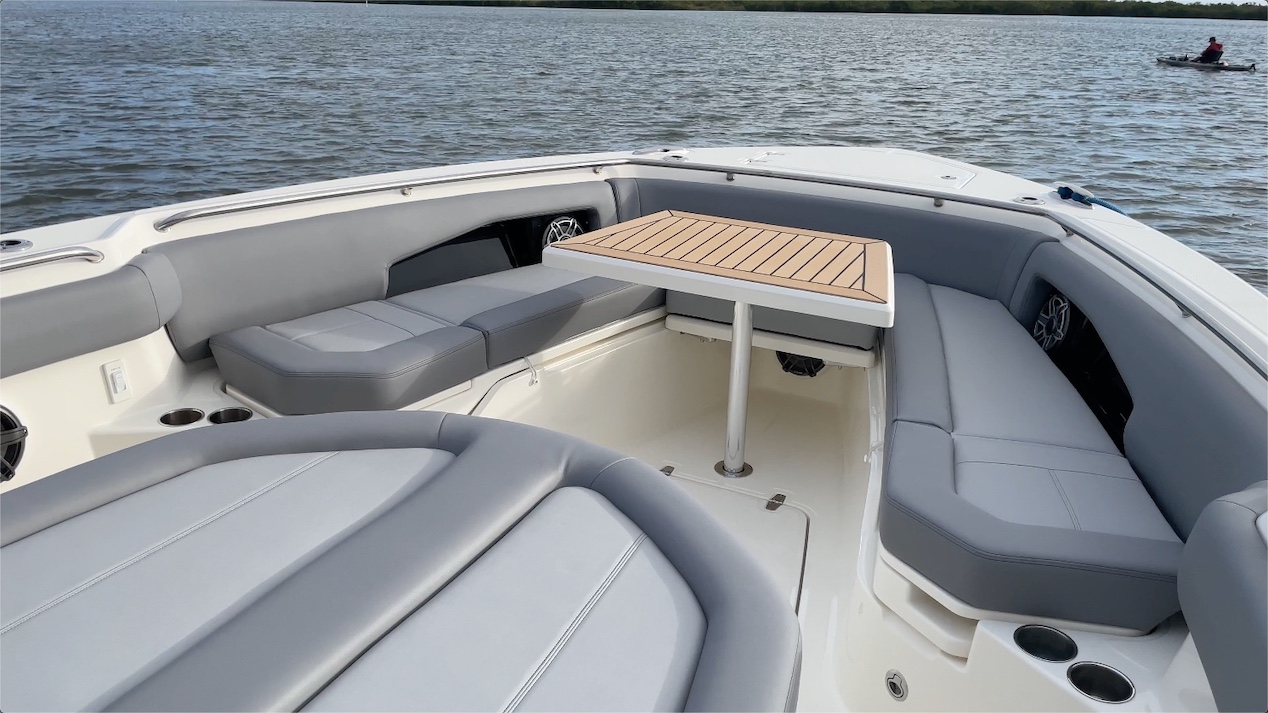
At the bow, there’s a large sun lounge with a flip armrest to both sides and to the center. The center one also includes integrated beverage holders. There’s a latch to the forward end that releases the entire cushion to access the storage underneath. This storage also includes dedicated storage for the bow table and its two pedestals, one for dining and one to convert to a sunpad.
There's a fish box in the deck and it's macerated. The switch is right at the port bulwarks. The V-seating converts to chaise lounges by lifting the seatbacks. Storage is underneath. There are recessed areas in the bulwarks that have speakers and connectivity. The rails are recessed below the caprails instead of being mounted on top of them. With the table removed there’s easy access to the forward bolster, making it easy to work when chasing down a fish. Equally easy is working the ground tackle that is now waist-high.



Tower Helm
On the left is a 12” (30.48 cm) SIMRAD display. The compass is right in line with the steering wheel. There’s a Mercury JPO (Joystick Piloting for Outboards) joystick on the right-hand side and the latest generation of the DTS (Digital Throttle and Shift). Underneath there's a storage compartment and a footrest underneath the console. The seat is doublewide. Above is a Sunbrella cover supported by the buggy top.

Lower Helm
Up above there’s an e-box, the Seakeeper gyro panel and a SIMRAD VHF radio. The windshield has an electrically actuated vent at the top. Electrical switches go across the top of the panel and then two glass-dash multi-function screens are from SIMRAD. Even though we have a glass dash panel there’s also have a physical volume knob for the stereo. On the right are Lenco trimtabs, the third generation DTS (Digital Throttle and Shift) from Mercury and the JPO (Joystick Piloting for Outboards) joystick. The helm seats are adjustable fore and aft mechanically, not electrically, so they're not going to fail years down the road. Below there’s a flip-down panel to elevate the operator another 6” (15.24 cm).
There are tracks at the hardtop level so we can enclose this whole area. To the starboard side of the helm seats is a refrigerated drawer. To the starboard bulwarks is the main electrical panel with the battery switches and ignitions.

Cabin
For getting into the cabin Boston Whaler, took a page from the yachting community and made what is, in effect, a watertight door and it's also lockable. It's a simple latch and then articulating hinges bring it ahead and to the side of the console. To close, just bring it over and it slams shut. It’s a very elegant solution.
There’s a lot to like in this cabin/head. Firstly, the overhead clearance is 6’4” (1.93 m). The Corian counter has a sink recessed into it with a pull-out sprayer making this a wet head. There’s a circular hatch leading to trash receptacle below. There are flip-out rod holders and we can flip out the base supports so the rod holders are going to be stored vertically up to the 6’4” (1.93 m) overhead height. To the port side are reel holders with the rods running forward horizontally and the forward area converts into a berth.


Options to Consider
- Deluxe transom prep station (replaces transom fold-away bench seat)
- Countertop - Solid surface
- Cutting board
- Grill - Electric 120 -V
- Freshwater sink
- Grab Rail – stainless-steel
- Lighting – LED accent lighting under countertop edge
- 16” (40.64 cm) SIMRAD NSO evo3s additional display electronics package
- 19” (48.26 cm) SIMRAD Electronics / Navigation Package
- Chirp Sonar With 3D
- Radar – Open Array
- Automatic Identification System
- FLIR Thermal Night Vision with Pan, Tilt and Zoom
- Theft Deterrent W/First Mate and Remote Connectivity System
- Inverter Package
- Generator
- Gyroscopic Stabilizer
Observations
There are three major boxes that are checked with the 360 Outrage – technical enhancements, design improvements seen throughout and most importantly the ability to take a well-equipped base boat and improve it to the level that makes everyone happy. Moreover, there are so many improvements to this model that she’ll define the brand for years to come.
Test Video Summary
Overview
The Boston Whaler 360 Outrage takes the Outrage line in an all-new direction, maximizing space and functionality. BoatTEST’s Captain tested her with twin 600-hp Mercury V12 Verado outboards.
“There are three major boxes that are checked with the 360 Outrage: technical enhancements, design improvements seen throughout, and most importantly, the ability to take a well-equipped vessel and improve it to the level that makes everyone happy.”
Mission And Intended Owner
- Built To Do: Fishing first, with family and entertaining versatility
- Designed For: Anglers who want a well-equipped boat that can also switch away from fishing, with an optional summer kitchen
- Locus Of Operation: Offshore
Design Overview
- Tower Supports: New black color, integrated into the console, signaling a whole new style for the Outrage lineup
- Tower Access: Non-skid steps up to a center hatch, instead of awkward side ladders
- Rails: Recessed instead of mounted on top of the cap rails
- Bulwarks: Recessed areas with speakers and connectivity
- Cabin Door: Watertight, lockable, on articulating hinges
- Power: e-Phantom lithium-ion battery system that takes the place of a generator
“Gotta love the design stylings of the tower supports, new color black, and it’s integrated into the console, that signals a whole new style for the Outrage lineup, and I really have to say I like it.”
Specifications
- Length Overall: 36 feet, 5 inches
- Beam: 11 feet, 3 inches
- Draft: 32 inches
- Fuel Capacity: 415 gallons
- Cockpit: 8 feet, 7 inches by 4 feet, 2 inches
- Livewell: 55 gallons, pressurized
- Cabin Headroom: 6 feet, 4 inches
Test Conditions And Test Weight
- Sea State: Calm conditions in the Intracoastal Waterway
Performance
- Tested Power: Twin 600-hp Mercury V12 Verados turning 27.5 prop sets
- Optional Power: Triple 300s, 400s or 450 Racing outboards
- Top Speed: 61.3 mph at 6,400 rpm
- Best Cruise: 36.1 mph at 4,000 rpm, burning 34.1 gph
- Fuel Economy At Best Cruise: 1.1 mpg
- Range At Best Cruise: 395 statute miles, holding a 10% reserve
| RPM | MPH | GPH | MPG | Range (SM) |
|---|---|---|---|---|
| 4,000 | 36.1 | 34.1 | 1.1 | 395 |
| 6,400 | 61.3 | — | — | — |
Acceleration:
- Time To Plane: An average 4.1 seconds
- Minimum Planing Speed: Holds plane down to 15.3 mph
- 0–20 mph: An average 5.4 seconds
- 0–30 mph: 7.4 seconds
- 0–40 mph: 10.2 seconds
Sea Trial And Handling
- Feel: The solid feel of a Boston Whaler
- Turns: Just enough stern slide to take the hard edge off
- Lean: More lean into turns because the tower raises the center of gravity, but not excessive
- Speed In Turns: She drops speed as she digs in her shoulder, so add power
- Trim: Managed manually: drop trim in turns, raise it on straightaways, with about the low 20s on the gauge for her optimum running angle
- Conditions: Calm water only, so ocean handling could not be assessed
“We unfortunately tested in calm conditions in the Intracoastal Waterway, so we can’t comment on how she handles ocean conditions, but she’s still a Boston Whaler, that speaks volumes.”
Engine Room Or Mechanical Compartment
- Access: Mechanical room in the center of the cockpit deck
- Contents: Bilge pumps, water pumps, macerator pumps and the e-Phantom lithium-ion batteries
- e-Phantom Panel: In the cabin, along with the main breaker panel
- Main Electrical Panel: In the bulwarks to starboard of the helm
- Overhead Height: 6 feet, 4 inches in the cabin
Features Inspection
The Helm
- Overhead: E-box with the Seakeeper gyro panel and Simrad VHF
- Windshield: Three-piece, with an electrically actuated vent at the top
- Speakers: Under the panel
- Compass: Centered, in line with the helm
- Switches: Electrical switches across the top of the panel
- Glass Dash: Two Simrad panels
- Stereo: A physical volume knob alongside the glass dash
- Glove Box: To the left, with connectivity and a drain at the bottom
- Controls: Lenco trim tabs, third-generation Mercury DTS digital throttle and shift, and the JPO joystick
- Climate Control: Well-placed vents
- Footrests: Two levels
- Seats: Adjustable fore and aft mechanically rather than electrically, so they won’t fail down the road
- Platform: Flip-down elevated platform for shorter captains
- Enclosure: The helm area can be fully enclosed
- Outriggers: Yes
- Refrigerated Drawer: To starboard of the helm seats
“Even though we have a glass dash panel, we also have a physical volume knob for the stereo, because simple things need to be done still.”
“Helm seats, they are adjustable fore and aft, mechanically not electrically, so they’re not going to fail way down the road and I like that.”
Upper Control Station
- Equipment: Remote-control spotlight, open-array Simrad antenna and forward-looking infrared
- Display: 12-inch Simrad
- Compass: In line with the wheel
- Controls: JPO joystick, latest-generation DTS and Lenco trim tabs
- Storage: Clever compartment that doubles as a footrest
- Seat: Double wide
- Shade: Sunbrella cover on a Bimini top
Anchor Locker And Ground Tackle
- Windlass: Quick windlass leading to a through-the-stem anchor roller
- Remote: Alongside
- Washdown: Freshwater
- Rode Access: Easy, under the hatch
- Hatch: Finished on both sides, with a gas strut and a turn-and-lock latch
- Cleats: 10-inch pull-up cleats on both sides
- Access: Removing the bow table and platform also opens access to the forward bolster for working fish
Boarding Amenities
- Dive Door: Standard, to port, with the ladder stored at the transom
- Reboarding Ladder: Concealed to starboard, angled away from the running gear
Cockpit Arrangement And Equipment
- Fishing Gear: Padded bolsters, rocket launchers, rod holders, tow rails, cannonball holders, and raw and freshwater washdowns
- 5-Gallon Bucket Storage: Yes
- Livewell: 55 gallons, pressurized, with a bait divider
- Fish Boxes: Two in the deck, both macerated
- Cockpit Seat: Pulls out from under the bolster
- Cockpit Table: Pedestal base, with the table stored under a hatch
- Awning: Extends overhead
- Aft-Facing Seats: Under the tower; pull the side pin and the seatback converts into a working surface
- Summer Kitchen (Optional): Replaces the 55-gallon livewell and flip-out transom seat with a grill, sink, refrigeration and ice maker, while keeping a 25-gallon livewell and the aft-facing seats
“Pull the side pin and pull the seat back, now we create a working surface. How’s that for clever.”
Bow Arrangement
- Sun Pad: With flip armrests on both sides and in the center, and center beverage holders
- Storage: Under the seating, including dedicated storage for the bow table and its two high-low pedestals
- Filler Cushion: Turns the area into a sun pad
- Fish Box: Macerated, in the deck, with a switch alongside
- Rod Holders: Additional, in the bow
Interior Spaces
Cabin:
- Door: Watertight and lockable, with a simple latch, swinging on articulating hinges to the side of the console
- Headroom: 6 feet, 4 inches
- Wet Head: Corian counter with a recessed sink and pullout sprayer
- Trash: Receptacle alongside, easy to empty
- Storage: Plenty alongside, plus storage under the berth cushions
- Rod Storage: Vertical holders up to 6 feet, 4 inches, with flip-down base supports holding the reels and butts forward
- Berth: The whole area converts into a berth
- e-Phantom: Lithium-ion batteries replace the generator, running all electrical systems including the Seakeeper all day or longer
“Boston Whaler really took a page out of the yachting community and made what is in effect a watertight door... very elegant solution.”
Advantages And Disadvantages
Advantages
- Fresh new styling for the Outrage line
- Fast: 61.3 mph top speed and 36.1 mph best cruise
- 395-mile range from a 415-gallon tank
- Solid Whaler feel with manageable turns
- Tower reached by non-skid steps instead of side ladders
- 55-gallon pressurized livewell and macerated fish boxes
- Standard dive door
- Summer kitchen option keeps the aft-facing seats and a 25-gallon livewell
- e-Phantom lithium system replaces the generator
- Watertight cabin door, 6'4" headroom and vertical rod storage
- Mechanical seat adjustment that won’t fail over time
Disadvantages
- Tested only in calm water, so ocean handling was not shown
- More lean in turns because of the tower’s higher center of gravity
- Drops speed when digging in during turns
- Summer kitchen replaces the 55-gallon livewell and flip-out transom seat
Related Boats

Boston Whaler 320 Outrage (2014-)
2 x 300-hp Mercury Verado

Boston Whaler 370 Outrage (2012-)
3 x 300-hp Mercury Verado

Boston Whaler 350 Outrage (2019-)
3 x 300-hp Mercury Verado

Boston Whaler 270 Dauntless (2019-)
2 x 200-hp Mercury Verado FourStroke L4 DTS