Brief Summary
The EdgeWater 230CC is a versatile center console with many standard features that help its owners enjoy fishing, dayboating, and tow-sports. Built using EdgeWater’s proprietary Single Piece Infusion Structural System, the 230CC has a variable deadrise hull and an all-composite, no-wood construction. The result is a solid, yet lightweight hull that uses a single outboard.
Test Results
| RPM |
MPH |
Knots |
GPH |
MPG |
NMPG |
SM |
NM |
dBa |
| 600 |
3.3 |
2.8 |
0.6 |
5.4 |
4.7 |
536 |
466.3 |
63 |
| 1000 |
5.2 |
4.5 |
1.3 |
4 |
3.4 |
392 |
341 |
64 |
| 1500 |
7.1 |
6.2 |
2.2 |
3.2 |
2.8 |
320 |
277.8 |
69 |
| 2000 |
8.5 |
7.3 |
3.6 |
2.3 |
2 |
232 |
202.1 |
74 |
| 2500 |
10.6 |
9.2 |
5.6 |
1.9 |
1.6 |
187 |
163 |
79 |
| 3000 |
15.8 |
13.7 |
7.1 |
2.2 |
1.9 |
220 |
191 |
83 |
| 3500 |
28.5 |
24.8 |
9 |
3.2 |
2.8 |
314 |
272.6 |
80 |
| 4000 |
33.7 |
29.3 |
12.6 |
2.7 |
2.3 |
266 |
231.2 |
82 |
| 4500 |
38 |
33 |
17 |
2.2 |
1.9 |
222 |
193 |
79 |
| 5000 |
42.6 |
37 |
23.8 |
1.8 |
1.6 |
177 |
154.1 |
80 |
| 5500 |
48.3 |
42 |
26.4 |
1.8 |
1.6 |
181 |
157.5 |
87 |
| 5700 |
51.1 |
44.4 |
26.5 |
1.9 |
1.7 |
191 |
165.8 |
88 |
Specifications
| Length Overall |
22’ 8'' / 6.9 m
|
| Beam |
8’ 6''
2.6 m
|
| Dry Weight |
3,900 lbs.
1,769 kg
|
| Tested Weight |
5,347 lbs.
2,425 kg
|
| Draft |
15''
0.38 m
|
| Deadrise/Transom |
20-deg.
|
| Max Headroom |
open
|
| Bridge Clearance |
7’ 6''
2.3 m
|
| Weight Capacity |
2,549 lbs.
1,156 kg
|
| Person Capacity |
10
|
| Fuel Capacity |
110 gal.
416 L
|
| Water Capacity |
N/A
|
| Total Weight |
5,347 lbs.
2,425 kg
|
Acceleration Times & Conditions
| Time to Plane |
3.2 sec.
|
| 0 to 30 |
9.4 sec.
|
| Ratio |
N/A
|
| Props |
18T 15 1/4 Saltwatwer Series 2
|
| Load |
3 persons, 1/2 fuel, no water, 50 lbs. of gear
|
| Climate |
80 deg., 72 humid.; wind: 0-5 mph; seas: 0
|
Engine Options
| Tested Engine |
1 x 300-hp Yamaha
|
| Std. Power |
Not Available
|
| Opt. Power |
Not Available
|
Contents of Report
Overview
If a boater is looking for versatility, then there’s no doubt that a center console should be part of the conversation, and EdgeWater has been building them for more than 25 years. The EdgeWater 230CC is the first in a new line of boats for the company, and this build shows off much of what the design team has learned over the years.
Of course, EdgeWater uses a proprietary Single Piece Infusion Structural System, which combines engineered knitted fiberglass fabrics with foam composite structural stringers and vinylester resin into the mold in one step, resulting in a single-piece construction with an advantageous ratio of components, to minimize weight and maximize strength. EdgeWater takes the construction of the 230CC just as seriously as the company’s larger models, which range from 15’1” (4.6 m) up to 37’ (11.2 m) in the center console configuration, and from 24’6” (7.5 m) to 28’ (8.53 m) in the crossover design.

The EdgeWater 230CC is a versatile platform for fishing or family activities.
Features Inspection
 This rendering of the layout of the 230CC does not show the leaning post.
Stern Platform and Transom Area
Beginning at the stern platform, many boaters will find it easy to step aboard here because the platforms extend beyond the aft bulwarks 3’3” (.99 m) on either side of the single outboard. On our test boat, the engine was a 300-hp Yamaha, an upgrade from the standard 250-hp Yamaha F250. There’s a platform deck all the way across forward of the splashwell to simplify moving about this area for engine checks or from which to launch watersports.
 The integrated platform has bulwarks to either side equipped with powder-coated grab rails.
On the aft end of the starboard platform is a telescoping, folding, three-step reboarding ladder beneath a hinged cover that opens outboard. ABYC standards require a ladder that extends 22” (.56 m) to aid in reboarding. On the portside platform there’s a hatch to a stern anchor locker.
 The starboard platform has a hinged cover with a telescoping reboarding ladder underneath it.
 On the port side of the swim platform there’s a stern anchor locker with a gas-assist ram to hold the lid open. Just because this anchor locker is located in the stern does not mean the boat should be anchored from here. It is for a spare anchor.
Our test boat had the option of four rod holders ($472) across the aft side of transom. To port on our test boat is a 28-gallon (106 L) livewell ($858) with a clear gasketed lid so it may be pressurized to keep bait happy when the running gets rough. There’s a 17” (.43 m) wide transom gate to starboard opening inward, with a stainless slide bolt latch and an 8” (.20 m) step down into the 25” (.64 m) deep cockpit through the gate.
A standard retractable tow pylon raises the connection point for the towline to 22” (.56 m) above the top of the transom; plenty of height to clear the top of the engine cowling.
 The transom gate opens inward and has no hardware to hold it open. Note the twin scuppers in the corner of the cockpit.
Cockpit
Except for where the gate precludes it, there’s a 33” (.84 m) wide bench seat across the transom with snap-in-place seat cushions and padded bolsters that serve as backrests. The seat has a locker beneath for stowage with a gasketed, guttered lid to drain away water before it intrudes. A removable hatch in the bottom gives access to the finished bilge, pumps, and through hulls.
To port is a 12-gallon (45.4 L) livewell. The lids are finished in nonskid to serve as an aft casting platform when the cushions are stowed, but anglers should bring their boat shoes as those cushion snaps may be tough on the feet. There’s a cover USB plug to juice up devices at the port end of the transom bench.
In the 11” (.28 m) wide covering boards to both port and starboard, there are two rod holders per side. The cockpit has padded bolsters all around to allow anglers or passengers to brace against them in comfort.
 With the cushions removed from the transom bench, this elevated platform will help increase casting range, and is to be used in reasonable conditions.
Beneath the powder-coated leaning post is a 40-quart cooler that stows on a dedicated tray that keeps it from sliding around, yet has a lift-and-lock latch that, when lifted, slides the cooler aft to allow the lid to be raised to access the contents.
The leaning post itself is a handy structural element on this boat, for passengers to brace against while seated in the cockpit. The post also has a grab handle across its aft side for passengers to use while standing or sitting.
 It’s smart for passengers to brace themselves when sitting aft, considering the view may not allow them to predict the skipper’s next move.
Three under-gunwale rod holders to starboard keep tackle off the deck while one other is to port. On that side, there’s stowage and a raw-water washdown bibb.
 The under-gunwale area to port has a single rod rack, with a handy stowage cubby above and a tidy way to stow the washdown hose coil. Those bolsters are 6” (.15 m) top to bottom, and are 27” (.69 m) high amidships.
Leaning Post
The helm and companion seats have contrasting upholstery with diamond stitching, custom embroidery, and slots for ventilation in the seatbacks. Fold-down armrests and two separate fold-up bolsters make these seats more comfortable and versatile for the helmsman. The seats have a robust fiberglass backing and a wide grab handle behind for cockpit passengers.
 The helm and companion seats let two occupants modify their positions independently with flip-down armrests and bolsters.
Console
There are fire extinguishers in dedicated, recessed stowage brackets in the bulwarks to both port and starboard of the console, so they don’t interfere with the 22” (.56 m) wide side decks. The console has grab handles welded to the integrated windshield frame and T-top supports on either side for security when moving fore and aft.
The windshield is made of 3/8” acrylic and it is framed forward and to both sides. The frames are robust and integrated into the T-top support frame. On top of the console, the compass is mounted on centerline. Our test captain prefers it be aligned with the steering wheel, which is offset to port.
 While the framed windshield design may obscure the view, our test captain preferred that to a curved windshield mounted around the frame, due to the distortion that a curved acrylic windshield often has. Also, it is a far cry from T-top supports that are mounted to the deck.
Helm Area
There’s a 12” multifunction display, the Yamaha engine display, a Fusion stereo control head, and a bank of switches for electrical components. The test boat had rocker switches but EdgeWater tells us that this model will be equipped with push buttons in the future, and that the dash will have a leather brow treatment as well. The helm has a cushioned stowage area for odds and ends that would benefit from a little bit more of a raised edge.
The stainless steel wheel has a steering knob and is mounted on tilt base. Moving starboard across the helm dash from the wheel, we find the Lenco trim tab control with LED indicators, single-lever Yamaha engine control binnacle, and a pair of stainless steel beverage holders, with a covered USB receptacle in between – makes sense since cupholders often serve as phone holders these days. There’s a molded-in angled footrest, with room for toes in a recessed area below for a variety of comfortable helm positions.
 The helm dashboard has good space for electronics and is well designed with grab handles integrated into the T-top frame for improved passenger comfort at speed. Visibility is excellent for this type of boat.
 The footrest is terrific, but the placement of the ignition switch is less so, right in the knee strike zone.
The console has a seat on its forward end, facing forward and handy to the bow social area. The seat has a cushioned backrest, and a recessed latch because it’s incorporated into the door to the console interior.
 The console has a seat on its front with a lift and turn latch to swing open the door embedded in the seat back to starboard…
 …Giving access to the head compartment within. Note the storage behind the Porta-Potti.
T-Top
The T-top is ruggedly built and supported on a powder-coated welded-aluminum frame. There are built-in three-color LED lights to light the helm and leaning post, plus LED spreader lights positioned to light the foredeck and cockpit. The T-top also has stereo speakers, a mesh bag for stowing life jackets, and mounts for outriggers. Taco 15’ outriggers ($2,663) are available as an option.
An electronics box houses the VHF marine radio and glovebox stowage with a flip-up lid. Grabrails to either side extend far back to let passengers hang on in comfort. Five rocket-launcher rod holders line the aft end of the T-top.
 An overhead electronics box can keep a VHF accessible and readable. This setup, with a wired remote mic mounted to the starboard side of the console, keeps the mic wire from hanging down and distracting the driver.
Inside the Console
Inside the console, the sole is two steps down, where the overhead height in the console is 5’1” (1.5 m) and 3’11” (1.20 m) over the standard Porta-Potti with pumpout, but there’s an available electric head with dockside pumpout ($3,297).
The boat’s batteries are in the step, and the electrical panel with battery switch is to the starboard side. Robust stainless steel opening portlights are on either side. Lockers in the lower aft bulkhead of the compartment can be used to stow dive tanks or fenders. There’s dedicated stowage for the tabletops in here as well, along with the folding carbon-fiber poles for the sunshades.
The tables stow vertically in slots behind the Porta-Potti, and, when they’re removed, a lid drops into place that creates a flat surface and prevents small objects from dropping in there. Cargo-net stowage on the portside bulkhead and under the seat in the door will come in handy.
 The bow table stows neatly inside the console. Those hatches above give easy access to the back side of the helm dashboard for electronics installation.
 The aft bulkhead has a flip-down lid that becomes a handy shelf with a lipped edge when not stowing the tables.
 The batteries are easy to inspect, right beneath the step into the console interior.
Bow
There’s also a powder-coated rail on the top of the bulwarks next to the caprail that begins amidships and continues to the bow. A 6-½” pull-up cleat on the caprail amidships to port and starboard are welcome for mooring. The bow has wraparound seating with padded bolsters all around to act as a backrest.
Lockers beneath the bow lounges are convenient stowage for tackle or fenders. At the aft end of the seating on either side is a side table of sorts with a built-in separate beverage holder and rod holder, along with a covered USB receptacle to charge a device. The bow table is standard and is made of vacuum-formed plastic, and has a trapezoidal shape with beverage holders in the four corners and finished in SeaDek matting.
 The bow table mounts to a side-mounted bracket.
 When the table is lowered, an additional filler piece completes the forward casting deck. This is one of the most sturdy fill systems we have seen in class.
 The table also can be lowered to serve as a sun pad with filler cushion.
 There’s dedicated stowage for the table’s pedestal base with a bracket in one of the lockers beneath the bow seating.
 Carbon-fiber poles mount in rod holders in the bow covering boards, and support a sunshade that stretches to the forward edge of the T-top (there’s another to provide relief to the stern area).
The foredeck is finished in nonskid and has a pair of 6-½” pull-up cleats to manage the docklines, as well as separate port and starboard navigation lights. The anchor locker is beneath a hatch in the foredeck, and it has a channel forward out the front that allows the anchor line to run straight forward. The locker lid is held open with a gas-assist ram, to let the skipper deal with the anchor with both hands. There’s an athwarthships cleat in the locker right at the front edge, to make it easy to secure the rode, and a Danforth anchor hangs by its stock with its shank pointing downward, with bungees to hold the ends in place. An available windlass ($2,682) with forward controls can automate the anchor recovery process.
 The foredeck anchor locker allows easy access to the rode.
The EdgeWater 230CC has a LOA of 22’8” (6.90 m), a beam of 8’6" (2.59 m), and a draft of 15” (38 cm) with the engine tilted up. With an empty weight of 3,900 lbs. (1,769 kg), half fuel, three people and test power, we had an estimated test weight of 5,347 lbs. (2,425 kg).
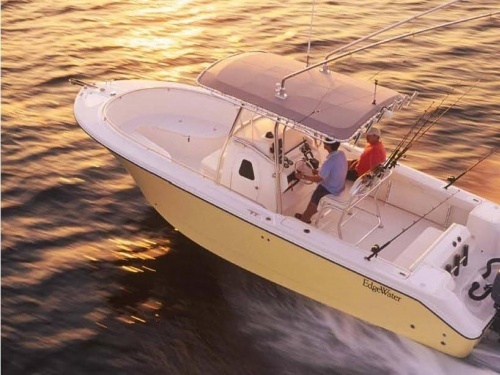
 The EdgeWater 230CC has a slightly bow-high running attitude, as is proper.
With the 300-hp Yamaha 4-stroke turning an 18T 15 ¼ Saltwater Series 2 propeller and running up to 5700 rpm, we reached our top speed of 51.1 mph. Best cruise was reached at 3500 and 28.5 mph. It was at that speed that the 9 gph fuel burn translated into 3.2 mpg and a range of 314 statute miles, all while still holding back a 10-percent reserve of the 110-gallon (416 L) total fuel capacity.
 Note how the strakes on the EdgeWater 230CC knock down spray low on the hull to keep everyone dry on board.
Acceleration
With minimal bowrise, we accelerated to planing speed in 3.2 seconds, reached 20 mph in 5.7 seconds and 30 mph came and went in 9.4 seconds.
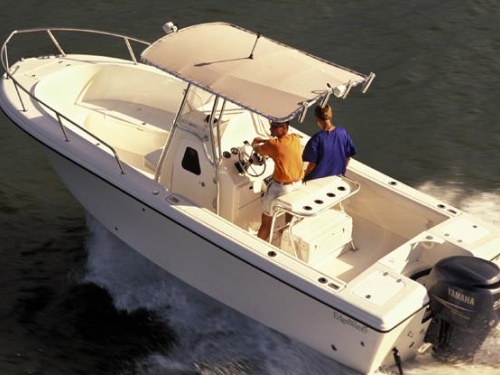
 The EdgeWater 230CC had a level running attitude as she accelerated.
Handling
With calm water we were left with crossing the wake of our camera boat and found that she transitions with no pounding and a smooth re-entry. Her chines carry all the way to the bow to form spray rails creating a dry ride. Hard turns showed just a touch of ventilation on the prop, even trimmed all the way down, and no chine walk. Overall, she’s a fun boat to drive and she seems to like being driven hard, and we feel she’d do very well offshore in reasonable conditions.
 On our test of the EdgeWater 230CC, we made our own excitement slicing through the camera boat’s wake, and she had a smooth re-entry and displayed no bad tendencies.
Noteworthy Standard Features
- • Single Piece Infusion (SPI) Structural System
- • Powder-coated leaning post, T-top frame, recessed bowrail, and grab rails
- • Forward walk-in console with fiberglass liner
- • Underwater blue LED lights
- • Dedicated stern anchor locker
Price
$120,000 base price with 250-hp Yamaha F250 4-stroke outboard.
Warranty
Transferrable Lifetime Limited Warranty
Observations
Astute observers will note that the EdgeWater is particularly well-designed, tooled, and finished. The builder has packed a lot of functionality into 23’ (7.01 m), but not at the expense of well-crafted details. Items such as its in-gunwale rod racks, integral T-top supports in the console, the bow casting platform system, carbon fiber poles for awnings, and stern platform treatment, among others, demonstrate EdgeWater’s attention to detail.
The company says that what “ultimately separates EdgeWater from Grady-White, Pursuit, Everglades, and Boston Whaler is our exclusive structural systems – Single Piece Infusion or SPI®. Weight is critical for superior hull performance and fuel economy, and SPI creates an incredibly strong, one-piece, unsinkable structure that can endure the most extreme stresses and adventures.”
We should add that this EdgeWater is one of only three brands that we know of that will put in writing that their boats will float level if swamped.
All of the above is costly, and EdgeWater shares that distinction with the other boats at the top of the center console pyramid.
The design shows signs of evolution, with next-generation features and versatility built into a hull that runs smoothly on her variable deadrise hull.
With a long list of standard features, the 230CC can be fitted out with upgrades that make sense for the way each owner will use the boat.
Test Video Summary
Overview
The EdgeWater 230CC is a family-friendly center console with plenty of fishing features. BoatTEST’s Captain tested her with a single Yamaha 300-hp four-stroke outboard. The test boat was hull number one, a prototype, so some changes were planned for production.
“It’s easy to say that this is a family-friendly boat and throw that out as a marketing term, but I’m here to tell you there’s an awful lot to like on this boat.”
Mission And Intended Owner
- Built To Do: Fishing, family outings and watersports
- Designed For: Families who also fish
- Locus Of Operation: Tested in calm water; The Captain believes she would be just as good offshore
Design Overview
- Chines: Carry all the way to the bow to form spray rails
- Engine Platform: In front of the outboard, for walking across and easy service
- Hardtop Supports: Set into the console so they don’t take space from the side decks
- Windshield: Framed at the sides and front instead of wrapping around, which avoids distortion
- Dedicated Storage: Every extra feature has its own dedicated storage space
“I like that better than having a wraparound windshield, because then you get distortion... So, well done there, EdgeWater.”
Specifications
- Length Overall: 24 feet, 6 inches
- Beam: 8 feet, 6 inches
- Draft: 15 inches
- Empty Weight: 3,900 pounds
- Fuel Capacity: 110 gallons
- Cockpit Depth: 25 inches
- Bolster Height: 21 inches rising to 27 inches
- Side Decks: 22 inches wide
- Swim Platforms: Each extends 3 feet, 3 inches from the transom
- Transom Door: 17 inches wide, with an 8-inch step down
- Cap Rail: 11 inches wide
- Stern Bench: 33 inches
- Cooler: 40 quarts
- Rod Holders: 17
- Head Headroom: 5 feet, 1 inch, and 3 feet, 11 inches over the porta potti
Test Conditions And Test Weight
- Sea State: Calm water
- Load: Half fuel and three people
- Test Weight: 5,347 pounds
Performance
- Tested Power: Yamaha 300-hp four-stroke turning an 18 x 15.25 Saltwater Series II propeller
- Top Speed: 51.1 mph at 5,700 rpm
- Best Cruise: 28.5 mph at 3,500 rpm, burning 9 gph
- Fuel Economy At Best Cruise: 3.2 mpg
- Range At Best Cruise: 314 statute miles, holding a 10% reserve
| RPM |
MPH |
GPH |
MPG |
Range (SM) |
| 3,500 |
28.5 |
9 |
3.2 |
314 |
| 5,700 |
51.1 |
— |
— |
— |
Acceleration:
- Time To Plane: 3.2 seconds, with minimal bow rise
- 0–20 mph: 5.7 seconds
- 0–30 mph: 9.4 seconds
Sea Trial And Handling
- Wakes: Crossing the camera boat’s wake, she transitioned with no bang and a smooth re-entry
- Spray: Dry ride, thanks to chines that form spray rails
- Turns: No chine walk
- Character: Fun to drive, and seems to like being driven hard
“Overall, it’s a fun boat to drive, it seems to like being driven hard. I’d really like to be able to get this offshore, as I feel she’d be just as good there.”
Engine Room Or Mechanical Compartment
- Bilge: Completely finished, visible through the transom storage
- Batteries: Under the step inside the console
- Electrical Panel: To starboard inside the console
- Installation Access: Easy access to the back of the console
- Engine Service: Platform in front of the outboard makes removing the cowling easy
- Cockpit Depth: 25 inches
- Overhead Height: 5 feet, 1 inch in the head
Features Inspection
The Helm
- Display: 12-inch multifunction display
- Engine Display: Yamaha
- Audio: Fusion stereo
- Electrical Panel: At the helm
- Storage: Padded space behind the dash
- Trim Tabs: Lenco, with LED indicators
- Controls: Yamaha engine controller
- Drink Holders: Two to the right, with USB between them
- Wheel: Stainless steel, with a steering knob, on a tilt base
- Footrest: Comfortable, with a recessed toe area
- Seats: Multiple foam densities, diamond stitching, custom embroidery, flip-down armrests and individual flip-down bolsters
- Production Changes: A leather brow will be added and rocker switches will be replaced with push-button switches
- Hardtop:
- Outrigger supports
- Three-color LED lighting
- Electronics box with the VHF
- Life jacket storage
- Speakers aft
- LED light rail on the sides
- Grab handles all the way around
“I’d like to see the compass in front of the helm.”
“A little bit of a raised edge here would be a little bit better to keep things in place.”
“The ignition is just underneath, right in the knee-strike zone, I could think of a better position for that.”
Anchor Locker And Ground Tackle
- Anchor Locker: Concealed, under a hatch fully forward
- Anchor Keepers: At the back of the locker
- Cleat: For securing the rode
- Rode Notch: Fully forward, for the rode to run through
- Windlass: Optional
- Stern Anchor Locker: On the port side of the transom
- Cleats: Three 6.5-inch pull-up cleats on each side
Boarding Amenities
- Swim Platforms: Two
- Boarding Ladder: Three-step, concealed under a starboard hatch
- Transom Door: Starboard side
- Cap Rail Boarding: Wide enough to step in without using the gate
- Ski Tow Pylon: Retractable, centered on the transom, raising the tow line 22 inches above the cap rail to clear the engine
Cockpit Arrangement And Equipment
- Rod Holders: Four across the transom, two in each cap rail, five on the hardtop and four at the bow
- Livewell: To port, under a snap-down cushion
- Stern Casting Platform: With hatches closed, the non-skid covers form an elevated platform
- Horizontal Rod Storage: Four rods under the starboard gunwale, plus one more to port for a boat hook or gaff
- Washdown: Raw water, to port
- Stern Bench: 33 inches, with a seatback that uses the wraparound padded bolsters
- Cooler: 40 quarts, on a slide, with a lift-and-lock latch that locks when pushed back
- USB: On the port bulkhead
- Leaning Post: Well supported, with a grab handle usable seated or standing
- Fire Extinguishers: On both sides
- Rails: Grab handle on the side of the console and a powder-coated rail inside the cap rail
Bow Arrangement
- Seating: Wraparound, with a padded bolster and a forward-facing console seat
- Drink Holders: Oversized, for bigger cups
- Table: Standard, injection-molded, with drink holders and SeaDek matting, lowering to form a sun pad
- Sunshades: Carbon fiber poles for a bow sunshade, plus one for the stern
- Casting Platform: Elevated, fully forward
- Storage: Insulated, self-draining storage under both seats that doubles as fish boxes
“There’s a standard bow table, which was surprising as they’re usually optional.”
Interior Spaces
Head Compartment:
- Toilet: Standard porta potti with pump-out
- Headroom: 5 feet, 1 inch, and 3 feet, 11 inches over the porta potti
- Side Panels: Open on both sides for dive tank or fender storage
- Dedicated Storage: Table pedestal, table and shade, with lids that drop into place when items are removed
- More Storage: On the port bulkhead and under the seat
“I really like that all the extra features on this boat have dedicated storage spaces.”
Advantages And Disadvantages
Advantages
- Over 50 mph top speed
- 3.2 mpg and a 314-mile range at best cruise
- Planes in 3.2 seconds with minimal bow rise
- Smooth re-entry and a dry ride, with no chine walk
- 17 rod holders and elevated casting platforms fore and aft
- Standard bow table, an item usually optional
- Retractable ski tow pylon and long swim platforms
- Framed windshield with no distortion
- Dedicated storage for every accessory
- Well-built seats with multiple foam densities
Disadvantages
- Compass is not in front of the helm
- No raised edge on the padded dash storage
- Ignition is in the knee-strike zone
- Tested only in calm water
- Windlass is optional
- Head has a porta potti