Access More Boat Tests
Already have an account? Login
EdgeWater 250CC (2026-)

Test Results
| RPM | MPH | Knots | GPH | MPG | NMPG | SM | NM | dBa |
|---|---|---|---|---|---|---|---|---|
| 650 | 3 | 2.6 | 0.9 | 3.3 | 2.9 | 466.7 | 405.5 | 69 |
| 1000 | 5.2 | 4.5 | 1.7 | 3 | 2.6 | 424.1 | 368.6 | 70 |
| 1500 | 7 | 6 | 2.8 | 2.5 | 2.2 | 347.5 | 302 | 72 |
| 2000 | 8.7 | 7.6 | 4.5 | 2 | 1.7 | 273.7 | 237.9 | 74 |
| 2500 | 11.2 | 9.7 | 6.7 | 1.7 | 1.5 | 234 | 203.4 | 77 |
| 3000 | 18.2 | 15.8 | 9.1 | 2 | 1.7 | 281.5 | 244.7 | 82 |
| 3500 | 25.5 | 22.1 | 11.6 | 2.2 | 1.9 | 308.5 | 268.1 | 85 |
| 4000 | 30.8 | 26.7 | 14.9 | 2.1 | 1.8 | 289.9 | 251.9 | 84 |
| 4500 | 35.6 | 30.9 | 20.2 | 1.8 | 1.5 | 246.4 | 214.1 | 88 |
| 5000 | 41.5 | 36 | 27.4 | 1.5 | 1.3 | 212.2 | 184.4 | 91 |
| 5500 | 46.5 | 40.4 | 36.2 | 1.3 | 1.1 | 179.9 | 156.3 | 93 |
| 5900 | 49.2 | 42.7 | 40.2 | 1.2 | 1.1 | 171.4 | 148.9 | 94 |

Specifications
| Length Overall |
26' 3" 8.0 m |
|---|---|
| Beam |
8' 6" 2.6 m |
| Dry Weight |
6,000 lbs 2,722 kg |
| Deadrise/Transom | 20° |
| Bridge Clearance |
10' 3" / 3.12 m (with radar) 8' 10" / 2.69 m (without radar) |
| Fuel Capacity |
140 gal 530 L |
| Water Capacity |
19 gal 72 L |
Acceleration Times & Conditions
| 0 to 30 | 8.7 |
|---|---|
| Load | Persons & Gear: 600 lbs/272 kg; Fuel on board: 497 lbs/225 kg; Total Load on board: 1,097 lbs/498 kg |
| Climate | 89°F; 70% humidity; wave: 2'; salt |
Engine Options
| Tested Engine |
2 x 200-hp Yamaha |
|---|
DNA Runs Deep
Captain's Report Edgewater 250 CC
by Capt. Ken Kreisler
The new Edgewater 250 CC continues the long legacy of the multi-functional model lineup of center console boats from an inventive, and competitive, U.S.-based company.

Major Features
- Single Piece Infusion (SPI) technology w/closed cell, infused hull
- Lifetime structural warranty
- 28-gal transom baitwell
- Dive door
- Raw/Fresh water washdown
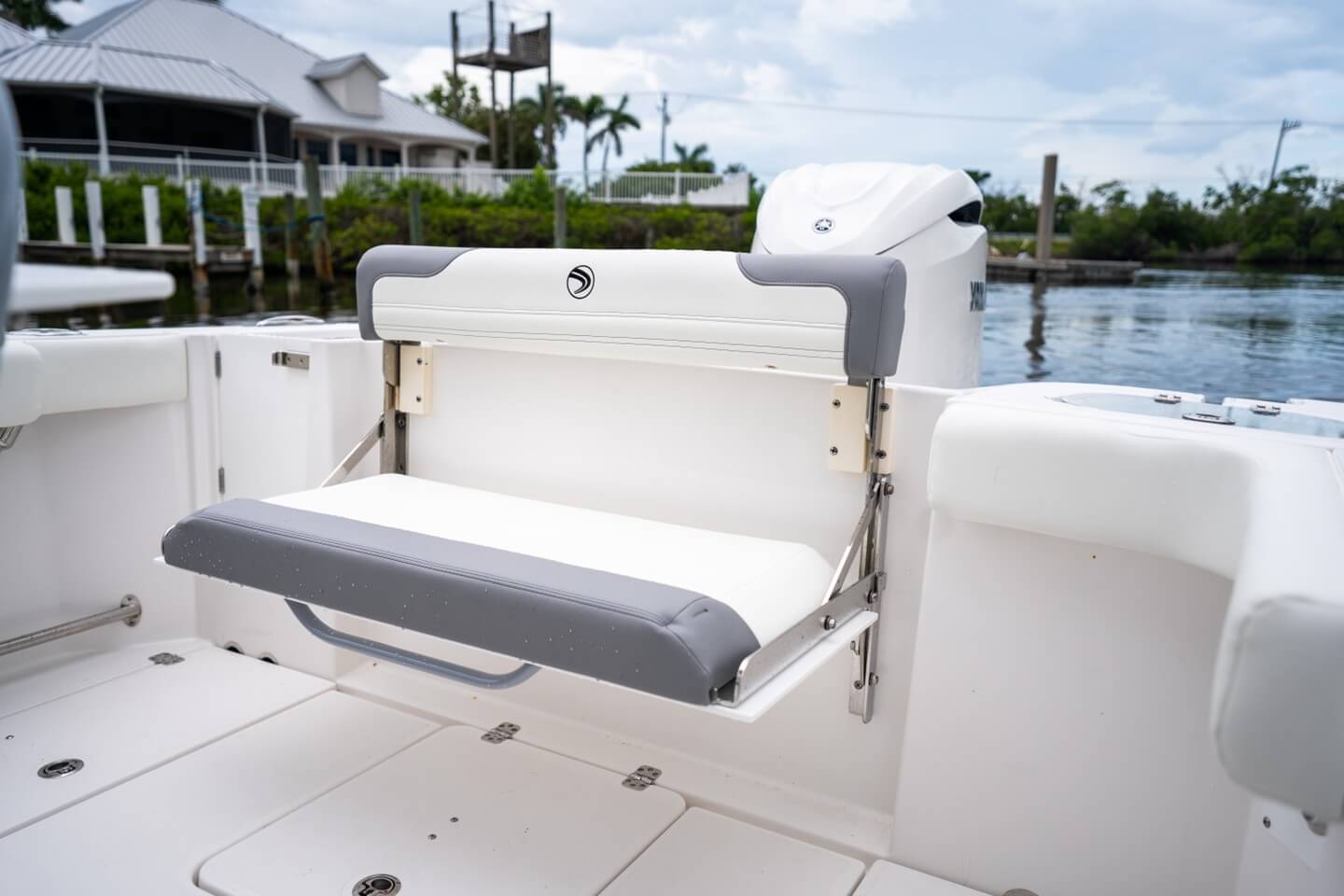
- Pull-out cockpit stern seating
- Two in-deck fish boxes w/macerators
- In-deck rod storage
- Yamaha DES Steering W/Tilt Helm
- Single Yamaha F350XSA2 30″ Integrated DES, Yamaha White
- Windlass w/200’ rode and 15’ chain
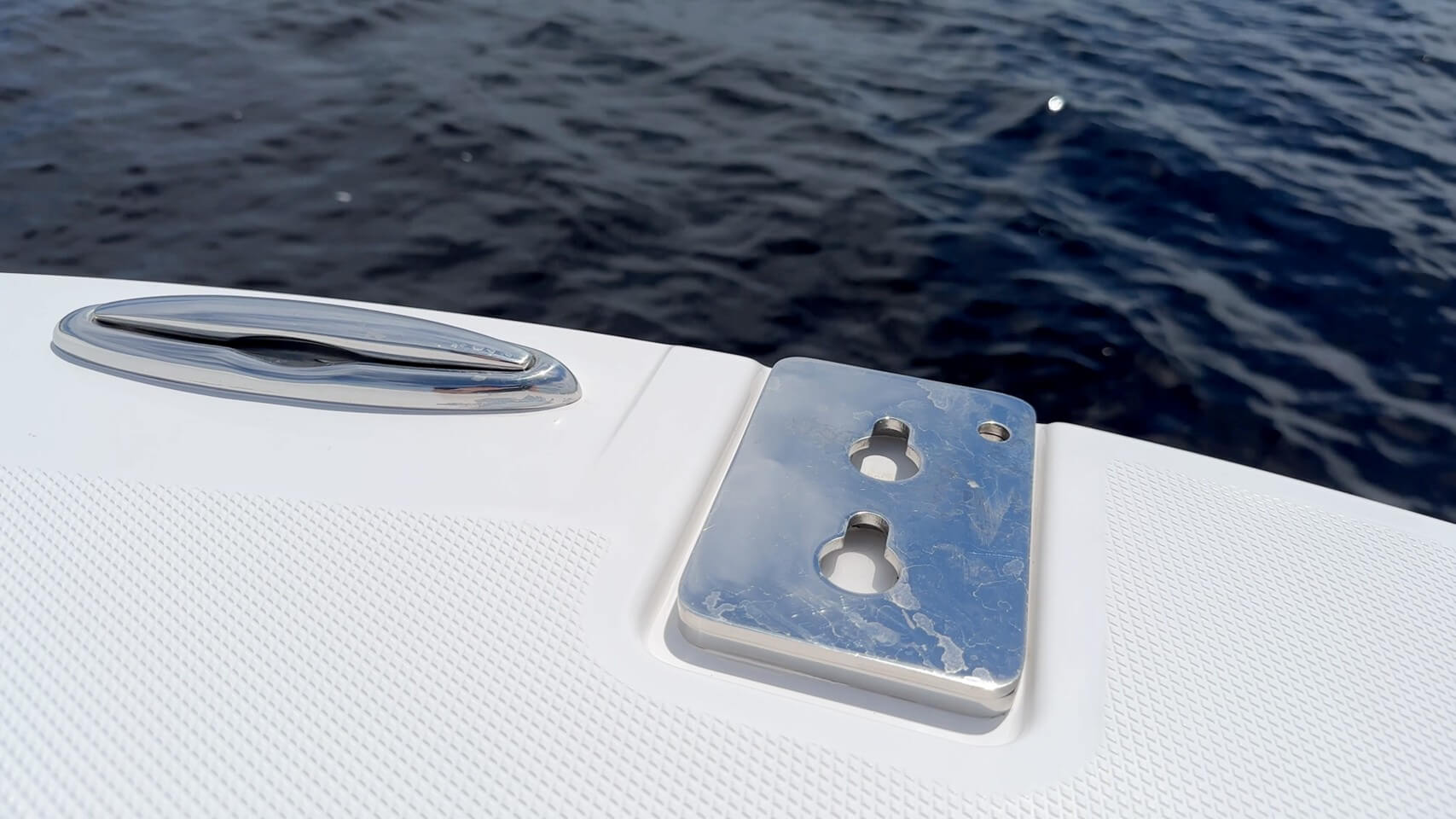
- SS Anchor Roller w/8″ cleat integrated into hull, 22 lb stainless anchor, stainless anchor chafe plate
- SeaKeeper Ride System
Notable Options
- Hull colors including pewter, Midnight Blue, Stars & Stripes Blue, St. Barth’s Blue, Marlin Blue, Seafoam Green, Ice Blue, all w/white bottom
- Single Yamaha F350XSA2 30″ Full Maneuverability (Joystick + Autopilot), Yamaha White, Dual Yamaha F200XSA2 Full Maneuverability (Joystick + Autopilot), Yamaha White, or Dual Yamaha F200XSA2 DES, Yamaha White
- Dual Garmin 8612 w/ B75M 20* Transducer, VHF 215 w/Antenna Remote Mic, Garmin 8612 w/ B75M 20* Transducer, VHF 215 w/Antenna Remote Mic, Garmin 9219 Wide Screen w/ B75M 20* Transducer, VHF 215 TD50 Touch Screen Pad w/Antenna, Remote Mic. GXM54 Sirius/XM/Weather
- Reverso Outboard Flush Single Engine, Reverso Outboard Flush Twin Engine
- Aft and Forward Shade System
- Outriggers, Taco 15′ Silver Radial
- Profish 1000 Anchor Windlass w/Anchor, Roller/Chute and Forward Controls
- Powder Coated Black or Grey Leaning Post, ICON 50 Cooler w/Slide
- Stereo Premium White Fusion Apollo 770, W/JL Speakers M6-650(6), LED Subwoofer M6-10(1) , AMP(1), Dive Door Remote
Boat Inspection
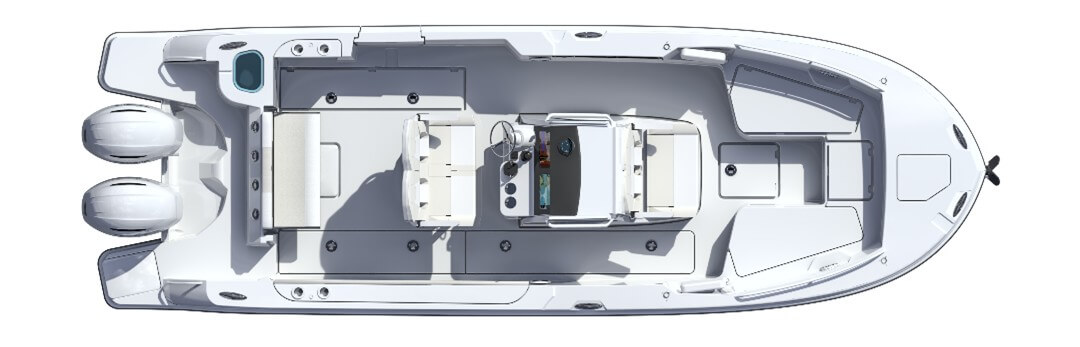
Bow
Helm


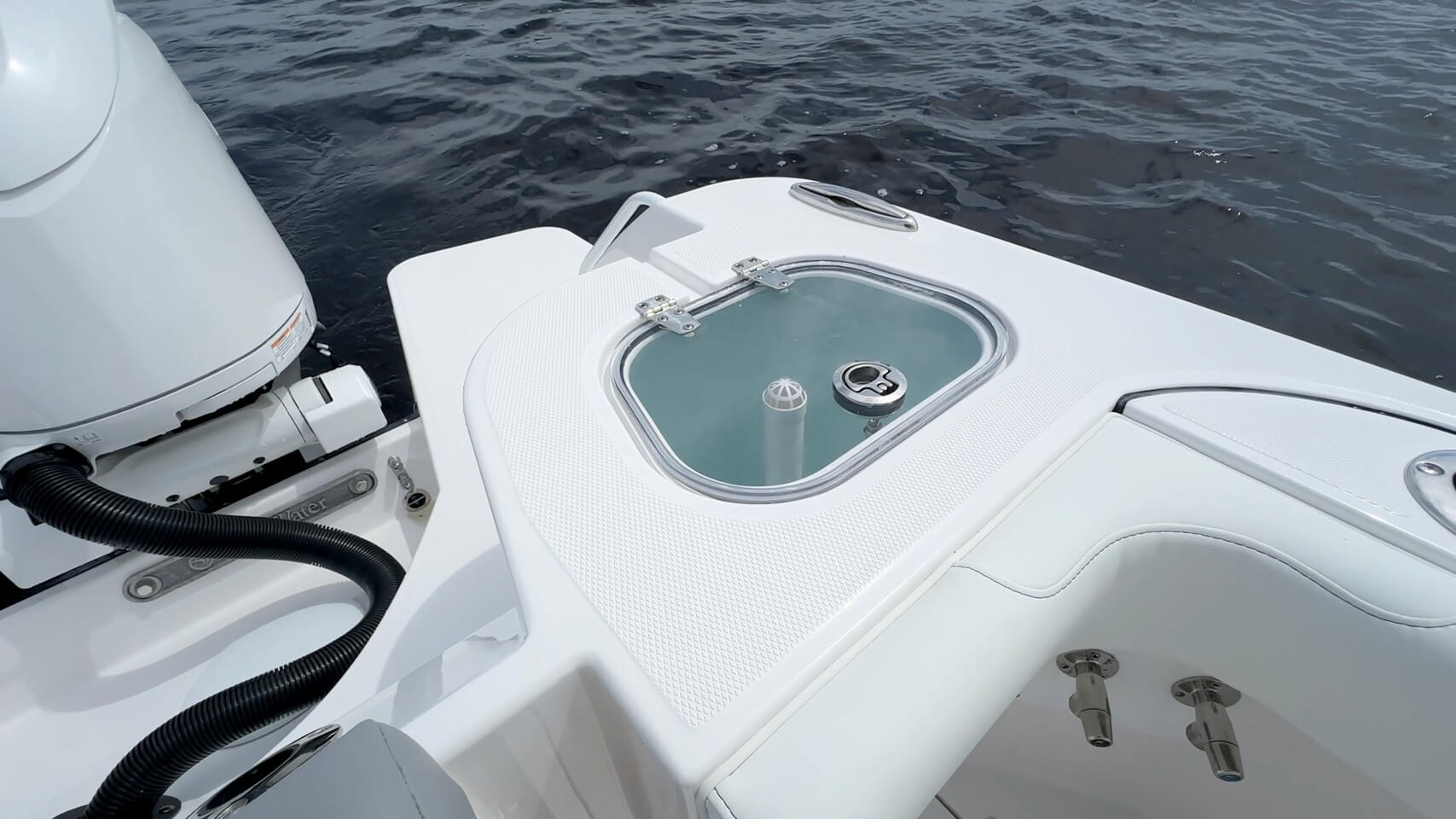
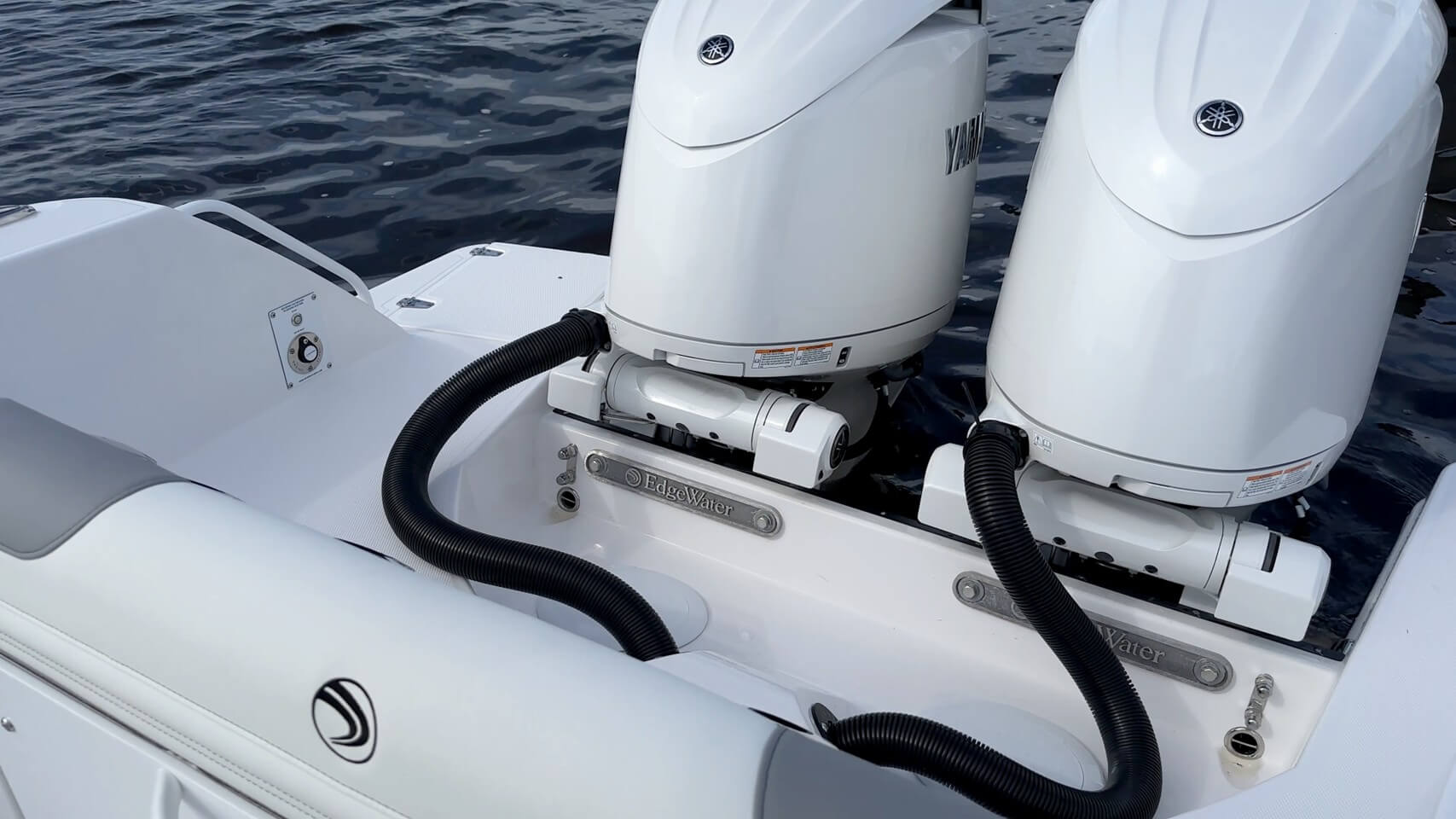
Cockpit & Transom
A Word About Performance
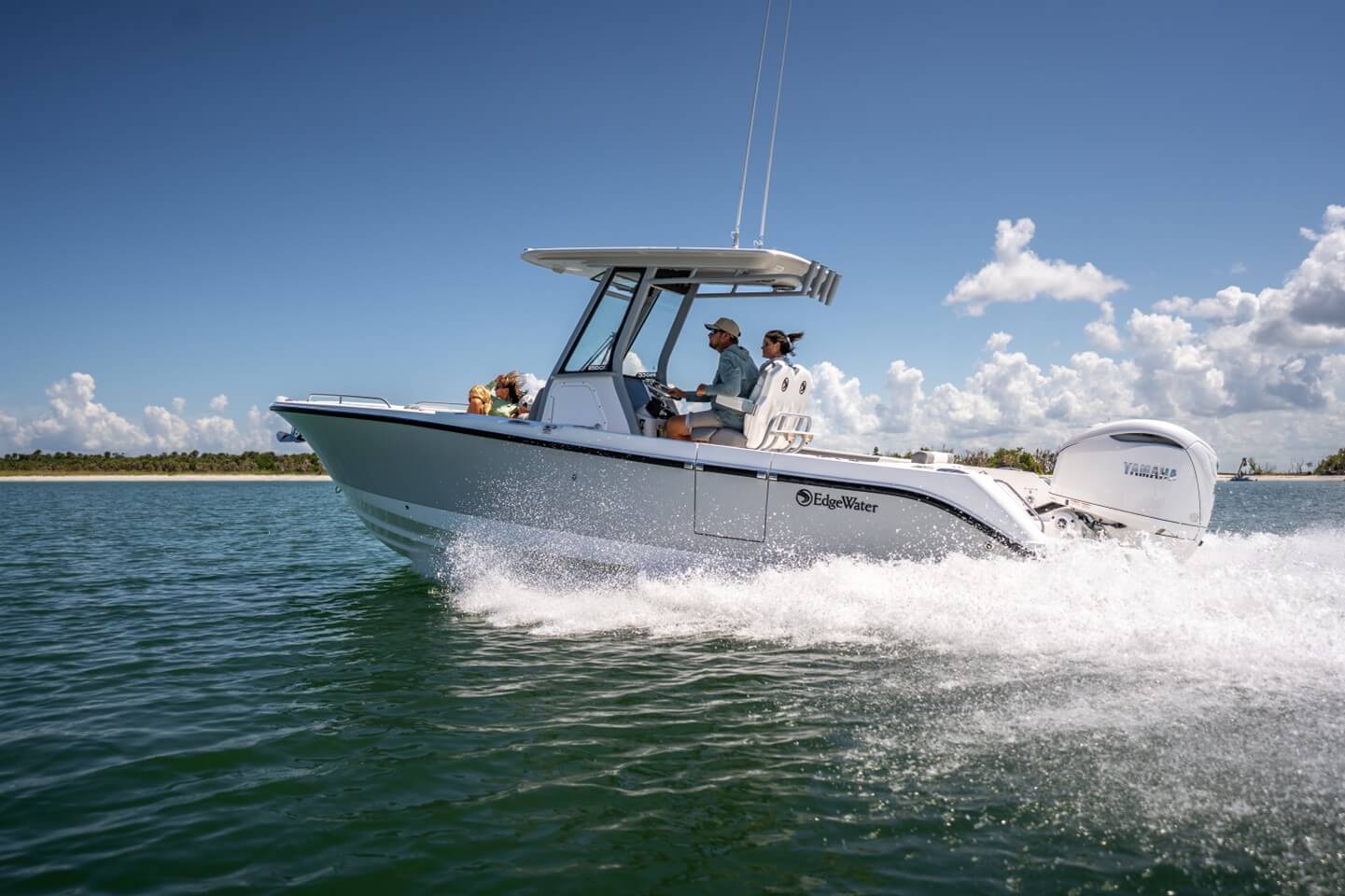
Our test day saw the air temp at 89° with relative humidity at 70% and the seas running at about two feet with a 10 knot wind. We were outfitted with a pair of 200-hp Yamaha outboards. The boat came in with an approximate weight of 7,100 lbs and half a tank of the 140 gallon capacity. There were two people on board and the motors were equipped with a pair of Reliance SES 14.25 x 18 pitch props.
At 5900 rpm, our top speed was recorded as 49.2 mph and at 3500 rpm, our best cruise, at 3500 rpm, came in at 25.5 mph. At that rate of speed, our range came in at 308.5 statute miles with a 10% fuel reserve.
With the choppy conditions seen on test day, we were able to notice how our Edgewater 250 CC handled the sea. Her deep-V hull was quite stable and we experienced little or no slapping. Solid underway, the single-piece construction lived up to its reputation on tight turns, head-on seas, and straight runs with no shakes or rattles.
Observations
The new Edgewater 250CC easily fulfills its prime directive as a serious, offshore fishing boat, equally at ease whether plying deep waters or near coastal excursions. In addition, with the kind of amenities and luxurious touches, she is also quite the appropriate platform for family outings. And with her 8’6” beam, she is road-legal for trailering.
With her hallmark single Piece Infusion (SPI), this to ensure a solid, safe, and robust hull, a lifetime structural warranty, a comprehensive list of standard and optional equipment, and a choice of single or dual Yamaha outboard power, the Edgewater 250 CC will provide the kind of excitement for all aboard this premier builder is known for.
Remember, life is better on a boat!
Performance Test & Features Transcript
Overview
Captain Katri's introduction: "This boat is designed primarily for offshore fishing, but it also has a lot of elegant and luxurious touches on board that make this more of a premium boat that can be enjoyed by families as well." She cited Edgewater's own customer research: "Edgewater actually surveyed their customers, and they found out that about 50% of the time, or maybe a little more than that, people actually go to the sandbar, but they want a boat they can also fish. And that's what this thing does."
Factory Tour — Single-Piece Infusion Construction
At the Edgewater factory, the crew observed a 25-footer nearing completion, about to go to QC. The reviewer noted: "We're watching the vacuum infused process of this hull, and we can see how the stringers and the hull are all done at once, and this is what makes the boats so rigid." She added: "That's something that you can't see when you're at a boat show or you're on the water. Granted, you could feel it when you're underway in some rough stuff, but being able to see it in action really says, okay, this is what's gonna make this Edgewater boat so sturdy."
Fiberglass materials: Different labeled materials are used throughout, corresponding to different resin flow rates required for complete saturation. Reviewer's stated rationale: "Each piece needs to be flowing through the right rates so that they all get saturated completely. That's gonna give you that optimum strength that you're looking for."
Deck construction (25 model, deck mold observed):
- No wood used in construction
- Foam core used instead — reviewer noted this as preferable to wood core specifically due to water intrusion risk: "This is a boat after all, and water does find its way into those type places."
- Insulation at compartment fronts is fairly thick — sufficient, per the reviewer, for these compartments to function efficiently as coolers if used that way
- Additional insulation noted at the livewell, intended to keep bait cool and alive
Fishing Features
Livewell: Pressurized, with insulation confirmed by the factory visit.
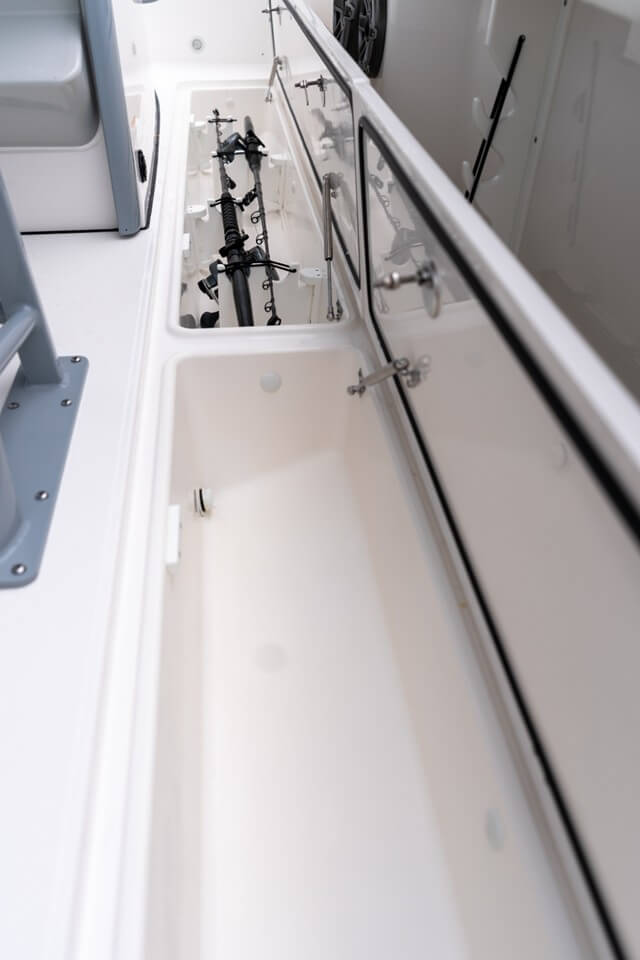
Side tuna door: Allows bringing large fish aboard directly into the insulated fish box below, which includes a macerator pump.
Unsinkable/foam-filled construction: The reviewer noted a typical tradeoff and how Edgewater addressed it: "A lot of times with the foam-filled boats you don't get the storage in the deck. Well, Edgewater made sure that that's an option. That's why you have these insulated fish boxes."
Rod storage:
- Four rod holders along the transom
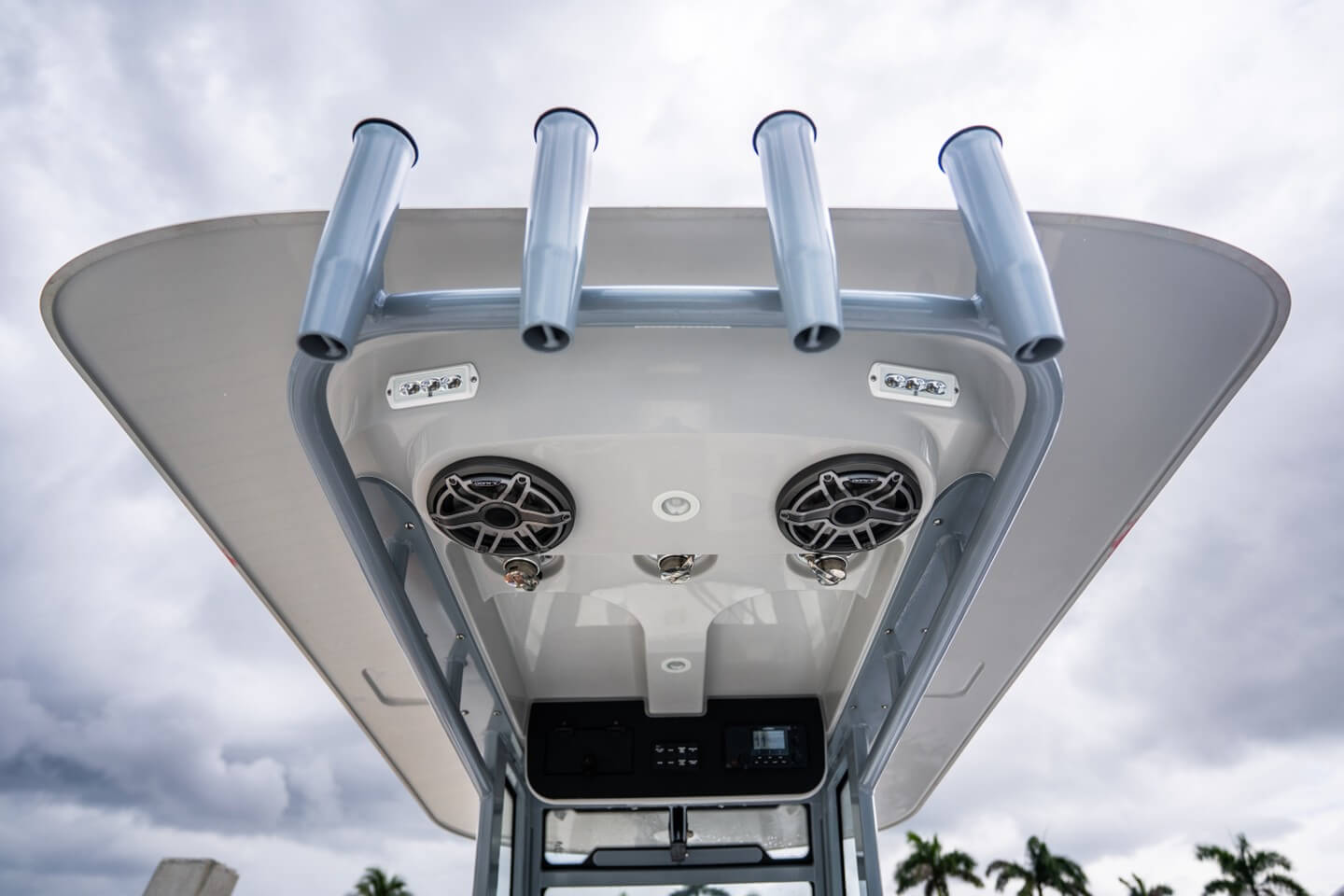
- Four additional rod holders at the top of the hardtop
- Cup holder/rod holder combos distributed around the boat
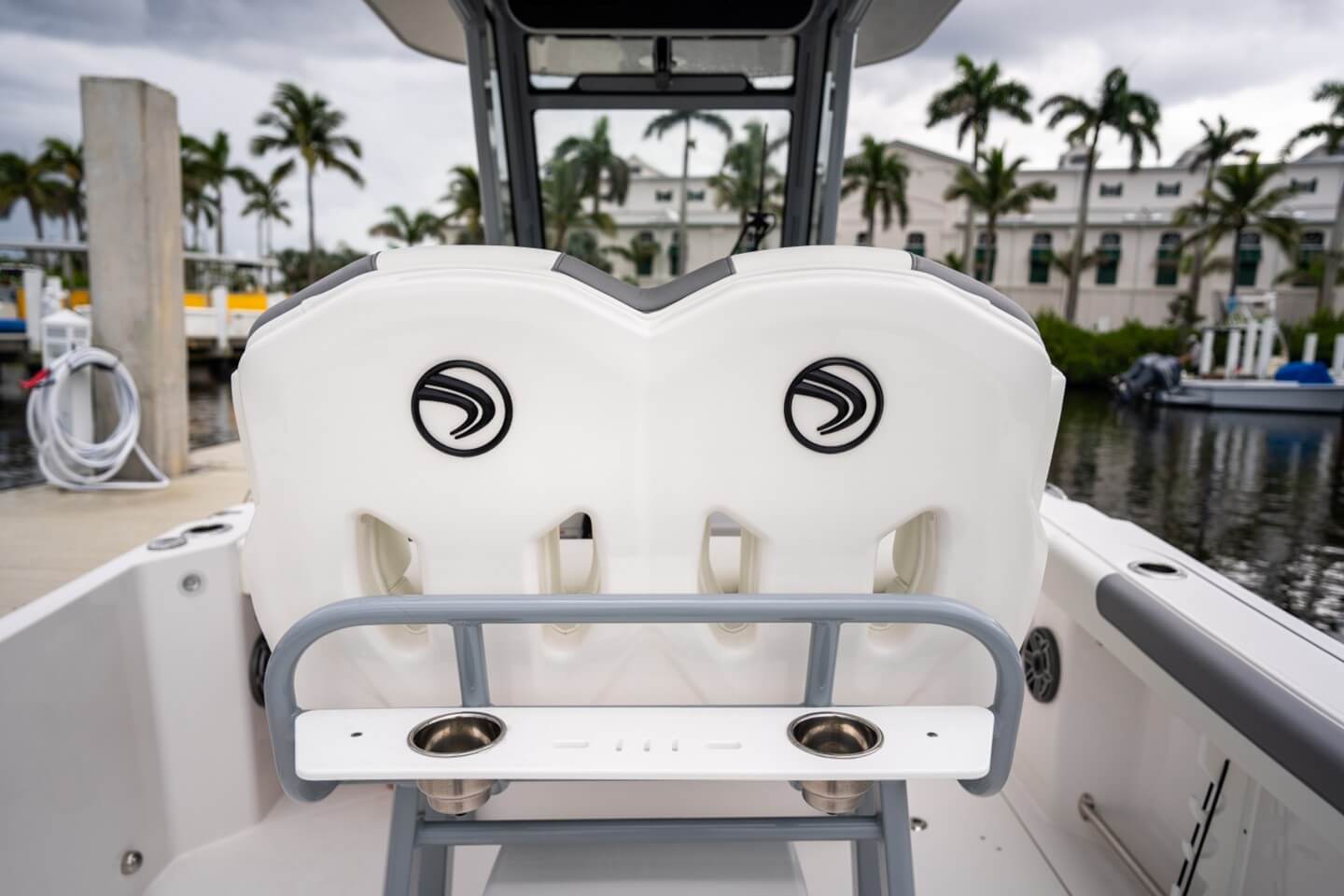
Helm-area fishing details: A substantial grab rail behind the helm seats, two additional cup holders, and cutouts for knives and pliers along the starboard side.
Gunwale: Tow rails, rod storage, and combing padding along the side of the boat.
Outrigger provisions: Mounting locations built into the hardtop for anglers wanting to add outriggers.
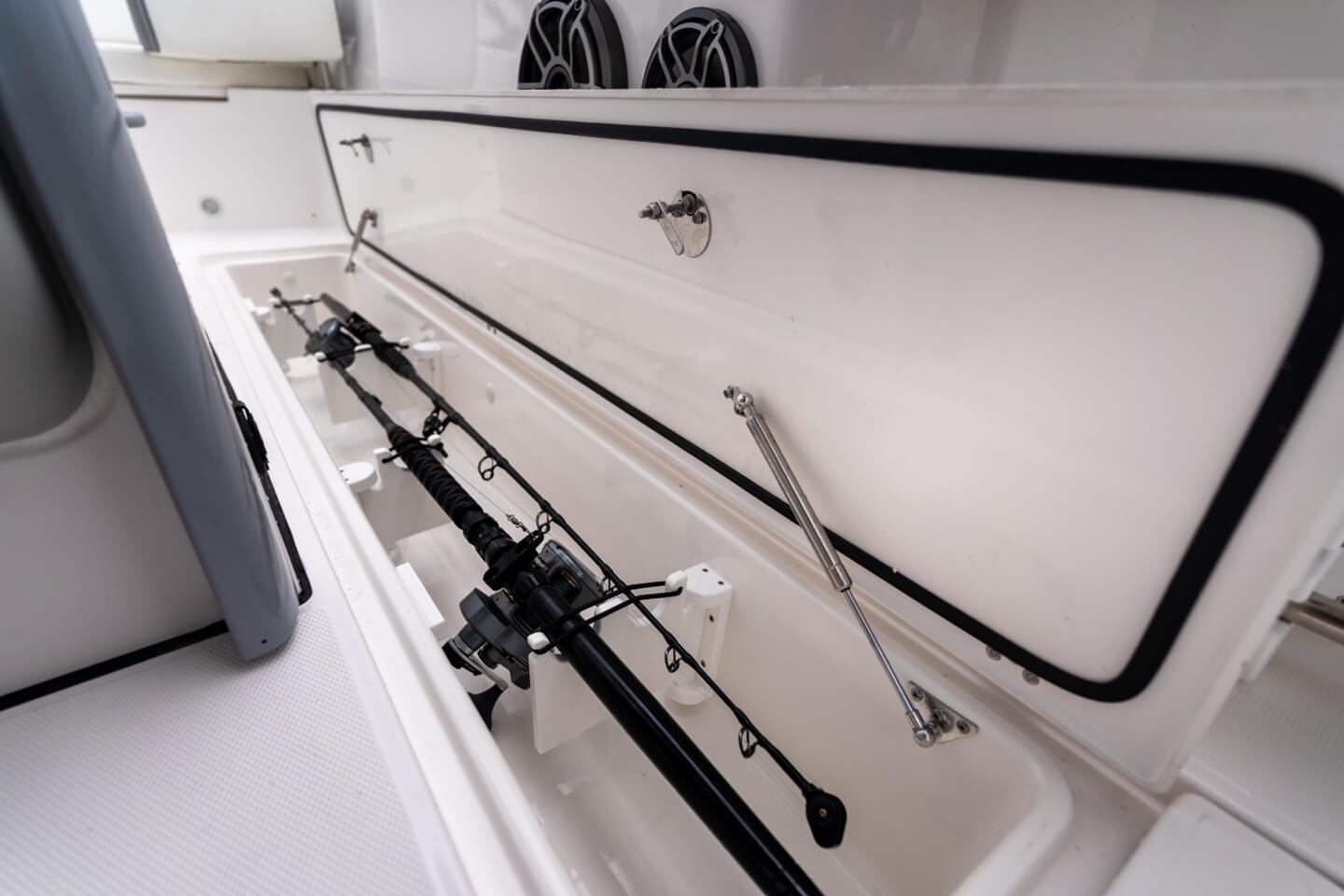
Under-deck rod storage (starboard): Lockable compartment, sized to fit two good-size rods in mounted brackets, or usable as general under-deck storage if rods aren't stored there.
Additional bow storage: A dedicated compartment identified as an ideal spot for a battery, should the owner wish to install a bow-mounted trolling motor.
Hatch construction note: The reviewer connected the deck hatches directly back to the factory tour: "Going through these deck hatches reminds me of the single-piece infusion construction method that they use that we saw in the factory this morning, and I can feel it [in] how solid it makes the boat as I walk around."
Warranty: Edgewater offers a lifetime warranty on all hulls in the center console market.
Luxury / Comfort Features (Bow)
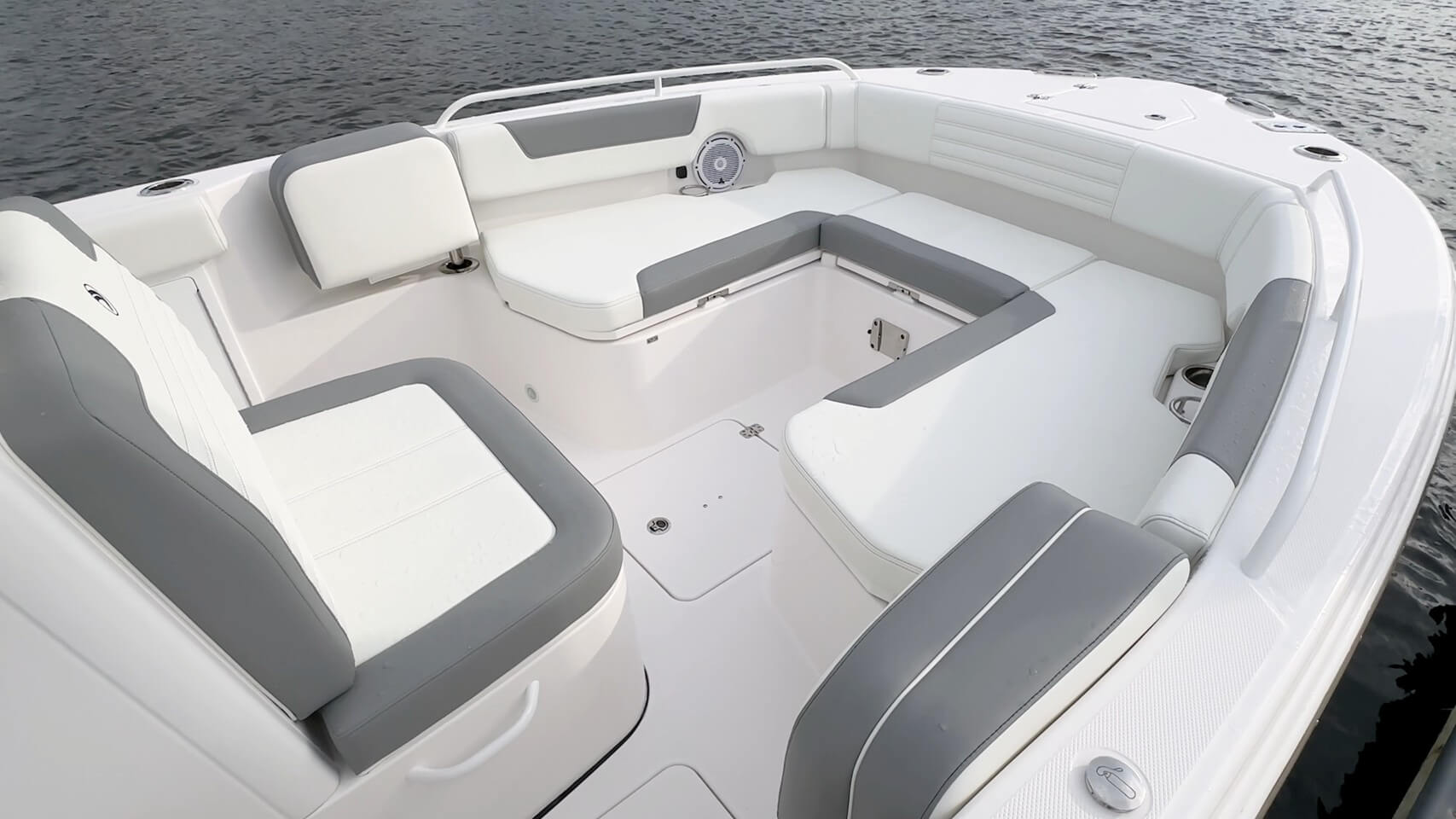
Bow seating: Wraparound U-shaped seating with padded backrest running the full perimeter. A flip-into-place backrest allows forward-facing seating while underway, at both this seating area and the seat just forward of the console.
Additional bow features: JL Audio speakers, cup holders, USB chargers, and handrails — the latter noted by the reviewer as important for ABYC compliance, which this boat meets.
Table: Secures into a bracket to create a dining area.
Storage / latch hardware: Storage is provided beneath the bow seats. The reviewer specifically praised the latch design: "It's a simple push button on the outside. It's not a paddle latch. You don't have to go up under the cushion. I think it's the cleanest way that I've seen this done so far, and I really like 'em."
Compartment finish: Insulated (confirmed at the factory), with finished hatch undersides — noted by the reviewer as "a sign of premium boats" — plus stainless steel gas struts and an interior light.
Bow (Ground Tackle and Access)
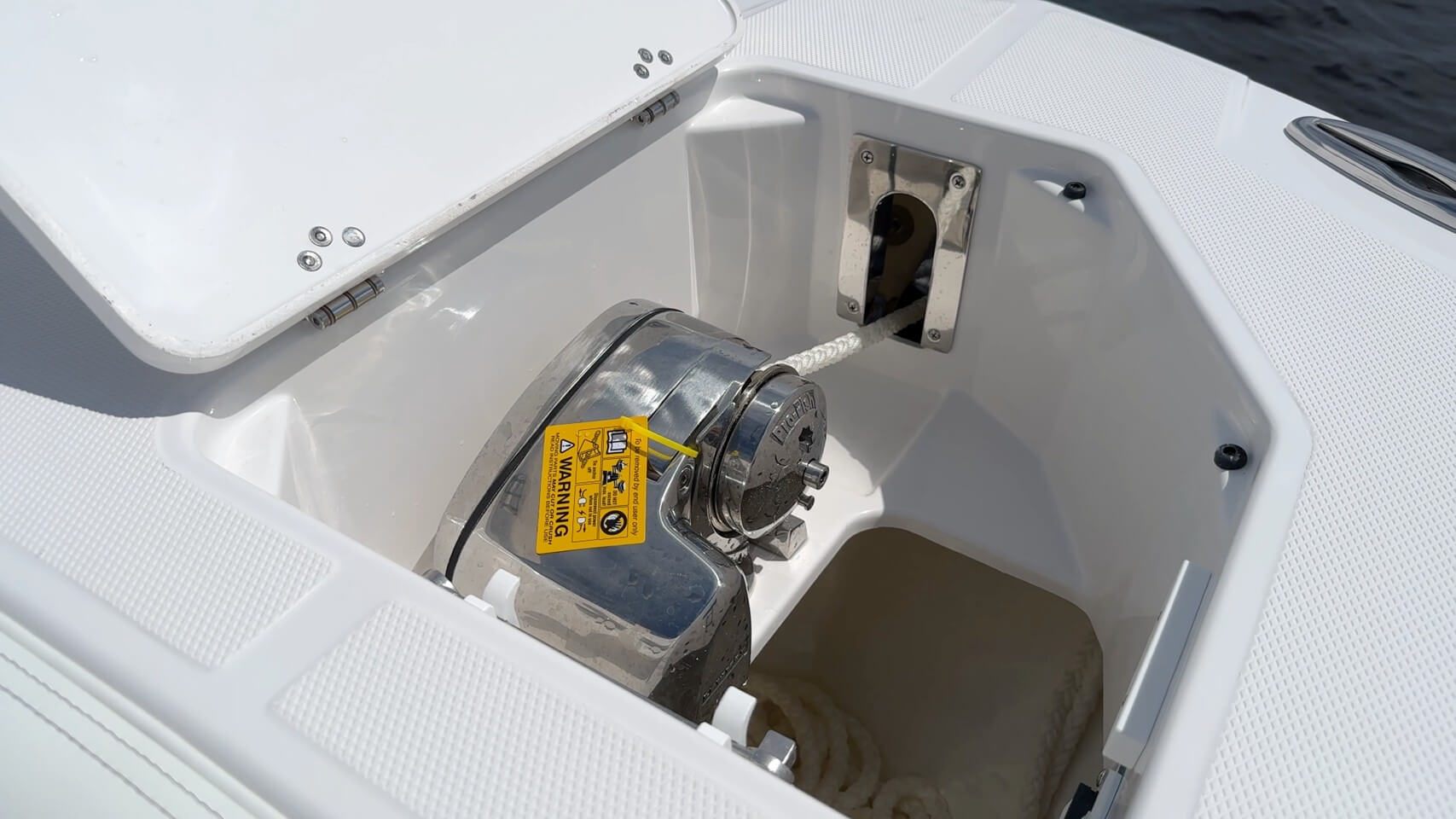
Anchor locker: Complete with an electric Lewmar windlass and ample room for the rode; deployed at time of filming while anchored in New Smyrna Beach.
Swim ladder mounting bracket: Fitted at the bow, allowing beach access.
Additional bow hardware: Two cup holders (fitted with rod holders) and two pop-up cleats.
Side Deck / Beam
Walkway width: Approximately 19 inches between the bolster and console — described by the reviewer as plenty of room to move around. A swim ladder is neatly concealed just under this area.
Gunwale note: The reviewer observed the gunwale narrows further aft and credited the construction method for allowing this without compromising strength: "Edgewater doesn't have to compromise the design in order to maintain the strength and integrity in their hulls. That's because of that single-piece infusion construction method."
Beam: 8 feet, 6 inches. The reviewer noted the significance of this figure: "That means that you can legally trailer it in any state. Some boats of this size range, they're actually a little bit over that because they're trying to get as much interior volume as they can. So remember, you're getting interior volume without sacrificing strength."
Center Console / Hardtop Construction
The reviewer praised the integration of the hardtop frame into the console structure, powder-coated and contoured to match the hardtop for a clean look. Grab rails continue around the full perimeter.
Standard audio: Two JL Audio speakers (premium package available, adding more speakers and a subwoofer).
Lighting: LED overhead lights for working light below deck, plus floodlights on the back of the hardtop and one on the front.
Retractable antenna mounts: Anchor light and VHF antenna spin to raise/lower — allowing quick lowering for low-bridge clearance without manual disassembly.
Additional console features: VHF radio push-button controls, and an electric vent for additional airflow underway.
Finish options (test boat): Color-matched underside of the hardtop and dash — gray and black on this unit. The dash material is non-reflective. Windshield tint was noted as high quality — the reviewer tested this with polarized sunglasses and found no splotchiness.
Helm Electronics
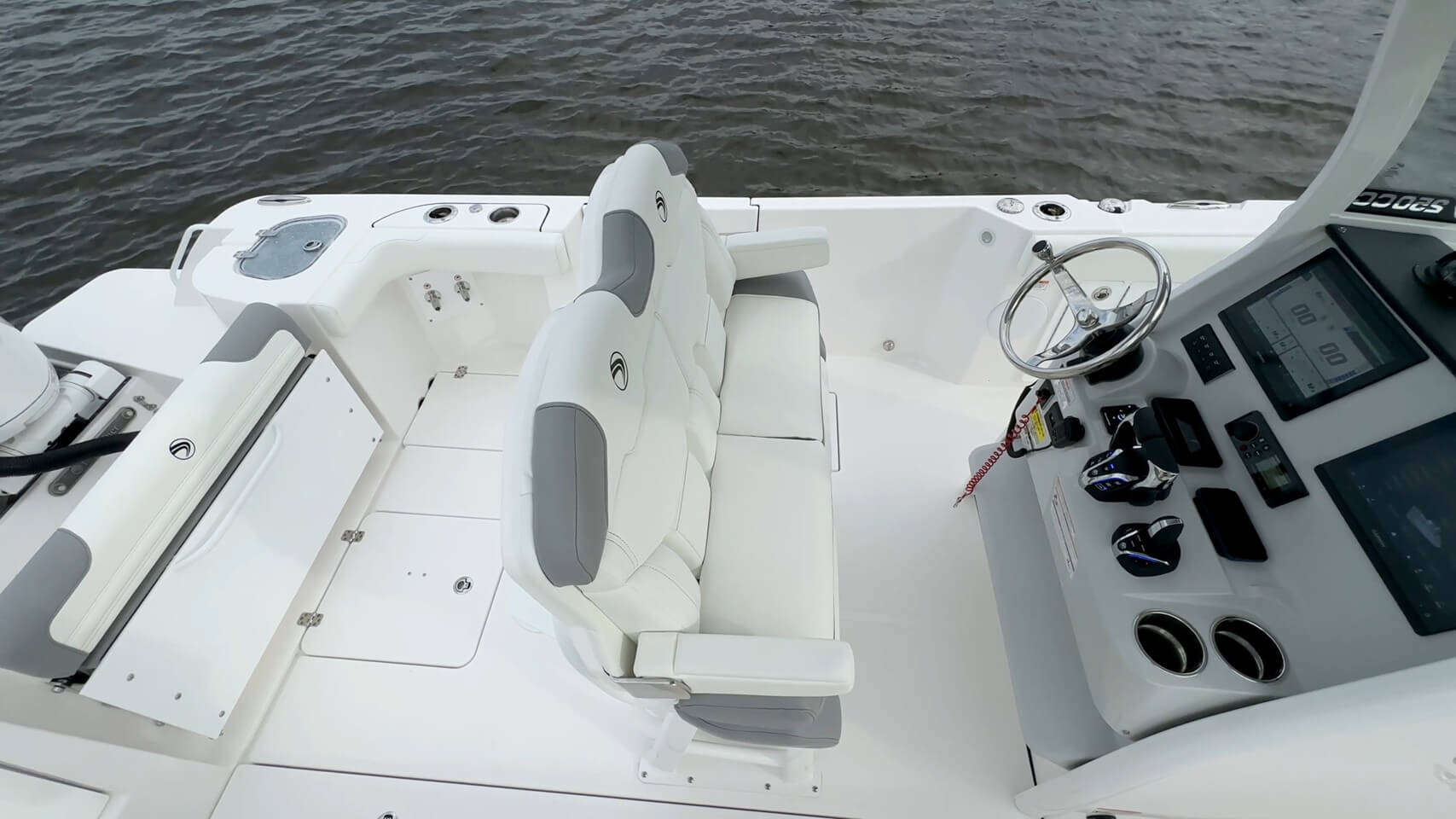
- Two 12-inch Garmin screens, with Garmin digital switching
- Fusion Audio unit with push-button controls
- Autopilot — noted by the reviewer as "extremely handy for some long runs"
- Two wireless Scanstrut phone chargers
- Seakeeper Ride system controls
- Joystick and throttles
- Steering wheel on a tilt base, fitted with a turning knob for quick docking maneuvers
- VHF mic, positioned within easy reach just under the wheel
- Engine start/stop buttons
Helm Seating
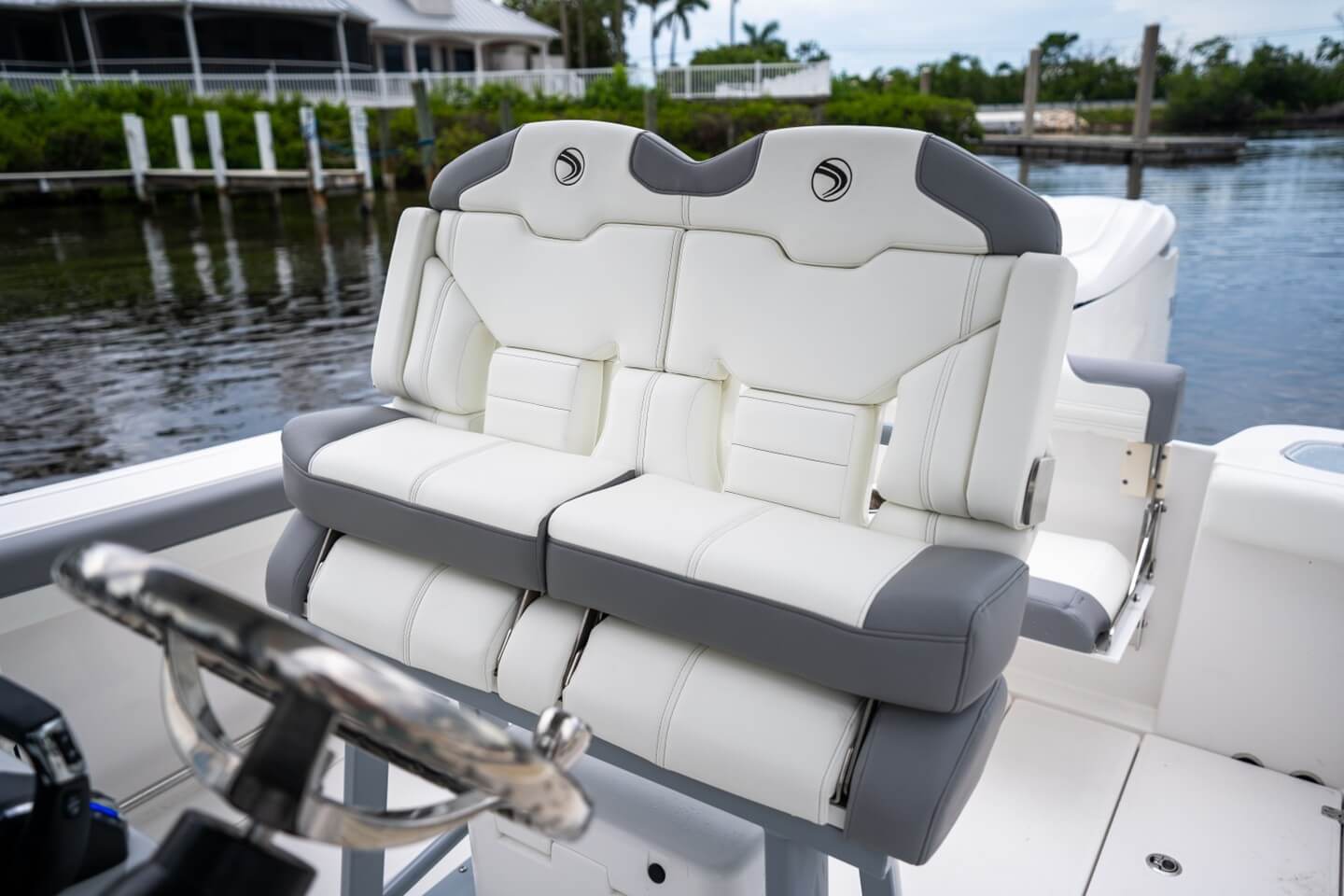
Width: 35 inches (double-wide). Both seats include bolsters for elevated viewing or standing while underway. Backrests are vented for airflow in hot conditions.
Storage: A cooler is standard, located under the seat armrest, for keeping beverages cold.
Head Compartment
The reviewer noted a well-placed grab rail useful both when moving forward and when descending into the head. Space is compact but includes elbow room, overhead room, a light, and extra storage.
Electrical System
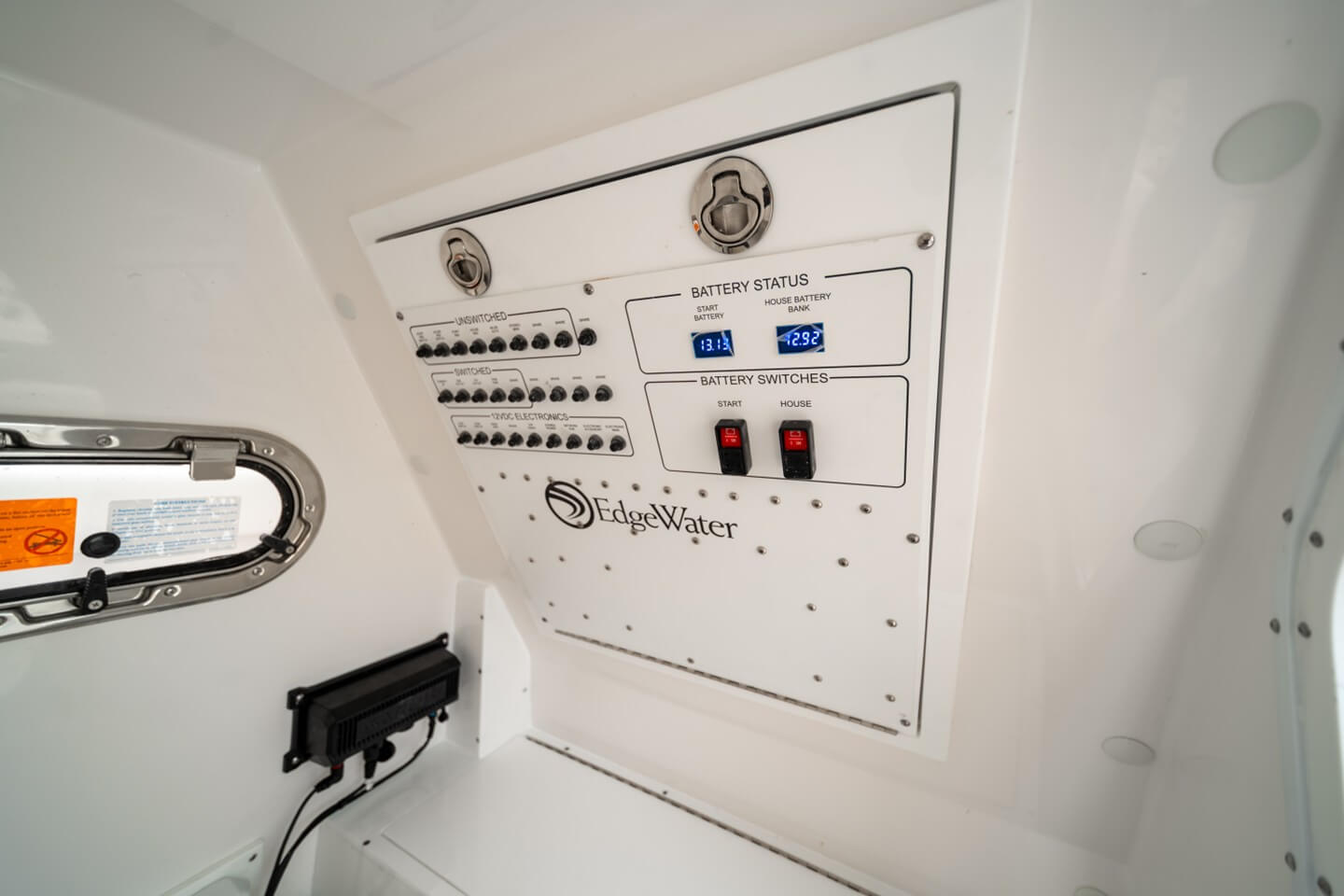
Panel: Fuses, battery switches, and battery status readouts are visible and organized.
Behind-panel access: The reviewer specifically highlighted the breaker area and corrosion-prevention treatment: "At first glance you may look and think, oh, look how dirty that is. Well no, that's not actually dirty. That is corrosion-preventative [coating]... So when that's there, you know someone has put the right touches on this electrical system to make sure it doesn't give out on you when you're in a harsh saltwater environment that's gonna protect it."
Additional electrical features: Access to two batteries, a triple-bank battery charger, and an opening port for ventilation. A magnetic catch holds the access door open so it doesn't swing/bang while in use.
Boarding / Transom Access
Swim ladder mounting (secondary location): Also installable at the side entry door bracket — the reviewer noted this as ideal for diving access, or as additional seating support when conditions are too rough to ride at the bow (a flip-down bench seat at the cockpit provides room for two to ride comfortably here).
Swim platform access: Through a 19-inch-wide opening at the transom door. Includes a freshwater shower/rinse and freshwater fill.
Engine flushing: Reverso freshwater engine flush system, intended to ease saltwater flushing at day's end.
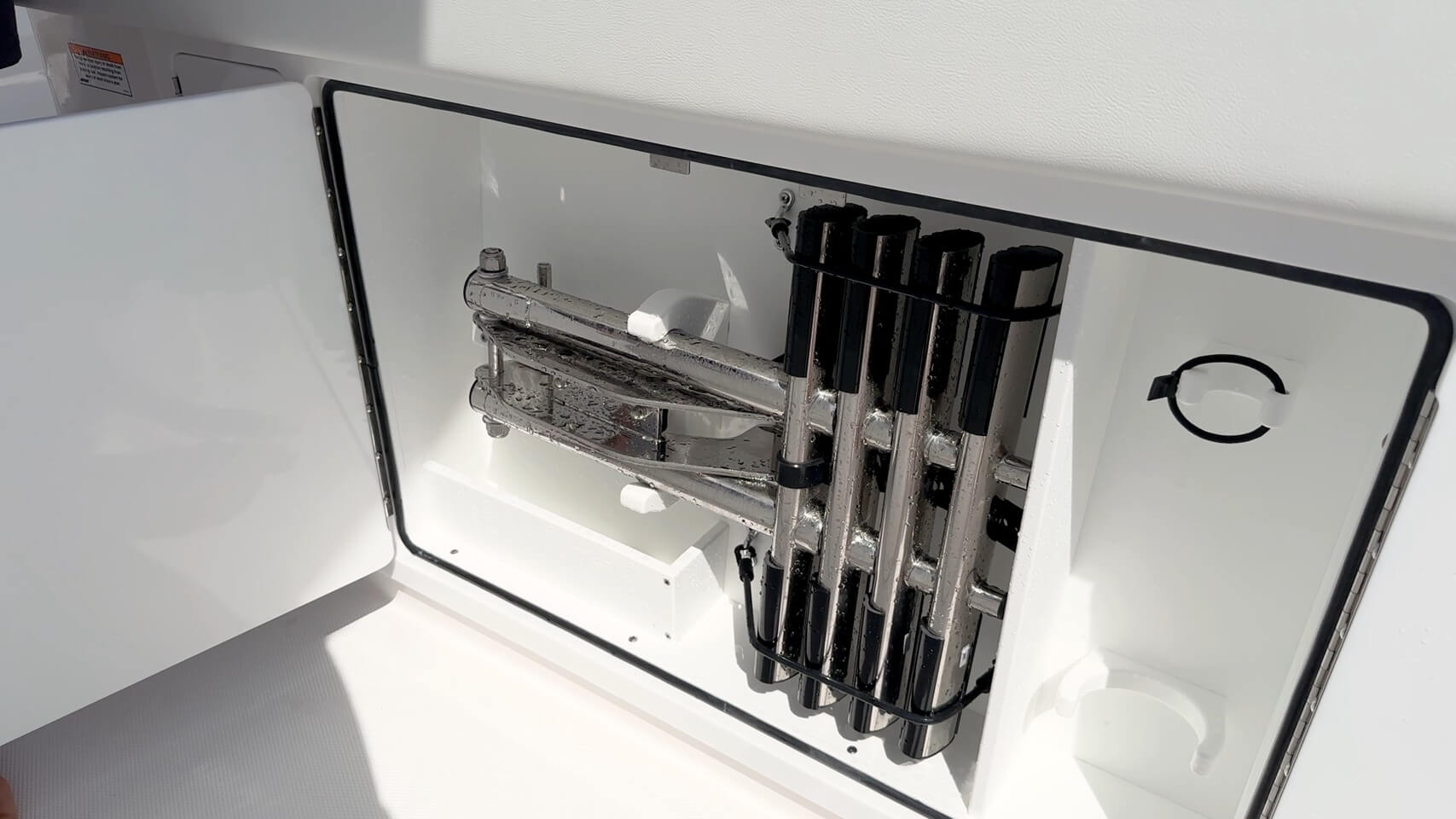
Telescopic swim ladder: Three-step, concealable beneath a hatch at the end of the pontoon/swim platform.
Swim platform walkway: Approximately 6 inches of non-skid surface provided for safe port-side crossing, despite the boat's overall 25-foot size.
Rigging: The reviewer noted the engine rigging appeared clean, expressing confidence in the Yamaha engines' expected performance.
Specifications (Test Boat)
- Length overall: 26 feet, 6 inches
- Beam: 8 feet, 6 inches
- Draft: 31 inches, engines down
- Test weight: 7,100 pounds, with 50% of the 140-gallon fuel capacity aboard and two passengers
- Engines: twin Yamaha 200s, turning Reliance SDS 14.25 x 18-pitch propellers (single-engine option also available)
Performance Numbers
Testing was conducted in fairly rough conditions.
- Top speed: 49.2 mph at 5,900 RPM
- Best cruise (in test conditions): 25.5 mph at 3,500 RPM, achieving 2.2 miles per gallon
- Range at best cruise: approximately 309 miles, with a 10% fuel reserve
- Hole shot 0–10 mph: 3.4 seconds
- 0–20 mph: 6.2 seconds
- 0–30 mph: 8.7 seconds
Sea Trial — Handling in Rough Conditions
Captain Trip, conducting the on-water test, noted favorable testing conditions: "Luckily we've got a sporty day out here today, so we really get to put the boat to the test... a lot of times we'll test the boat and it'll just be flat, and you don't really get to see how the boat performs."
He reported being invited to push the boat hard: "They even got to a point where they said, Trip, just give it all you got and see what the boat does. You're not gonna break it. So that's exactly what I did."
Head-sea performance: "I was coming into the waves, head seas, fairly spicy out here, and they even got airborne one time, and the boat felt solid." He attributed this directly to the construction method observed at the factory: "That single-piece infusion construction that we saw in the factory is indeed paying off."
Turning in rough seas: "When you're underway, even making cuts and sharp, aggressive turns in the rough seas — sometimes you'll hit a wave, turn the boat, it'll want to slam down to the side. Everything just shakes and rattles. I didn't notice any of that. T-top was hard. No wobbling, everything was just solid underfoot. I was comfortable and in control here. And of course visibility is fantastic."
Power assessment (twin 200s): "Plenty of power, like a fun and exhilarating amount of power. I could be running 30 miles an hour, hit the throttle on, you feel it pick up pretty quickly. It's really a sporty boat to run."
Dryness: "I stayed dry the whole time. The boat's not covered with salt, and we were in some pretty nasty stuff and really seeing a lot of spray out there."
Helm Seating Positions (In Use)
Captain Trip described three operating positions used during the test: standing with the bolster up; seated with the bolster up and feet on the footrest (while retaining full control); or fully seated with the bolster down for maximum comfort, noting the speaker placement overhead made for pleasant cruising with the radio up. His summary: "[This] would just be a fantastic boat to just do some casual cruising, sandbarring on, or even fishing, like this boat's built for."
Docking / Joystick Test
Conducted back at the dock, with current and wind both from behind the boat. Captain Trip explained his approach: "I'm gonna come in with my stern into the current and into the wind for better control. But really, with the joystick, it doesn't really matter, because you have a lot of control with it." He noted the joystick is included specifically with the twin 200 configuration (versus the optional single 350). The approach involved bringing the boat alongside parallel to the dock, stopping, then switching to joystick mode to complete the docking.
Test Video Summary
Overview
The EdgeWater 250CC is designed primarily for offshore fishing, with elegant and luxurious touches that make her a premium boat families can enjoy. BoatTEST’s Captain toured the EdgeWater factory to see her Single Piece Infusion construction, then tested her with twin Yamaha 200 outboards in rough conditions.
“EdgeWater actually surveyed their customers and they found out that about 50% of the time, or maybe a little more than that, people are actually going to the sandbar, but they want a boat that can also fish. And that’s what this thing does.”
Mission And Intended Owner
- Built To Do: Offshore fishing, plus sandbar and family days
- Designed For: Owners who want a premium fishing boat the family will enjoy
- Locus Of Operation: Offshore
Design Overview
- Construction: EdgeWater’s Single Piece Infusion process, which vacuum-infuses the stringers and hull at once for rigidity
- Materials: Fiberglass mats labeled by piece and by material, with different resin flow rates so every piece saturates completely for optimum strength
- Core: No wood in the construction
- Insulation: Thick insulation in the bow compartments and the baitwell
- Flotation: Foam-filled and unsinkable, while still offering in-deck storage
- Gunwales: Narrow where needed, without compromising strength, thanks to the infusion process
- Beam: 8 feet, 6 inches, legally trailerable in any state
- Hardtop Frame: Integrated into the console, powder coated and contoured to match the hardtop
- Warranty: Lifetime warranty on all EdgeWater center console hulls
“That single piece infusion construction that we saw in the factory is indeed paying off when you’re underway.”
Specifications
- Length Overall: 26 feet, 6 inches
- Beam: 8 feet, 6 inches
- Draft: 31 inches with engines down
- Fuel Capacity: 140 gallons
- Console Side Clearance: About 19 inches between the bolster and the console
- Helm Seat: 35 inches wide
- Transom Door Opening: 19 inches wide
- Swim Platform Walkway: About 6 inches of non-skid across the platform
Test Conditions And Test Weight
- Sea State: Fairly rough, spicy head seas
- Load: 50% fuel and two passengers
- Test Weight: About 7,100 pounds
Performance
- Tested Power: Twin Yamaha 200s turning Reliance SDS 14.75 x 18 props
- Optional Power: Single engine, including a single 350; the joystick comes with the twin 200s
- Top Speed: 49.2 mph at 5,900 rpm
- Best Cruise: 25.5 mph at 3,500 rpm
- Fuel Economy At Best Cruise: 2.2 mpg
- Range At Best Cruise: About 309 miles, holding a 10% reserve
| RPM | MPH | MPG | Range (Miles) |
|---|---|---|---|
| 3,500 | 25.5 | 2.2 | ~309 |
| 5,900 | 49.2 | — | — |
Acceleration:
- 0–10 mph: 3.4 seconds
- 0–20 mph: 6.2 seconds
- 0–30 mph: 8.7 seconds
Sea Trial And Handling
- Head Seas: Felt solid, even when she got airborne once
- Hard Turns In Rough Seas: No shaking or rattling
- T-Top: No wobbling
- Power: Fun and exhilarating with the twin 200s, picking up quickly from 30 mph
- Spray: Stayed dry the whole time in nasty conditions
- Visibility: Fantastic
- Comfort: Easy to drive standing with the bolster up, or seated with feet on the footrest
- Docking: Joystick gave plenty of control in wind and current
“Even making cuts and sharp aggressive turns in the rough seas, sometimes you’ll hit a wave, turn the boat, it’ll want to slam down to the side, everything just shakes and rattles. I didn’t notice any of that. T-top was hard, no wobbling. Everything was just solid underfoot.”
“I stayed dry the whole time.”
Engine Room Or Mechanical Compartment
- Electrical Panel: In the head compartment, with fuses, battery switches and battery status readouts
- Breakers: Behind the panel, very clean, with corrosion-preventative coating on the connections
- Batteries: Two, accessed below the electrical panel
- Battery Charger: Triple-bank
- Engine Flush: Reverso freshwater engine flush system
- Rigging: Clean at the engines
“That’s not actually dirty, that is corrosion preventative signs right there. So when that’s there, you know someone has put the right touches on this electrical system.”
Features Inspection
The Helm
- Dash: Optional color-matched dash and hardtop underside, in gray and black, with a low-reflection top surface
- Windshield: High-quality tint that doesn’t look splotchy through polarized sunglasses
- Displays: Two 12-inch Garmin screens with Garmin digital switching
- Audio: Fusion audio unit
- Autopilot: Push-button controls
- Charging: Two wireless Scanstrut chargers
- Stabilization: SeaKeeper Ride controls
- Joystick: With the twin-engine package
- Wheel: Tilt base, with a knob for quick turns when docking
- VHF Mic: Under the wheel, within easy reach
- Engine Start-Stops: Yes
- Helm Seat: 35 inches wide, with bolsters on both seats, vented backrests and heavy-duty armrest hardware
- Cooler: Standard, under the seat
- Hardtop:
- Two JL Audio speakers, with an optional premium package adding speakers and a sub
- LED overhead lighting
- Floodlights aft and forward
- Anchor light and VHF antenna that raise and lower by hand crank from below
- VHF radio and push-button controls
- Electric vent
Anchor Locker And Ground Tackle
- Windlass: Electric Lewmar
- Rode Space: Plenty of room
- Bow Ladder: Bracket for mounting the swim ladder at the bow for beach access
- Bow Hardware: Two rod-holder cup-holder combos and two pop-up cleats
Boarding Amenities
- Side Tuna Door: For landing big fish, also usable with the swim ladder for diving
- Swim Ladder: Stored neatly beside the console, mounting at the bow or side door
- Transom Door: 19 inches wide
- Freshwater Shower: At the transom, with the freshwater fill
- Swim Platform Ladder: Three-step telescopic, concealed under a hatch
Cockpit Arrangement And Equipment
- Livewell: Pressurized and insulated
- Fish Boxes: Long, insulated in-deck boxes with macerator pumps
- Rod Holders: Four on the transom, four on the hardtop, plus rod-holder cup-holder combos all around
- Helm Seat Back: Substantial grab rail, two cup holders and cutouts for knives and pliers
- Toe Rails: Under the starboard gunwale
- Coaming Padding: Along the sides
- Outriggers: Mounting points on the hardtop
- Lockable Rod Storage: Under the starboard deck, holding two rods, or folding away for general storage
- In-Deck Storage: Ideal for a bow trolling motor battery
- Flip-Down Bench: In the cockpit, seating two in rough conditions
Bow Arrangement
- Seating: Wraparound U-shaped seating with padded backrests and fine upholstery
- Backrests: Flip into place for forward-facing riding
- Console Seat: Yes
- Amenities: JL Audio speakers, cup holders and USB chargers
- Handrails: ABYC compliant
- Table: Secures in a bracket for dining
- Storage: Insulated, under the seats, with push-button latches, finished hatch undersides, stainless gas struts and interior lights
“I particularly like the latches that they’ve chosen... it’s a simple push button on the outside. It’s not a paddle latch, you don’t have to go up under the cushion. I think it’s the cleanest way that I’ve seen this done so far.”
Interior Spaces
Head:
- Access: Well-placed grab rail for entering
- Space: Elbow room and overhead room
- Light: Overhead
- Storage: Extra storage space
- Ventilation: Opening port
- Door: Magnetic catch to keep it open
Advantages And Disadvantages
Advantages
- Single Piece Infusion construction that felt solid in rough seas
- No wood in the construction
- Unsinkable foam flotation, with in-deck storage
- Lifetime hull warranty
- Stayed dry and rattle-free in spicy head seas
- Fun, exhilarating power with twin 200s
- Trailerable 8'6" beam
- Pressurized livewell, macerated fish boxes and a side tuna door
- Corrosion-protected electrical system
- Push-button seat latches, insulated storage and finished hatches
- Joystick docking with the twin-engine package
Disadvantages
- Joystick is available only with the twin 200s, not with the single-engine option
- Premium audio and color-matched hardtop and dash are optional
- Swim platform walkway is narrow, at about 6 inches
Related Boats
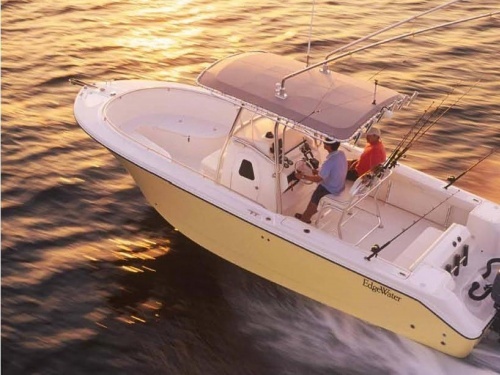
EdgeWater 247 CC
1 x 250-hp Yamaha outboard
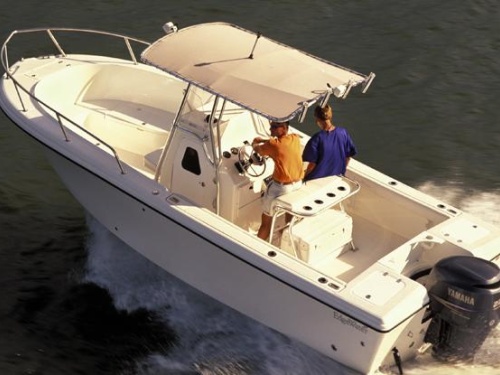
EdgeWater 225 CC
1 x 200-hp Yamaha 200 HPDI outboard
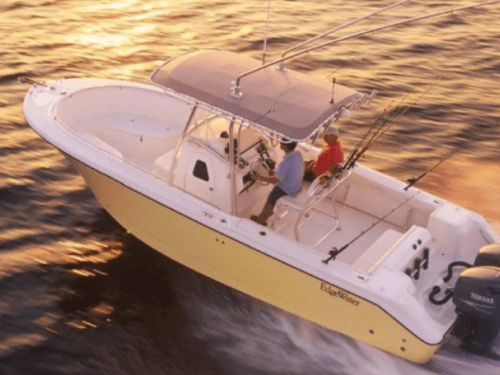
EdgeWater 260 CC
2 x 200-hp Yamaha HPDI outboards
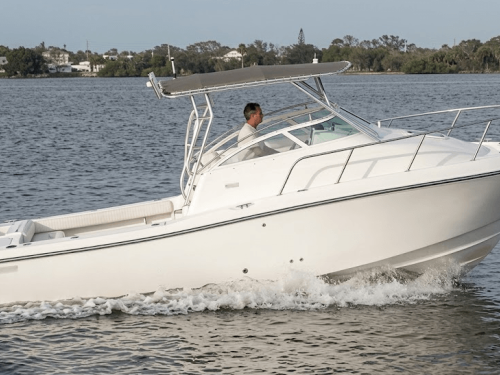
EdgeWater 225 EX
1 x 200-hp Yamaha 200 HPDI outboard