Access More Boat Tests
Already have an account? Login
Prestige Yachts 420 (2016-)
2 x 370-hp Volvo Penta IPS500

Brief Summary
The Prestige Yachts 420 offers private entries to each of its two full-beam en suite staterooms, a tricky design feat on a yacht under 42' (12.8 m) long. A roomy sun pad on the bow and another to port on the flying bridge give plenty of space to catch some rays, and a broad stairway, rather than a ladder, provides access topside. Interiors are by Garroni Design, just as in the company's larger yachts.
Test Results
| RPM | MPH | Knots | GPH | MPG | NMPG | SM | NM | dBa |
|---|---|---|---|---|---|---|---|---|
| 650 | 4.1 | 3.6 | 0.6 | 7.5 | 6.5 | 1946 | 1691.9 | 68 |
| 1000 | 6.2 | 5.3 | 1.8 | 3.5 | 3.1 | 917 | 797.6 | 70 |
| 1250 | 7.8 | 6.7 | 3.1 | 2.5 | 2.2 | 663 | 576.7 | 73 |
| 1500 | 9.7 | 8.4 | 5.1 | 1.9 | 1.6 | 494 | 429.4 | 72 |
| 1750 | 10.4 | 9 | 8.4 | 1.2 | 1.1 | 322 | 279.6 | 74 |
| 2000 | 11.6 | 10 | 13 | 0.9 | 0.8 | 232 | 201.6 | 76 |
| 2250 | 13 | 11.3 | 15.5 | 0.8 | 0.7 | 218 | 189.6 | 77 |
| 2500 | 17.1 | 14.8 | 20.5 | 0.8 | 0.7 | 217 | 188.8 | 78 |
| 2750 | 20.6 | 17.9 | 24.5 | 0.8 | 0.7 | 219 | 190.4 | 80 |
| 3000 | 26.3 | 22.9 | 30.5 | 0.9 | 0.7 | 225 | 195.7 | 79 |
| 3250 | 28.9 | 25.1 | 33.5 | 0.9 | 0.7 | 225 | 195.5 | 80 |
| 3450 | 32.4 | 28.2 | 40 | 0.8 | 0.7 | 211 | 183.8 | 82 |

Specifications
| Length Overall | 41' 6'' / 12.65 m |
|---|---|
| Beam |
13' 3.96 m |
| Dry Weight |
20,979 lbs. 9,515 kg |
| Draft |
2' 7'' 0.78 m |
| Deadrise/Transom | 16-deg. |
| Bridge Clearance | N/A |
| Fuel Capacity |
290 gal. 1,097 L |
| Water Capacity |
106 gal. 401 L |
Acceleration Times & Conditions
| Time to Plane | 6.2 sec. |
|---|---|
| 0 to 30 | 10.6 sec. (0to20) |
| Ratio | N/A |
| Props | N/A |
| Load | 4 persons, 3/4 fuel, no water, 50 lbs. of fuel |
| Climate | 85 deg.; 90 humid.; wind: 15-20 mph; seas: confused |
Engine Options
| Tested Engine |
2 x 370-hp Volvo Penta IPS500 |
|---|---|
| Std. Power |
2 x 300-hp Volvo Penta IPS400 D4-300 |
| Opt. Power |
2 x 370-hp Volvo Penta IPS500 D6 |
Overview
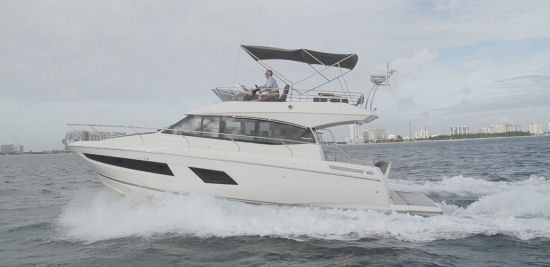
The new Prestige Yachts 420 is designed to pride boaters with a traditional “cabin cruiser” that can serves as a multi-purpose yacht for cruising, entertaining and day boating. It does all of that in a design that is in keeping with the Prestige styling theme that makes the boat look and have the functions of a motoryacht, but on a smaller scale. It is also intended for the owner who does not want a hardtop express cruiser… either in function or looks.
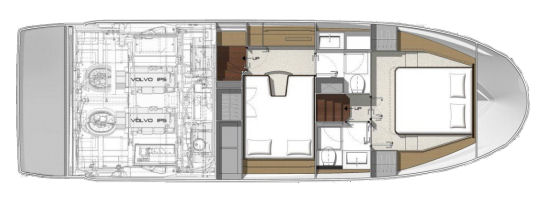
With two private staterooms with en suite heads, the 420 offers about as much privacy as possible for two couples, or a small family, when cruising. More significantly, the two staterooms have separate entrances, something practically unheard of in a 42 footer.
Finally, like all Prestige yachts, the 420 has been priced to offer significant value.
The Prestige Yachts 420 is one of seven models in its flybridge series. At 41’6” (12.64 m) it is the smallest of the range, which now reaches up to the Prestige Yachts 750. Like her larger siblings, the Prestige Yachts 420 is a product of Garroni Design with an emphasis on lots of windows for great views, a flying bridge that is larger than most for boats in this category, and a two-cabin/two-head layout which is unusually private.
The hull architecture and running surface was optimized for Volvo Penta IPS drives by J&J Design, working with the Jeanneau design and engineering staffs. The Prestige Yachts 420 carries a CE category of B-9, suitable for up to nine persons operating offshore with winds up to 40 knots and significant seas up to 13’ (3.96 m), or C-11, suitable for up to 11 persons when the boat is operating in coastal waters and large bays and lakes with winds to up to 27 knots, and significant seas up to 7’ (2.13 m) high.
Features Inspection
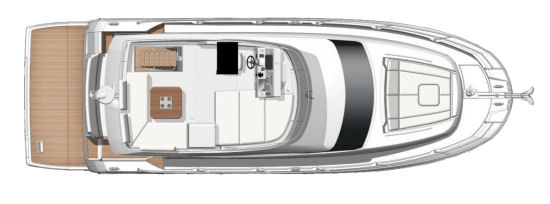
Flying Bridge.
Welded stainless steel safety rails completely surround the flying bridge, as required by both ABYC and CE standards. We particularly liked the fact that the rails are independent of the forward-raked windscreen, making them easy to grab, particularly when getting on or off the sun pad just to the right of the helm.
There’s room for four to five people at the dinette, and there’s also space between the sun pad and the L-shaped dinette for an optional outdoor galley with sink, refrigerator, and grill with a backsplash. The optional Bimini will make the flying bridge more comfortable on hot summer days.

The helm
is set to port and the wheel and helm chair are to the left of the console centerline. Standing, there’s a good view of the bow, so docking to starboard shouldn’t be too difficult to judge. With the helm chair positioned as it is, the helmsman can look directly down the stairwell with a good view of the port quarter, which will make backing down into a slip much easier. For those who want a better view aft, there’s an option for a third joystick on the aft deck and with its starboard mounting position both sides can now be covered for any docking situation.
There’s plenty of space on the dash for a single multifunction display, plus two analog style digital tachometers, two Volvo Penta engine displays, a stereo, an autopilot, and a radio speaker. The throttles mount just to the right of the wheel, and the IPS joystick is on the centerline. We liked the addition of a small handrail to aid the helmsman when standing.

The tilting wheel can be nearly vertical or more horizontal, depending on how each owner likes it. Systems switches, trim tab controls and the fuel gauge are to the left of the wheel. Just ahead, a small compass is mounted in line with the wheel.
Low Radar Arch.
We understand that the arch for mounting the optional radome, as well as lights and antennas is set low, keeping the design height of the boat looking sleek, and to make it passable under bridges on rivers and canals in Europe. We would, however, like to see an option for a taller arch or mast so that the radar projects over the occupants on the flying bridge. This can be made to be lowered when needed.


The Aft Deck and Foredeck.
Access to the aft deck is typical, with a locking stainless steel gate to starboard. The optional electrically actuated hydraulic swim platform, here with optional teak decking, stores well above the waterline for ease of boarding. And there’s a reboarding ladder under a flush-mount hatch to starboard, which has a slot for gripping when climbing.
When lowered, the platform will be perfect for swimmers, snorkelers, and paddle boarders to get on and off the boat. It can also be rigged to carry an inflatable dinghy, so launching and retrieving should be considerably easier when the platform is partially submerged. When this platform is chosen, it also requires an engine upgrade from the IPS 400’s to the 500’s.

Cockpit/Aft Deck.
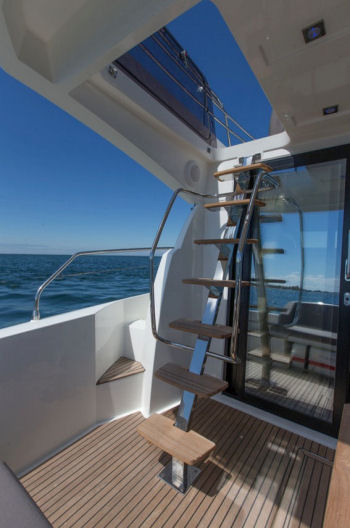
There’s room in the cockpit for a couple of folding deck chairs in addition to the built-in transom bench. A low stainless steel grab rail runs across the transom top, adding safety for those on the swim platform as well as those on the bench. Optional teak planking makes this area more inviting visually, and adds some slip resistance, as well. Teak treads on the ladder leading to the flying bridge add good footing, and there are handrails to both sides of the ladder. A pedestal table can be added as an option.
Going Forward.
Getting to the foredeck is made easier by the molded steps in the forward corners and the small handrail mounted to the aft corner of the deckhouse on either side. There’s a handrail along the cabin side, supplementing the usual outside rail mounted on the toe rail that runs all the way to the bow. Unobstructed access to both sides will let a helper easily and safely reach the side decks to help the docking manoeuver.
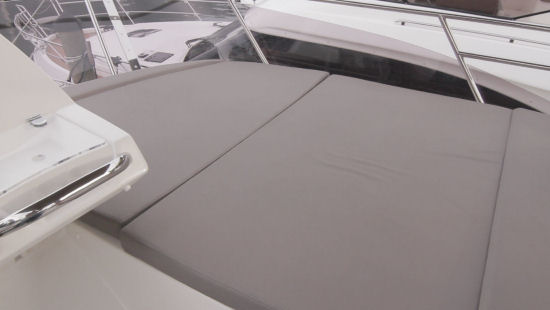
Once there, we found good bracing and access to the windlass and anchor, as well as the locker. The area around the windlass is recessed and drains directly overboard through a break in the toe rail. The sun pad is spacious enough for two, is mounted on a well-drained recess in the cabin top, and has two low handrails, one to either side, for safety.

There’s a sizable sun pad atop the trunk cabin, making a great spot for the sun worshipers to get their fix. We’d like to see this also be convertible to the chaise lounge position. Currently it’s in a fixed position requiring one to be propped up on the elbows, or many pillows to enjoy the view while underway.
The Salon.
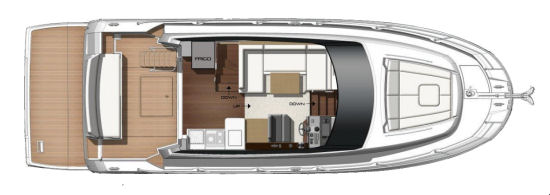
A triple wide sliding glass door that stores to port behind a standing locker opens double wide to connect the aft deck with the galley, which is just inside the door. There’s a full complement of appliances — microwave and refrigerator/freezer to port, ceramic cooktop and deep sink to starboard — as well. Just ahead of the galley is a console with bottle storage below and a television on top.

It’s a single step up to the bridge deck, where the dinette is found to port and the lower helm is to starboard. The views for those dining or relaxing to port are equal to the views from the lower helm: nearly 360 degrees. The dinette has an optional electrically operated center pedestal, and it can be lowered at the touch of a button to create a berth for two persons or a nice lounging area while underway.
The lower helm has a shelf to starboard for the dual lever binnacle, trim tabs controls and the IPS joystick. There’s enough room for the installation of a larger multifunction display, but only a single Volvo Penta engine display.


Accommodations
The VIP suite
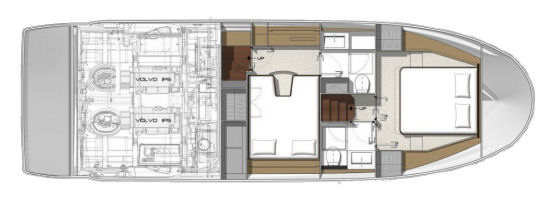
is in the bow, and it is surprisingly spacious due to the forward extension of the beam. There’s good access to both sides of the berth – which is larger than we might normally expect on this size boat -- with room left over for storage along both sides.
There’s a private door to the en suite head, which has a separate water closet that doubles as a shower compartment. With a separate door to the companionway, this head serves double duty as a day head.

The master stateroom
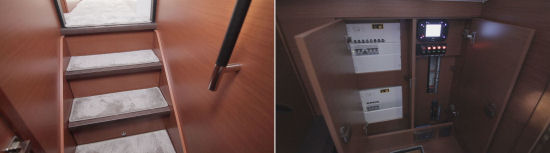
is found amidships, and it rivals the VIP for size, storage and utility. It is accessed from the galley area with its own private companionway access. We’d like to see some kind of gate on the port side where the stairway leads down to the stateroom for safety reasons in a seaway. We applaud the stainless steel safety rail that makes using those stairs much safer. The berth is actually two singles joined at the head, but it becomes a king size berth with the addition of a filler cushion.


Performance and Handling
Our test boat had a pair of 370-hp Volvo Penta IPS500 diesels that reached a top speed of 32.4 mph (28.2 kts) at 3450 rpm while burning 40 gph. At 2750 rpm, speed was 20.6 mph (17.9 knots) while burning 24.5 gph.
Time-to-plane was 6.2 seconds, while time to 20 knots was 10.6 seconds.
Best cruise is pretty subjective. Thanks to the efficiency of the pod drives and how they are so well matched to the hull, we calculated that the range will change by only 6 nm from 10 knots on up to 25 knots. Only at full power will it drop slightly lower. So the point is, set the speed based on the comfort level of the current sea conditions, and not so much on the comfort level of the fuel consumption.

Handling
Now regarding the riding comfort, there’s plenty of it. We tested in a confused sea with minor swells so we weren’t really able to give her a beating. But we were able to experience her sea kindly handling. In head seas, we could get her to pound at full speed, but dialed back to more normal speeds she rode quite nicely. Of course just off the seas, and certainly in beam or following seas, she’s even more comfortable, regardless of speed. The ride remained dry with the exception of the rainy test day.
Initiating turns will show a roll of 19-degrees into the turn, and with the reduced arc of throw that the pods have while cruising, the 420 will have a wide radius. This also means that nothing happens quickly when maneuvering nor do we want it to. This of course adds to the comfort level of the ride. No one wants to be thrown side to side while turning in a yacht.
Freeboard runs from 5’2” (1.57 m) at the rear of the sidedecks to 5’8” (1.72 m) at the bow.
Docking
Of course where she really shines is back at the dock. With the IPS joystick, we were able to bring her in gracefully and gently into the tight slip with no problems or concerns, even with a bit of a crosswind working against us. It’s simply a boat that anyone can operate so don’t let size be an intimidating factor.
Standard Features
Options
Observations
There are several things about the Prestige Yachts 420 that challenge assumptions about mid-size European motoryachts. First, the flybridge is fully functional for entertaining and navigation, not just for a massive sun pad. While the bulwarks here are low so that the top hamper does not look out of proportion, this area gives the boat important added functionality and utility over a hardtop version.
Second, it makes terrific use of frameless windows to give the salon a true open-plan feel. Third, the 420 achieves real privacy in two well-separated cabins with en suite heads.
As we all know, every boat is a compromise, and the 420 is no exception. But her relative light weight will pay off in fuel economy and speed. Prestige Yachts has packed a lot of functionality into just 42’ (12.8 m) and we think that this vessel will go a long way to fulfilling the boating dreams of many people.
Related Boats
Prestige Yachts 500 Fly (2015-)
Currently no test numbers

Prestige Yachts 450 (2013-)
2 x 435-hp Volvo Penta IPS600
Prestige Yachts 460 Fly (2017-)
2 x 435-hp Volvo Penta IPS600

Prestige Yachts F4.9 (2024-)
2 x 480-hp Volvo Penta IPS650