Access More Boat Tests
Already have an account? Login
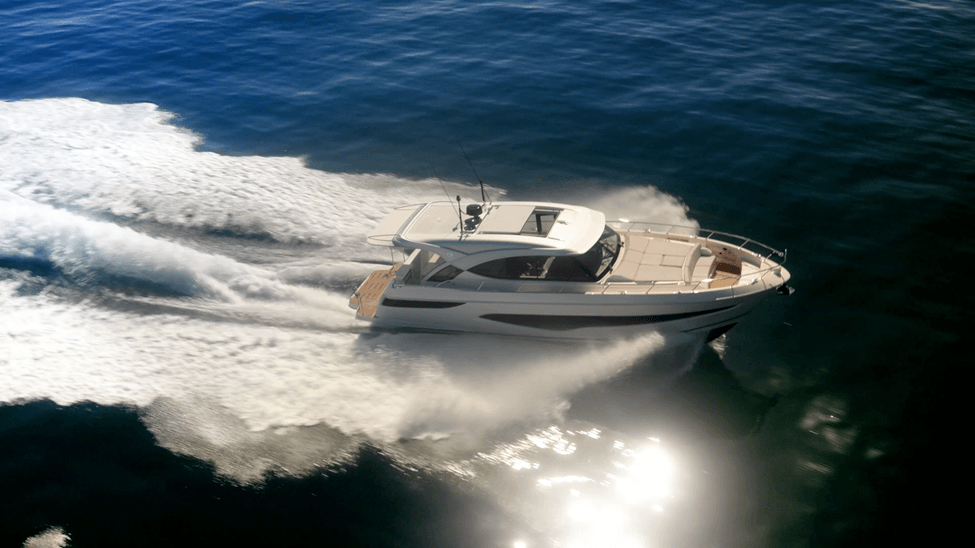
Riviera Yachts 4300 Sports Express (2026-)
2 x 480-hp Volvo Penta IPS650

Brief Summary
The 4300 Sports Express is a new model from Riviera Yachts aimed at families who want water sports, room to entertain, and weekend cruising in a high-quality build — with the running costs and reliability of inboard power rather than a wall of outboards. She is driven by twin Volvo Penta D6 IPS 650 diesels, which nearly every serious vessel in the 30-range uses for power. She is designed for families that want to step up from the limited capabilities of popular dayboats into a more expansive boating experience.
Test Results
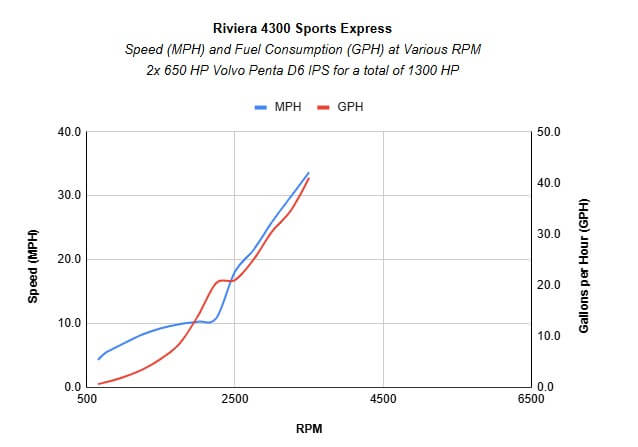
| RPM | MPH | Knots | GPH | MPG | NMPG | SM | NM | dBa |
|---|---|---|---|---|---|---|---|---|
| 650 | 4.3 | 3.8 | 0.7 | 6.6 | 5.8 | 1888.1 | 1640.8 | 61 |
| 750 | 5.4 | 4.7 | 1 | 5.4 | 4.7 | 1538.2 | 1336.7 | 65 |
| 1000 | 6.9 | 6 | 2.1 | 3.4 | 2.9 | 957.9 | 832.4 | 66 |
| 1250 | 8.3 | 7.2 | 3.5 | 2.4 | 2.1 | 673.3 | 585.1 | 68 |
| 1500 | 9.3 | 8.1 | 5.6 | 1.7 | 1.4 | 470.5 | 408.8 | 68 |
| 1750 | 9.9 | 8.6 | 8.6 | 1.2 | 1 | 329.2 | 286.1 | 70 |
| 2000 | 10.3 | 9 | 14 | 0.7 | 0.6 | 209.2 | 181.8 | 72 |
| 2250 | 10.9 | 9.5 | 20.5 | 0.5 | 0.5 | 150.9 | 131.1 | 76 |
| 2500 | 18.1 | 15.8 | 21 | 0.9 | 0.8 | 245.5 | 213.3 | 75 |
| 2750 | 21.5 | 18.7 | 25 | 0.9 | 0.7 | 244.8 | 212.7 | 73 |
| 3000 | 25.9 | 22.5 | 30.5 | 0.8 | 0.7 | 241.4 | 209.8 | 75 |
| 3250 | 29.8 | 25.9 | 34.5 | 0.9 | 0.8 | 245.7 | 213.5 | 77 |
| 3500 | 33.7 | 29.3 | 41 | 0.8 | 0.7 | 233.5 | 202.9 | 77 |
| 3800 | 38.2 | 33.2 | 51.5 | 0.7 | 0.6 | 211 | 183.3 | 79 |
Specifications
| Length Overall |
45' 6" 13.88 m |
|---|---|
| Beam |
14' 7" 4.45 m |
| Dry Weight |
34,167 lbs 135,497 kg |
| Draft |
4' 2" 1.28 m |
| Draft Down |
4' 2" 1.28 m with Props |
| Bridge Clearance |
15' 4" 4.67 m |
| Fuel Capacity |
316 gal 1,200 L |
| Water Capacity |
105 gal 400 L |
Acceleration Times & Conditions
| 0 to 30 | 22.0 |
|---|---|
| Load | Persons + Gear: 740 lbs/336 kg; Fuel: 1,754 gal/795 kg; Total Load: 37,078 lbs/16,818 kg |
| Climate | 64°; 69% humidity; wind 5-10 kts; waves 0-.5' |
Engine Options
| Tested Engine |
2 x 480-hp Volvo Penta D6 IPS 650 |
|---|---|
| Std. Power |
2 x 440-hp Volvo Penta D6 IPS 600 |
| Opt. Power |
2 x 480-hp Volvo Penta D6 IPS 650 |
RIVIERA 4300 SPORTS EXPRESS
The Intersection of Luxury and Sport
By Capt. Ken Kreisler and Capt. Trip Smith
Major Features
- 2 x 440-hp Volvo Penta D6 IPS 600 w/joystick
- 2 x 12” Garmin touchscreens
- Volvo Penta IPS powered yachts delivered with five-year limited warranty on engines, drives and electronics, and are further supported by Riviera’s two-year and seven-year structural limited warranties
- Living accommodations salon
- Line cutters between props
- 27,000 BTU helm and main deck air conditioning
- 24V-3000W battery charger and inverter
- Transom electric BBQ
- Hydraulic transom platform w/integrated seat
- 2 x 12” Garmin touchscreens
- Two drawer refrigerator/freezer, microwave, food prep area in lower galley
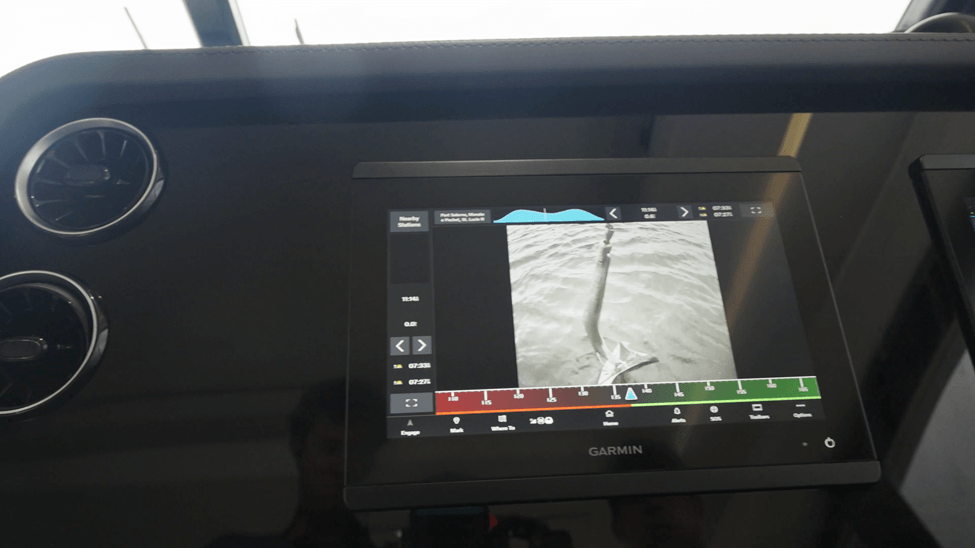
- Anchor chain counter at helm
Notable Options
- 2 x 480-hp Volvo Penta D6 IPS 650 w/joystick, autopilot, line cutters between props, bow thruster
- 18,000 BTU air conditioning in lower accommodations
- Transom docking station
- Volvo Interceptor System for Auto Trim, List, and Coordinated turn
- Volvo Dynamic Positioning System
- Starlink Satellite Internet System
- Dishwasher in lower galley
- Walnut privacy doors in aft cabin
- 2 x 16” Garmin touchscreens
- Sea Keeper 4.5 Gyro
- Pressurized washdown at bow and stern
- Electrically operated aft sun shade
- Kohler generator
- Aft deck refrigeration
- Dishwasher for lower galley
- Extended swim platform
- Solar panels
- Sleipner E100 Bow Thruster
- Garmin 48nm closed array radar
- Rainman 37 gal/hr Modular Watermaker
Vessel Inspection
The 4300 Sports Express is a new model from Riviera Yachts aimed at families who want water sports, room to entertain, and weekend cruising in a high-quality build — with the running costs and reliability of inboard power rather than a wall of outboards.
It is driven by twin Volvo Penta D6 IPS 650 diesels. Notably, nearly every express competitor in the mid-40s class runs the same Volvo Penta D6 package, which is a fair indication that the industry has settled on this as the most efficient way to power a boat of this size. Only one rival in the segment uses outboards.
Bow
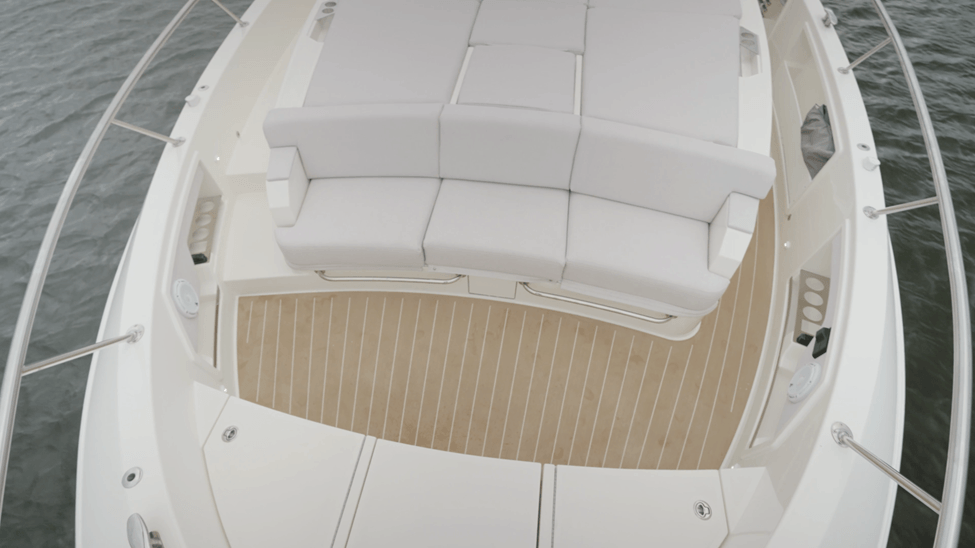
The bow sun pad lounges three to four adults, and its backrest support structure is among the most substantial seen on a boat this size. Cup holders and grab handles keep passengers secure under way.
Forward of that is where the 4300 separates itself: recessed bow seating that most boats in class don't offer. Pull the cushions and a table flips up, turning the bow into dining for six with opposing seating right in the eyes of the boat.
This is a dining arrangement you'd normally expect on a 60- or 70-footer — not a 43.
JL Audio speakers, more storage, cup holders, USB ports, and a separate audio zone round it out, so guests up front can set their own volume.
Ground Tackle
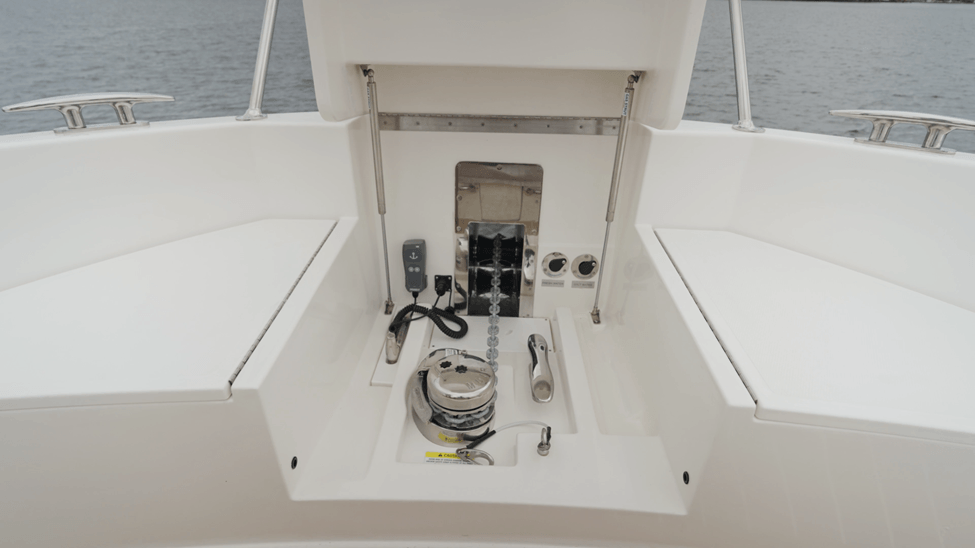
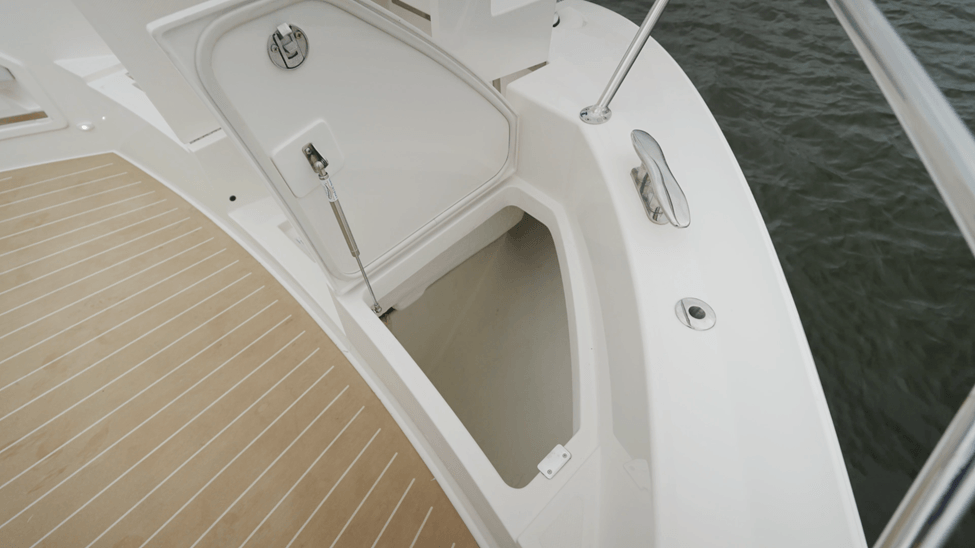
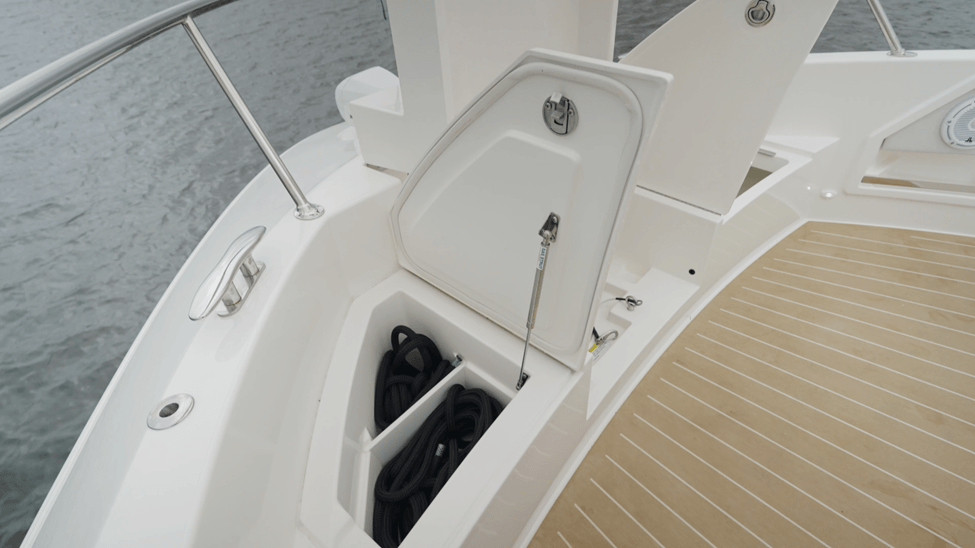
The bow and anchor-locker setup is unusual. Release the latch on the hatch, and gas struts lift the hatch and hold it open. Inside is the electric windlass with an all-chain rode, a remote to control it, and helm control as well. There's fresh- and saltwater washdown, and the boat can be optioned with a pressure washer — rarely seen on a boat of this size — with hookups at both bow and stern for rinsing off saltwater or a muddy chain and anchor.
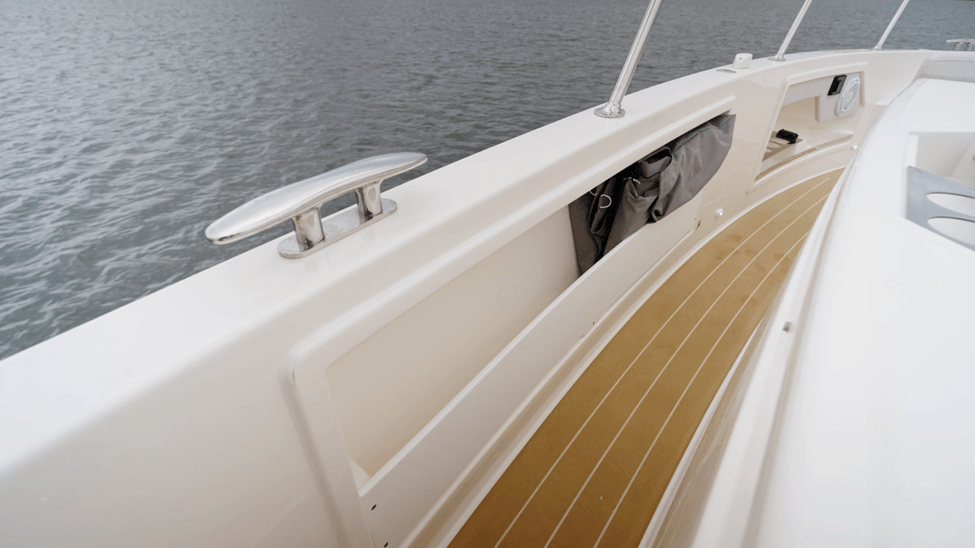
To starboard, a deep locker under a hatch suits a large fender and provides primary access to the all-chain anchor locker; a shallower locker to port handles a few dock lines.
The boat comes standard with a chain counter.
Helm
The first question to ask of any express cruiser is whether you can stand at the helm and see out without stooping under the windshield header. European designers, in particular, think that a low-angled windshield with rooftop sloping down to it, makes for a "sleek-looking" boat.
Trouble is, the captain can't stand at the helm and see out unless he/she bends over. This is a common shortfall on some European designs that aren't built to ABYC standards. The Riviera is, and standing visibility is excellent.
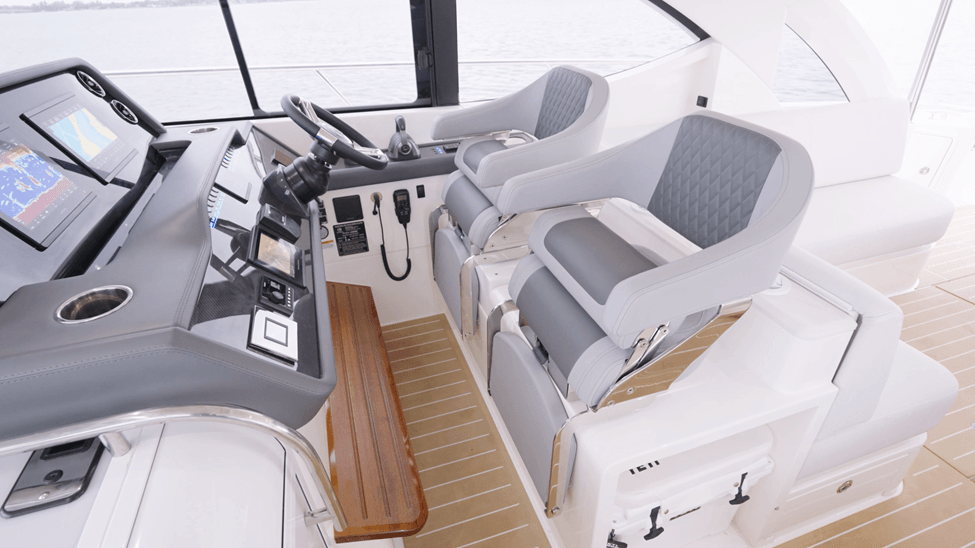
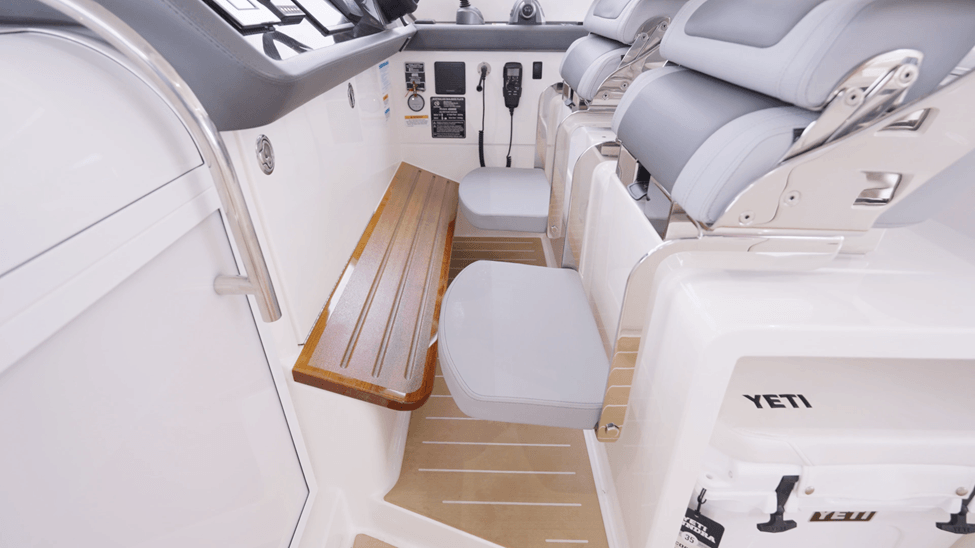
Seated, the ergonomics are built for long days. The footrest is padded — noticeable the moment you settle in — with a non-skid teak footrest alongside for quick moves off the seat. The driver's seat adjusts electrically for height and fore-and-aft position, the bolster flips down, and the wheel sits on a tilt base.
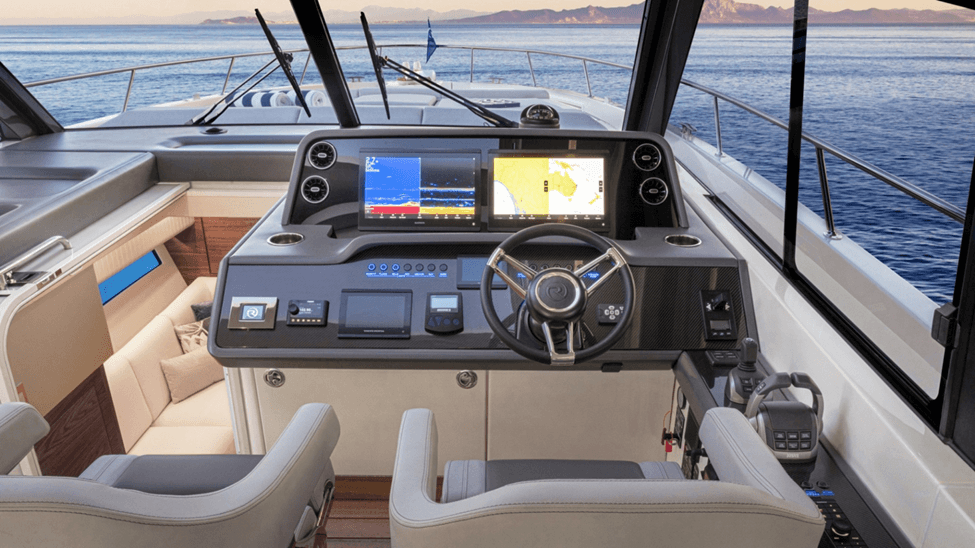
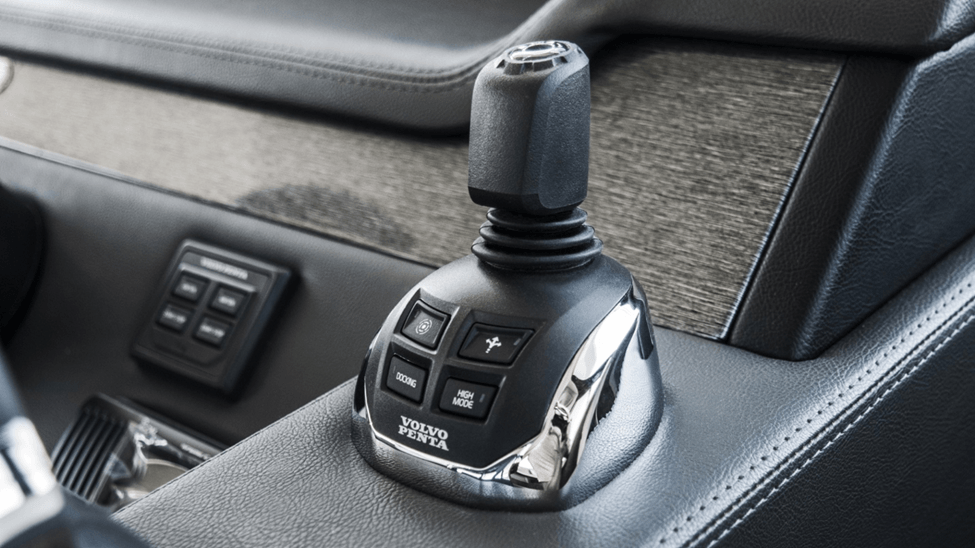
The helm carries twin 12-inch chartplotter screens, with an option to step up to 16-inch displays, and four AC ducts on the dash to keep the cabin conditioned on hot days. To the right of the tilt-base wheel are the spotlight control, Seakeeper gyro controls, joystick, and throttles, plus Garmin controls within easy reach so the operator can zoom the chart, drop waypoints, and work the autopilot without leaning forward to touch the screen.
Practical Details
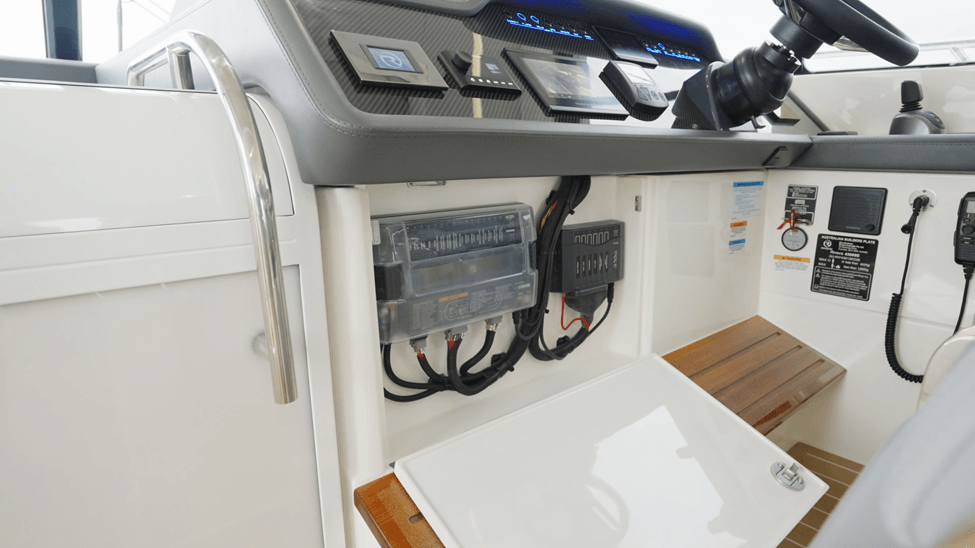
A small recessed cubby with USB ports handles device charging, and just to starboard below is easy access to the VHF radio. The helm seat is electrically actuated for height and fore-and-aft position, so you can dial in the sweet spot under way. A compartment under the dash opens to electrical fuses and control boxes, and the AC system sits under the helm seat, which unlocks and tilts forward for easy service access.
Controls fall to hand without leaning into the dash. To the right of the wheel are the spotlight switch, Seakeeper gyro controls, joystick, and throttles, plus Garmin controls that let you zoom the chart, drop waypoints, and work the autopilot without reaching for the touchscreen. A recessed cubby with USB ports handles device charging.
There is one element of the dash design, we'd like to see changed: the illuminated buttons for some accessories are mounted behind the wheel. This design makes them hard to see, and harder still to reach around and touch. Wethink Riviera could move them to the right of the wheel on the dash facing.
Living Accommodations
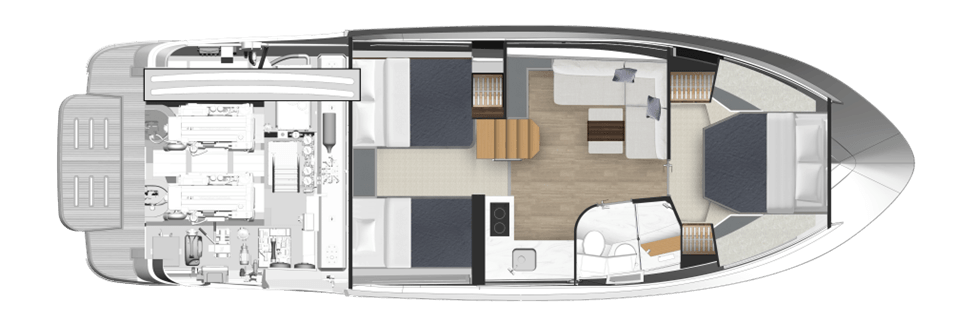
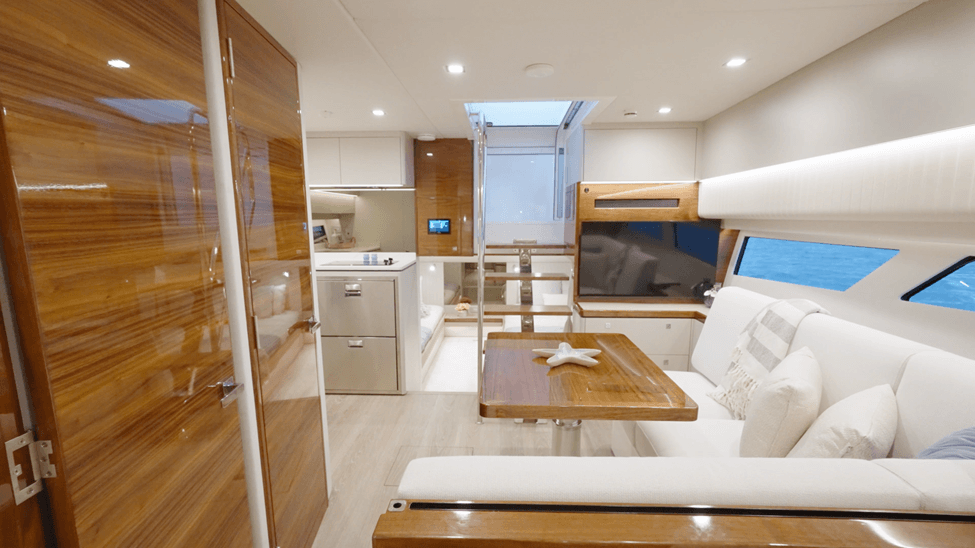
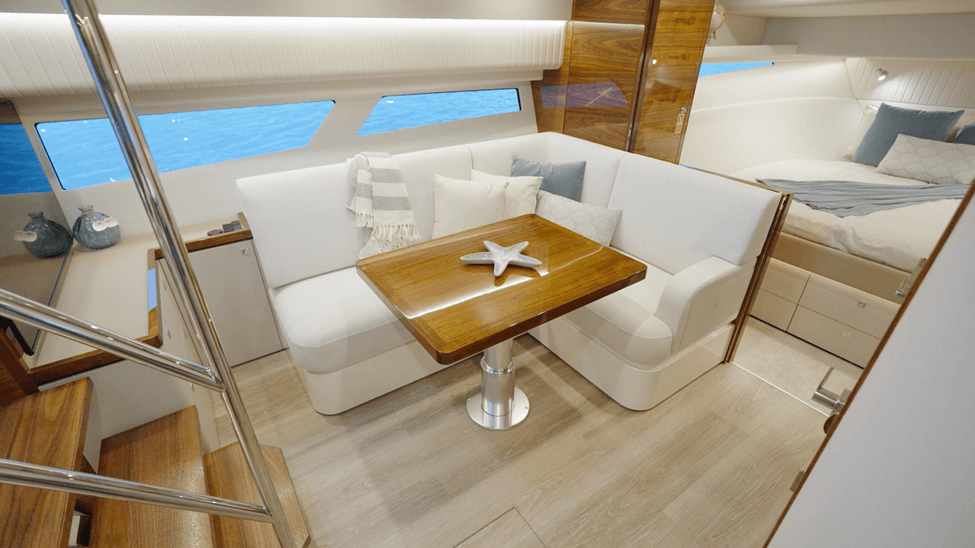
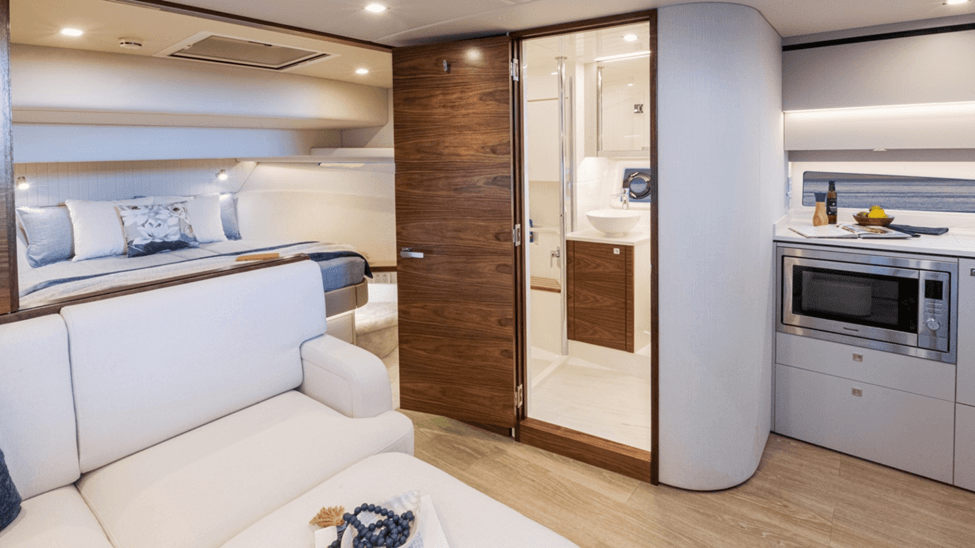
Her high freeboard allows for excellent headroom throughout and her accommodations cabin reads more like a loft than a boat. The view runs uninterrupted from the forward cabin to the guest cabin-area aft, and hull-side windows plus layered lighting keep it bright, open, and airy. Upholstered surfaces — in place of the vinyl settees common on overnighting express cruisers — give it a homier, more comfortable feel.
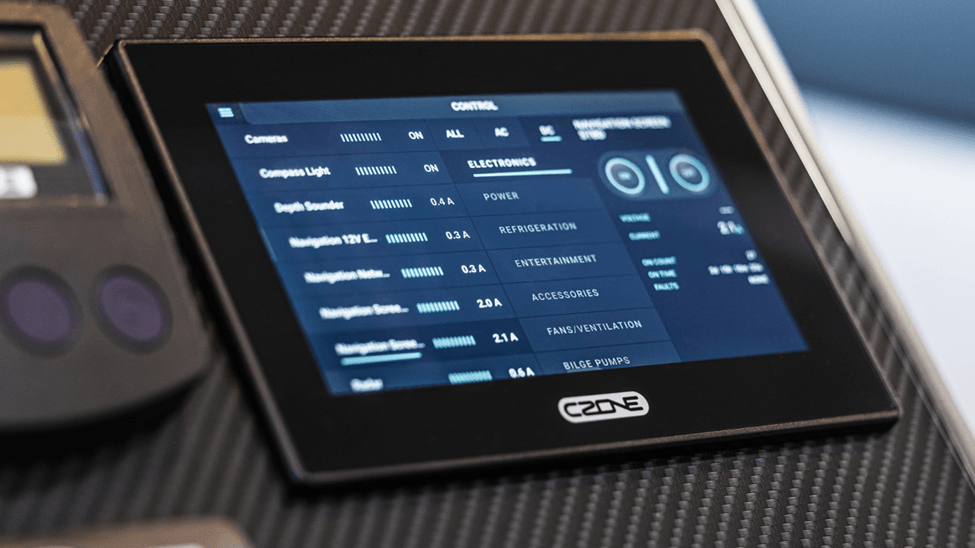
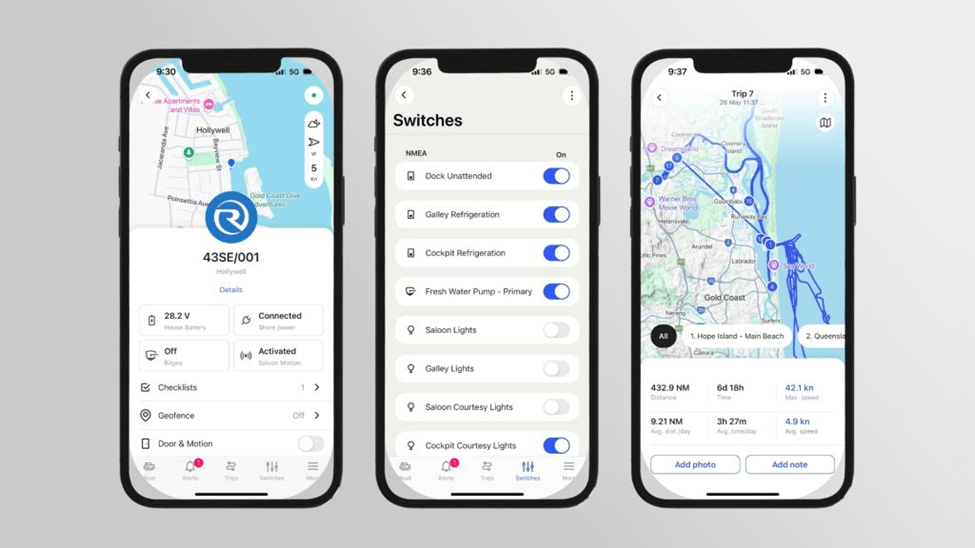
Handholds and non-skid treads make the companionway safe under way. A CZone digital switching system handles the transition from cruising mode to entertaining mode in one step: it shuts down the loads you don't need at anchor — the Garmin displays, the VHF — and powers up the ones you do, without hunting through breakers.
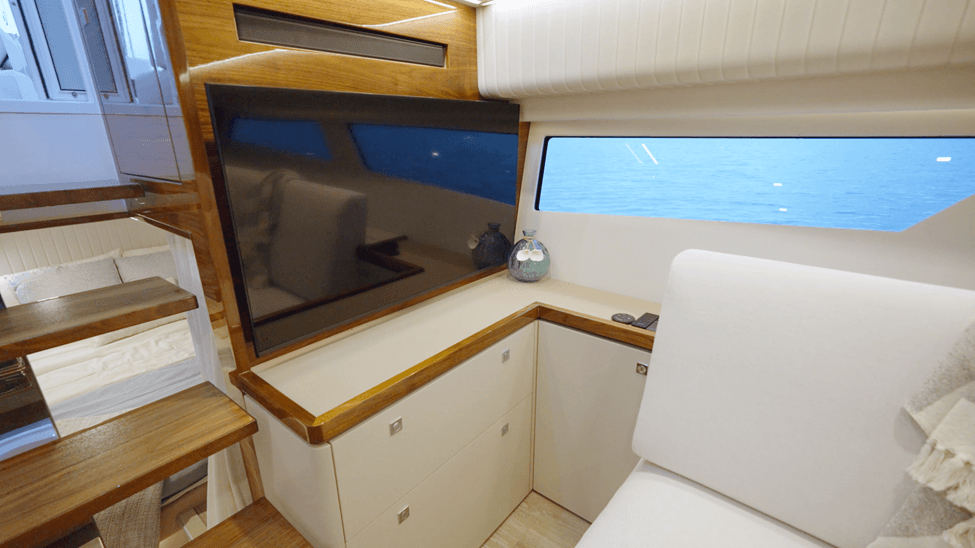
The L-shaped seating with hi/lo table converts to a berth or lounge, paired with a high-end TV and sound system, and storage runs to two pull-out drawers, a cabinet, an overhead cabinet, and a companionway compartment reachable from cabin or deck.
Galley
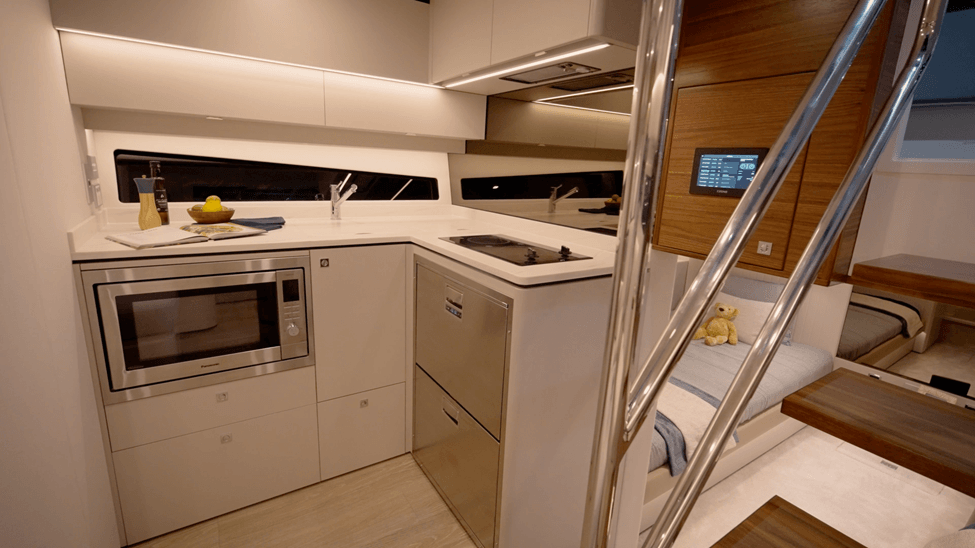
To starboard, the galley handles the stove, microwave, and the boat's primary refrigeration. Buyers can swap the lower refrigerator/freezer for a dishwasher. A hull-side window brings in daylight, while recessed LED strip lighting and a mirror stretch the sense of space; a dedicated trash bin tucks under the counter.
Head
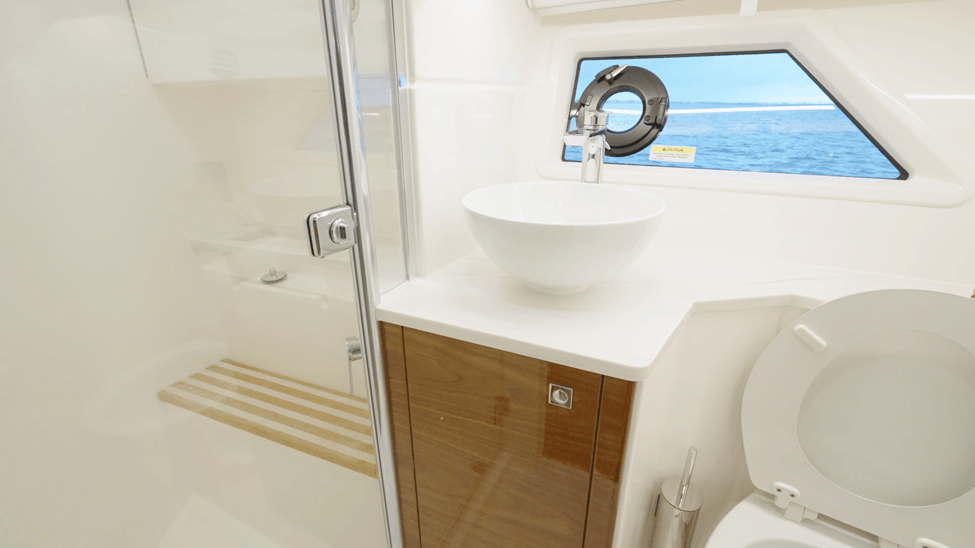
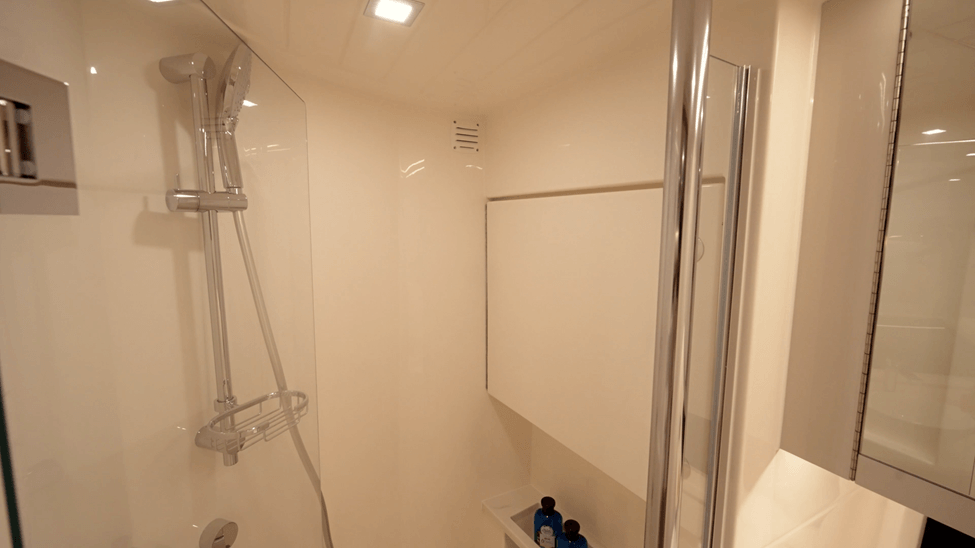
Forward to starboard, the head has a generously sized shower with a bench seat and a cubby shelf to keep soaps and shampoos secure — a real shower, not a token one. A vanity with a vessel sink offers storage above and below, and a hull-side window has an opening port.
Worth noting: every opening port on the boat is alarmed, so if one is open as you get under way, an alarm sounds before you take water aboard. The shower door is engineered well beyond the norm — solid and smooth-operating where many boats cut corners.
Forward Owner's Cabin
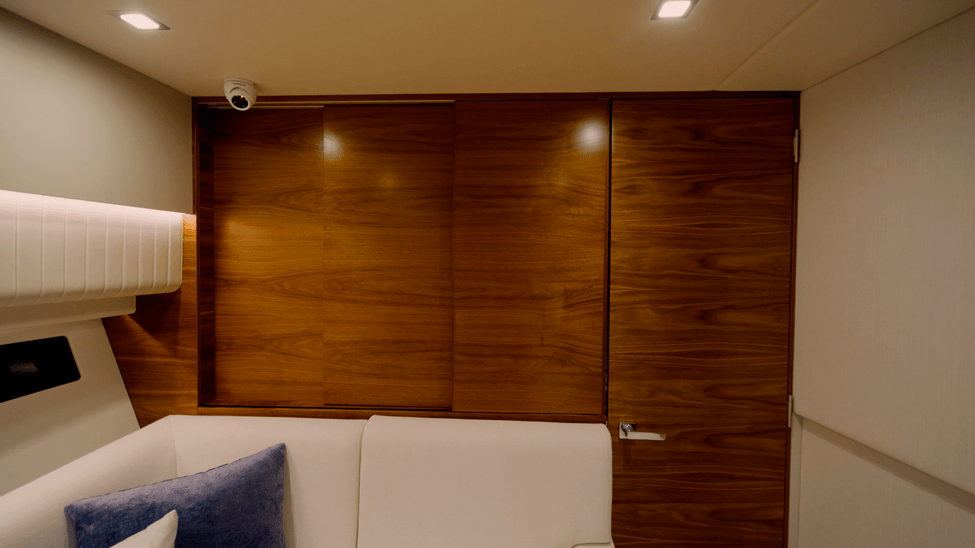
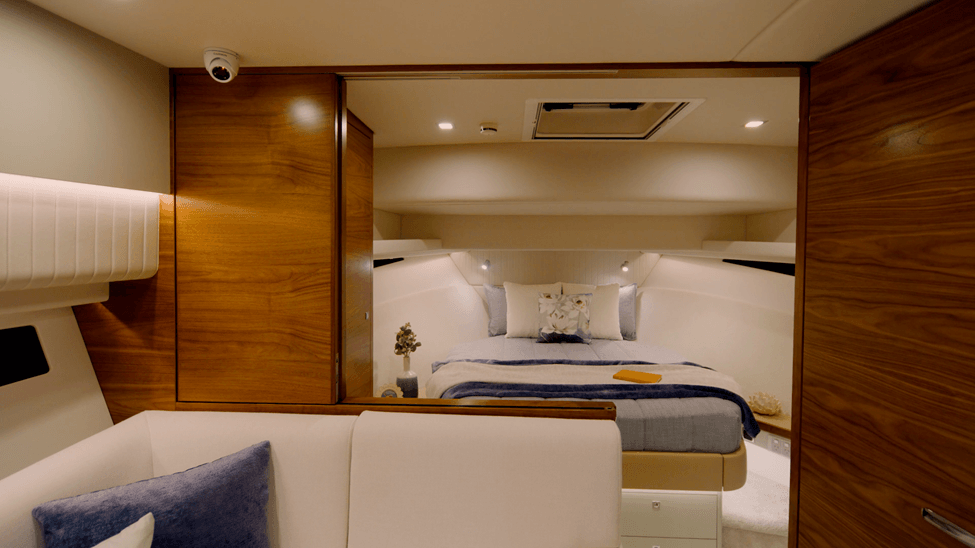
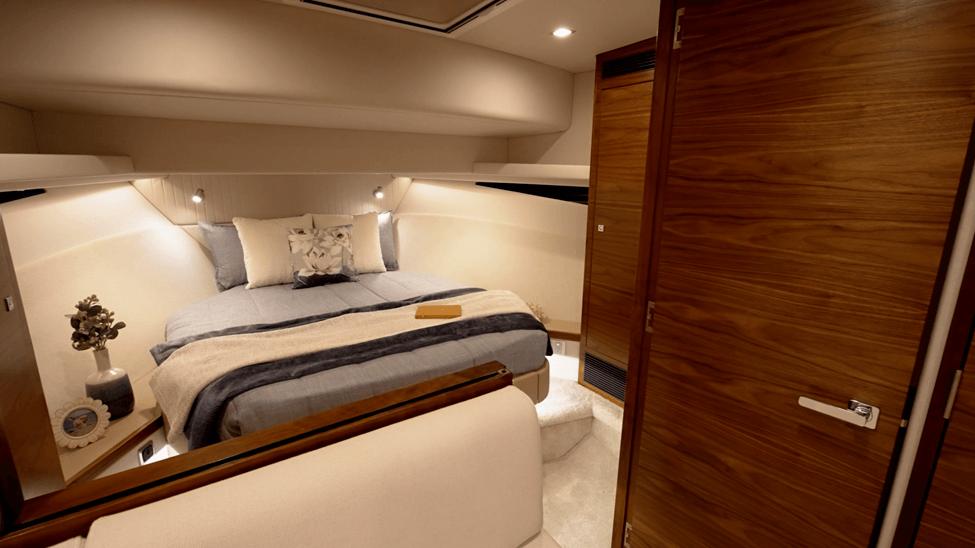
A sliding bulkhead locks into place and the door closes off, making a private cabin -- if desired. The craftsmanship shows here: high-gloss walnut (a matte finish is optional). A cedar-lined hanging locker sits to starboard, with a larger one to port.
We should point out that increasingly motoryacht builders are dropping the traditional cedar-lined hanging lockers – even boats over 100 feet. So, it is notable, that Riviera continues the tradition of the more costly cedar.
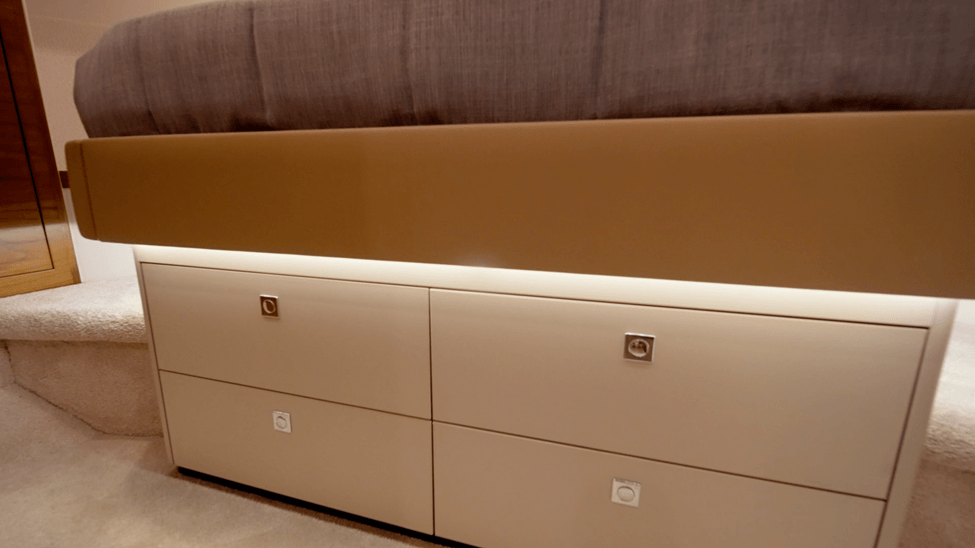
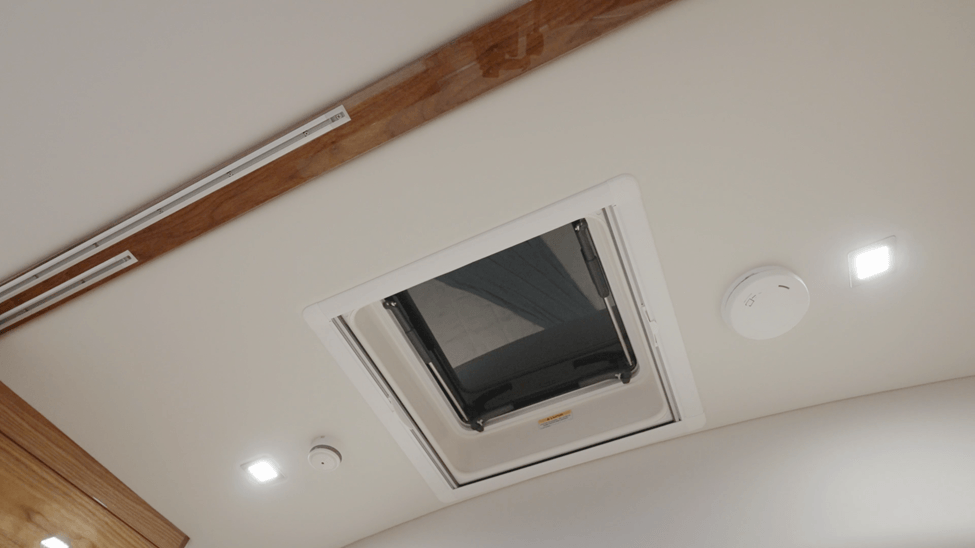
The island berth has four drawers at the foot and a larger storage space beneath — the bow thruster, if optioned, lives there. Upholstery is padded throughout, with hull-side windows, recessed strip and puck lighting, reading lights, and an overhead hatch for ventilation.
Aft Guest Cabin
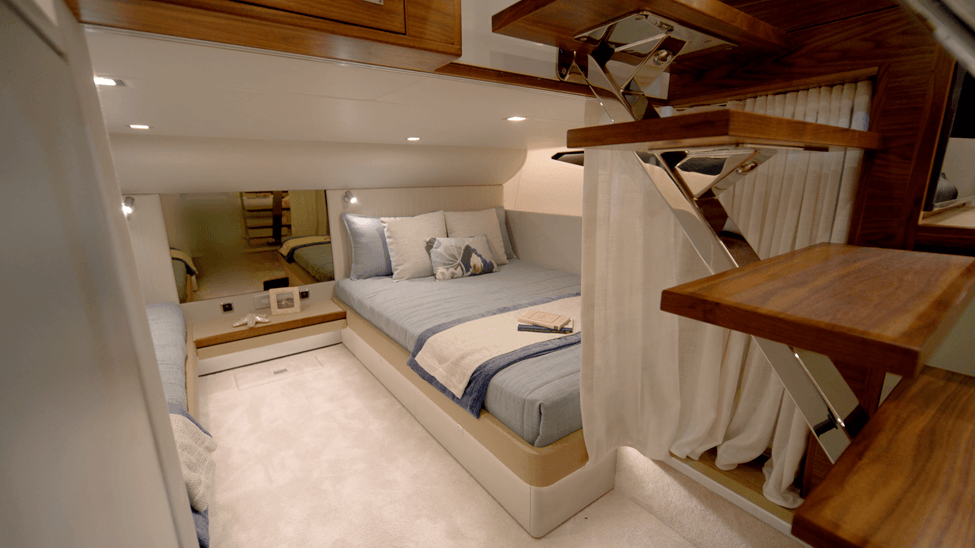
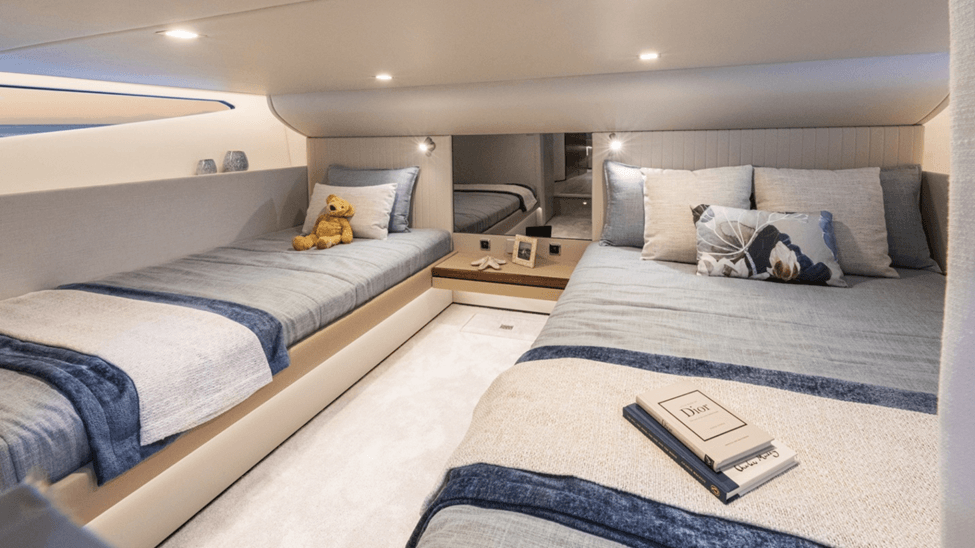
One step down leads to the aft cabin. The overhead drops considerably, but seated headroom is adequate, and the beam keeps it feeling large and airy. Thee ae two berths in this area; the port berth is noticeably wider than the starboard one. Two storage drawers sit underneath, and a shallow side table spans both berths with a hidden drawer and USB ports — a natural spot for phones and chargers.
Mirror, padded upholstery, and hull-side windows finish it off, with a hanging locker forward. For more privacy, the standard curtain can be upgraded to the same walnut doors used forward.
Main Deck
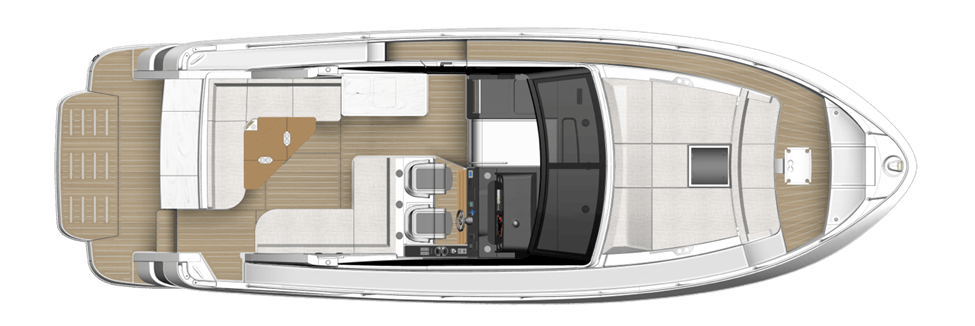
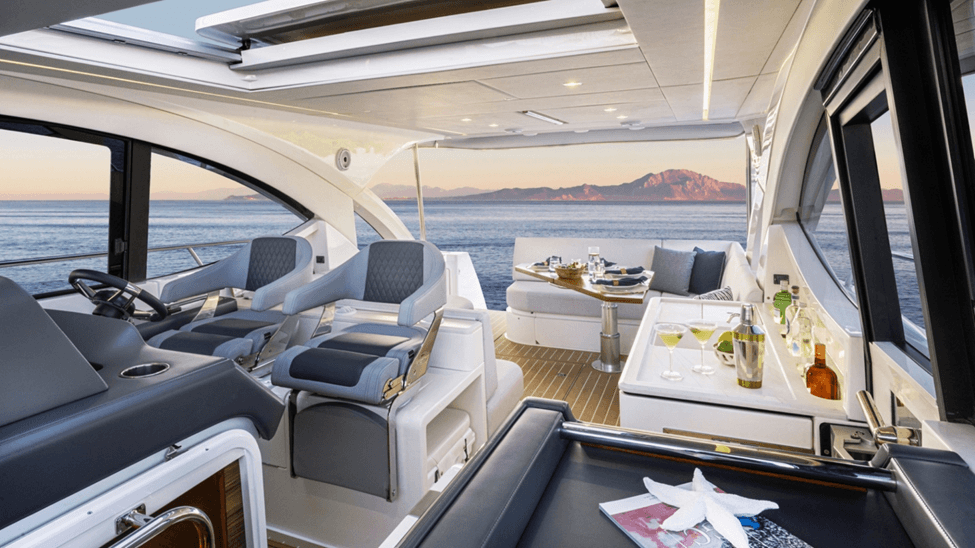
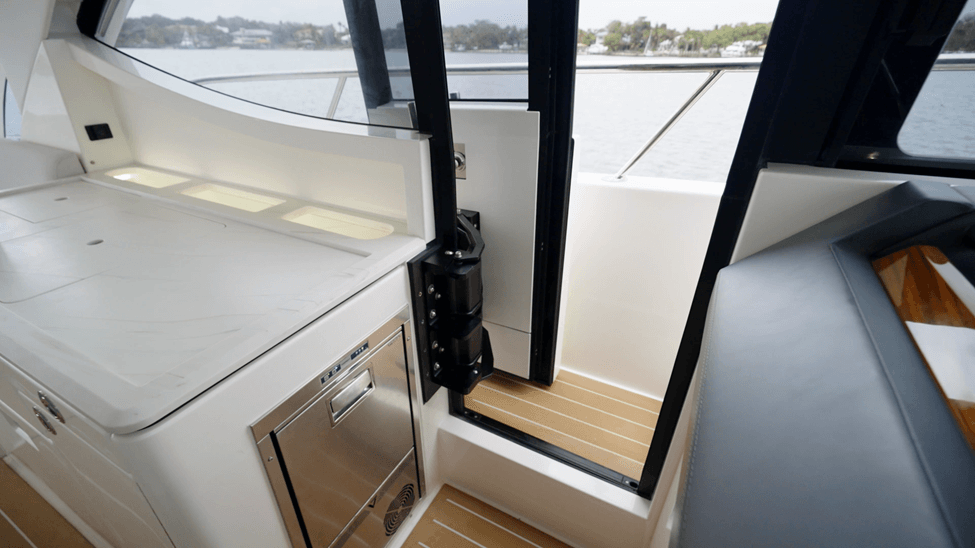
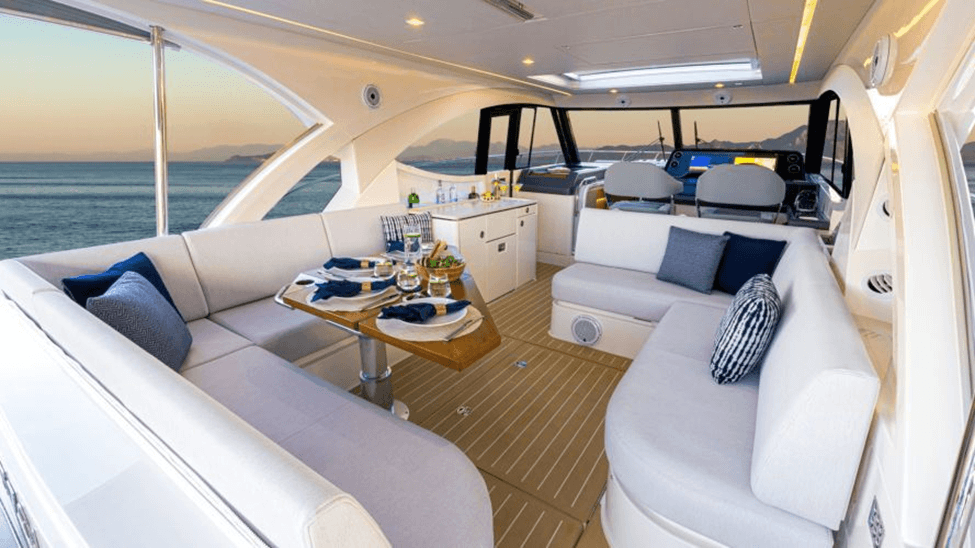
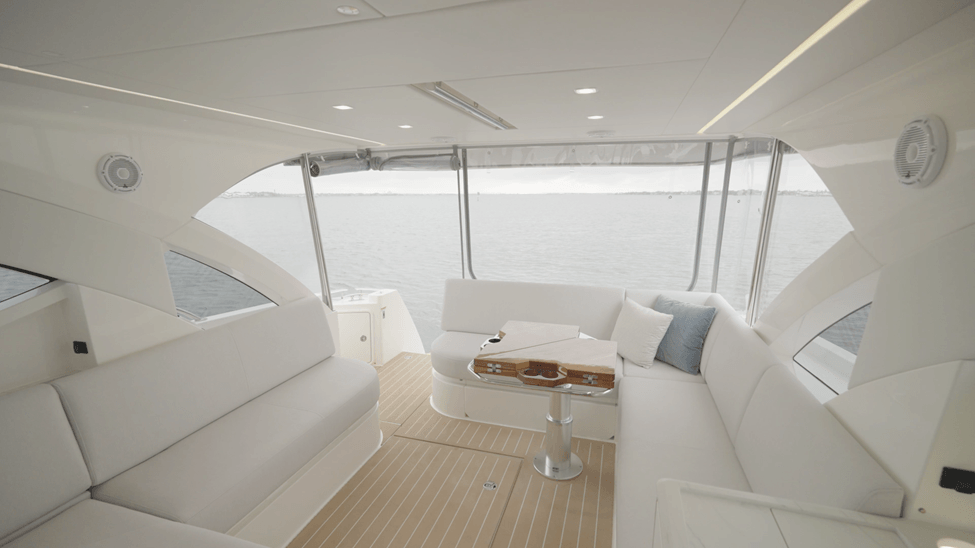
The enclosed main-deck coupe is the primary social zone. The port side-entry door connects the foredeck to this space, and just inside is a well-equipped wet bar: ice maker, glassware and stemware storage, and a refrigerator finished to match the joinery rather than left as bare stainless, plus rear storage for wine or small items, a dedicated trash bin, and a sink.
A sunroof above the helm brings in light and ventilation. The L-shaped seating includes storage and USB charging, and the seatbacks rise as the seat lifts. One clever option is a chiller plate built into the seat base — effectively a refrigerated locker, holding the canvas covers at a chilled 42°F.
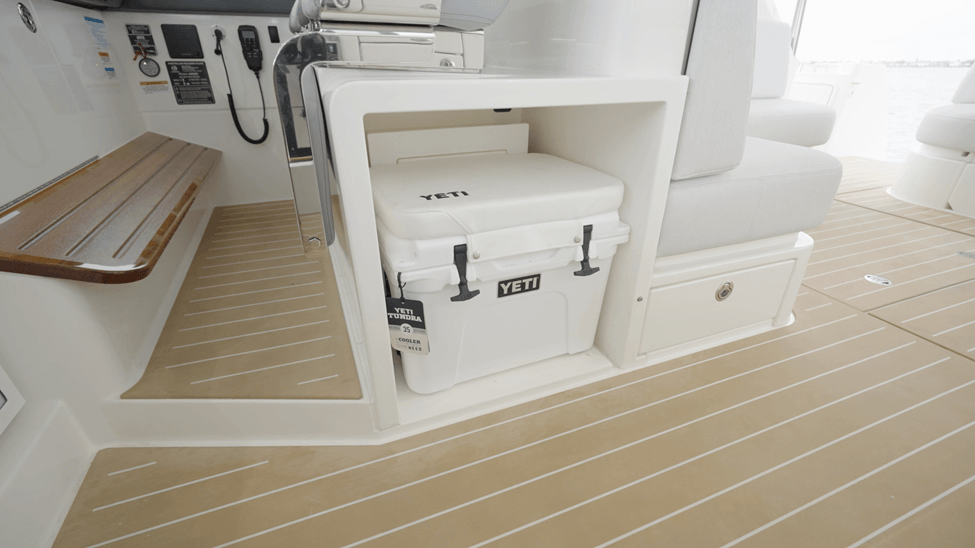
Opposite, a second run of L-shaped seating pairs with an optional hi/lo table that drops to form a daybed; the freestanding cooler shown earlier pulls out to add seating at the table when the guest list grows. Clear enclosures close the space off for heat or cold, and an overhead grab handle is the kind of blue-water touch Riviera is known for.
Climate Control Done Right
A second BoatTEST captain aboard a sistership flagged the air conditioning specifically. Riviera has, if anything, overbuilt it: three AC receptacles at the windshield, four at the helm, three more behind the helm, and two on the starboard side.
Most express cruisers promise that closing in the cockpit will keep it cool. This is one of the few where that's actually true.
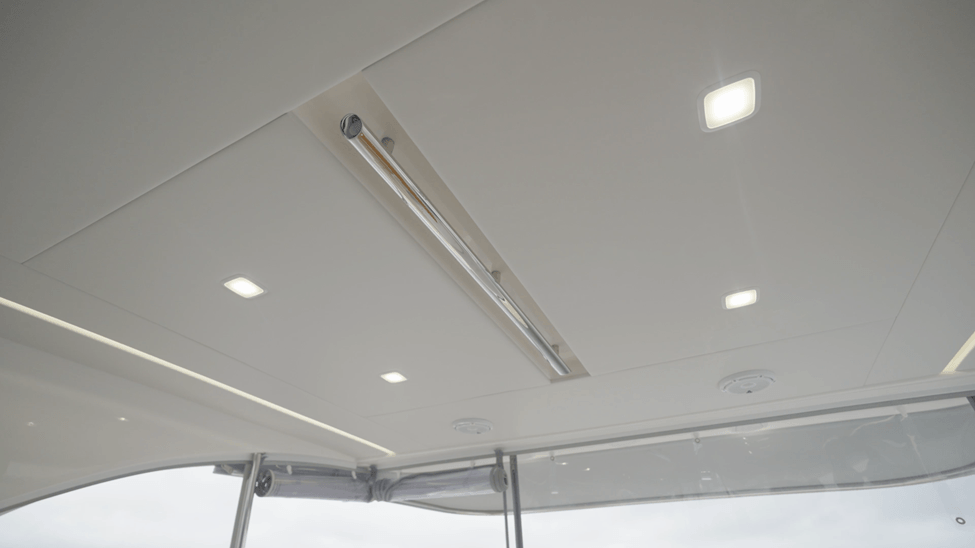
A TV mounted above turns the space into an outdoor movie room — drop the table, drop in the filler cushion, and settle in at anchor.
Aft End
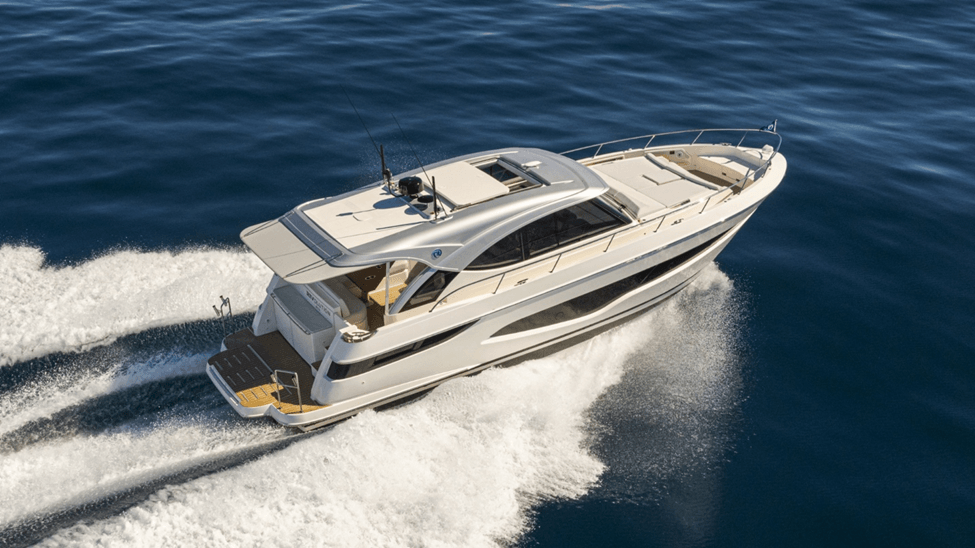
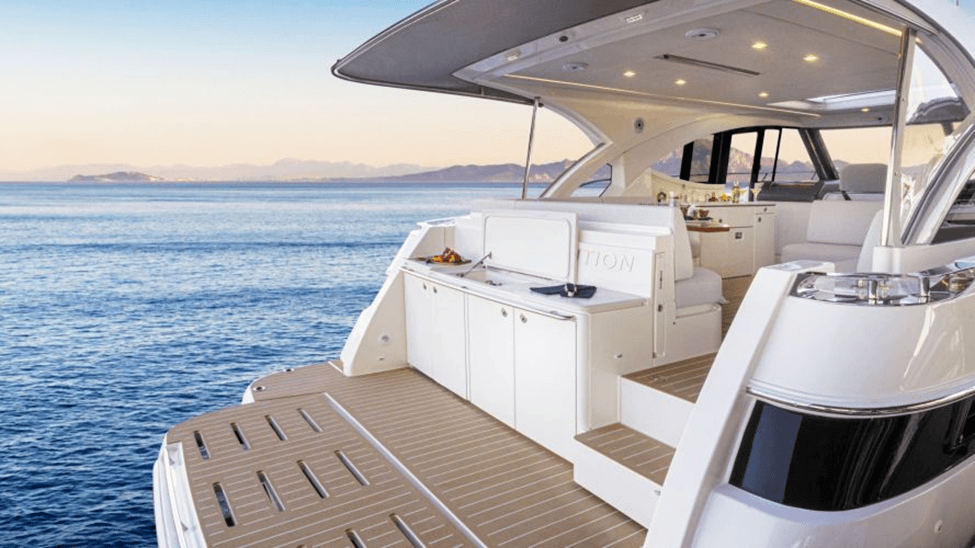
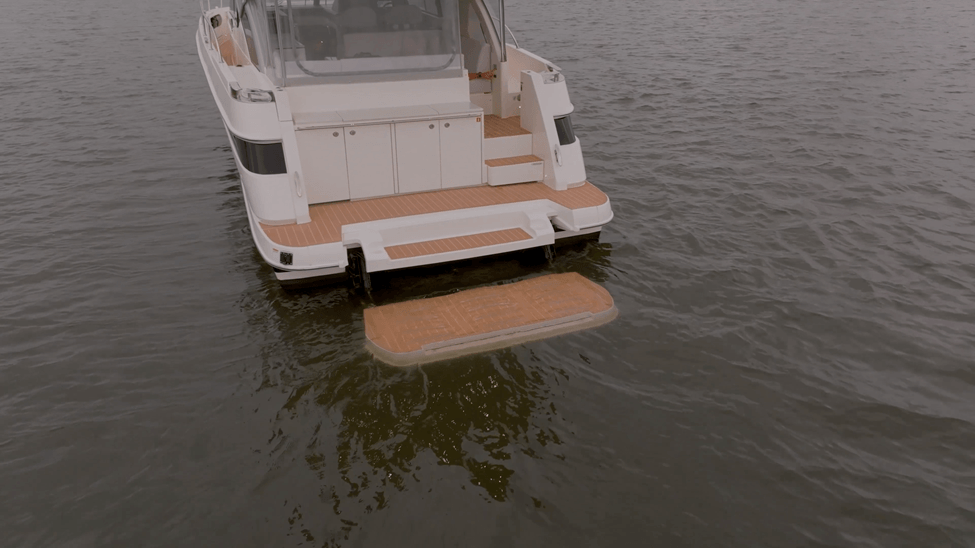
The transom is the boat's social anchor on the water. The 12-foot-wide stern platform is open and safe to swim around — no outboards, no exposed propellers — and functions as swim step, beach, and gathering spot in one.
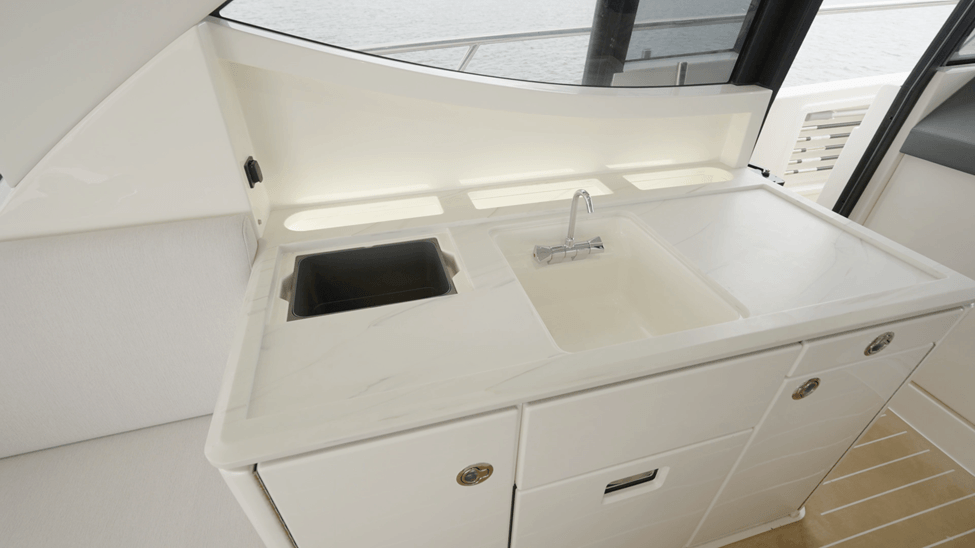
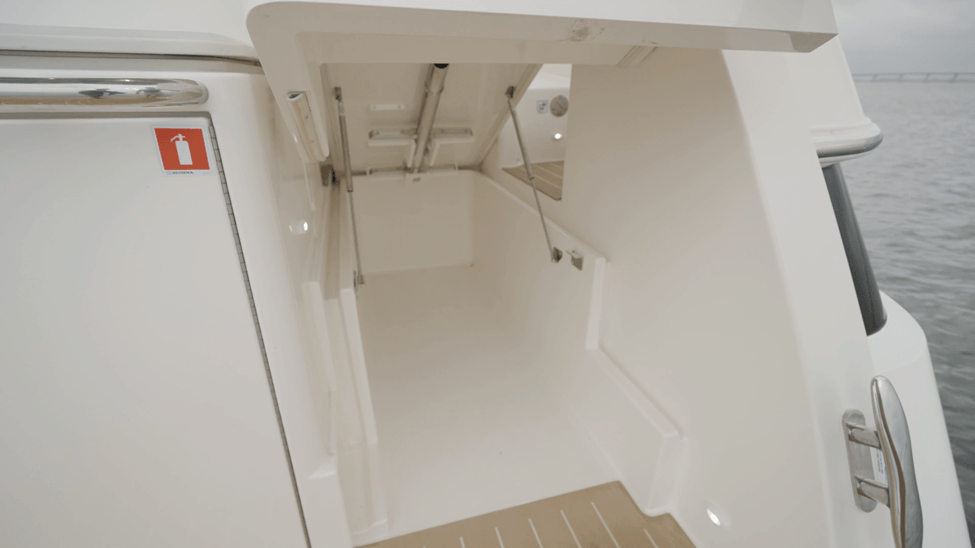
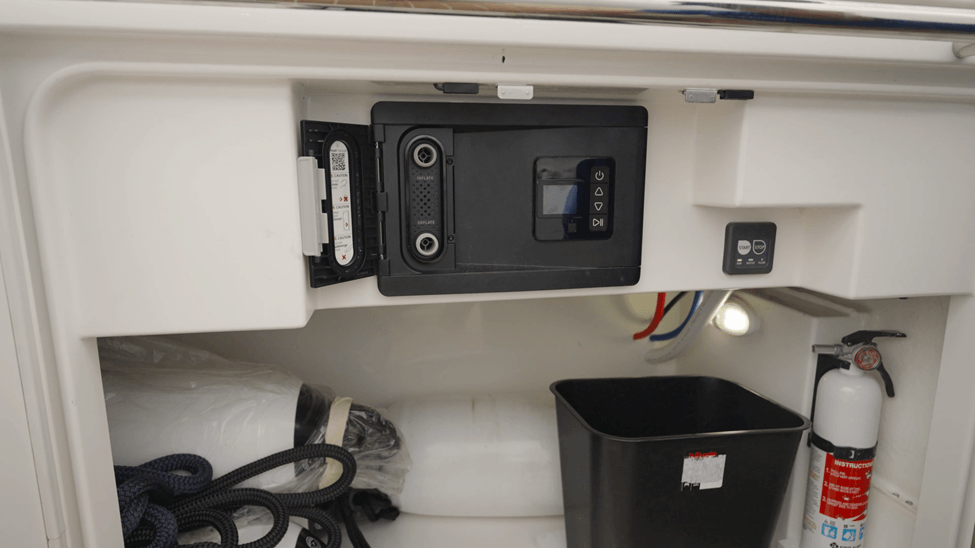
Two steps down is one of the standout zones aboard. Under the steps is a large storage area, available with a tender cradle and charging port. The cooking station has a sink beneath the countertop, an electric grill, and storage that includes a dedicated trash bin and an inflator for water toys.
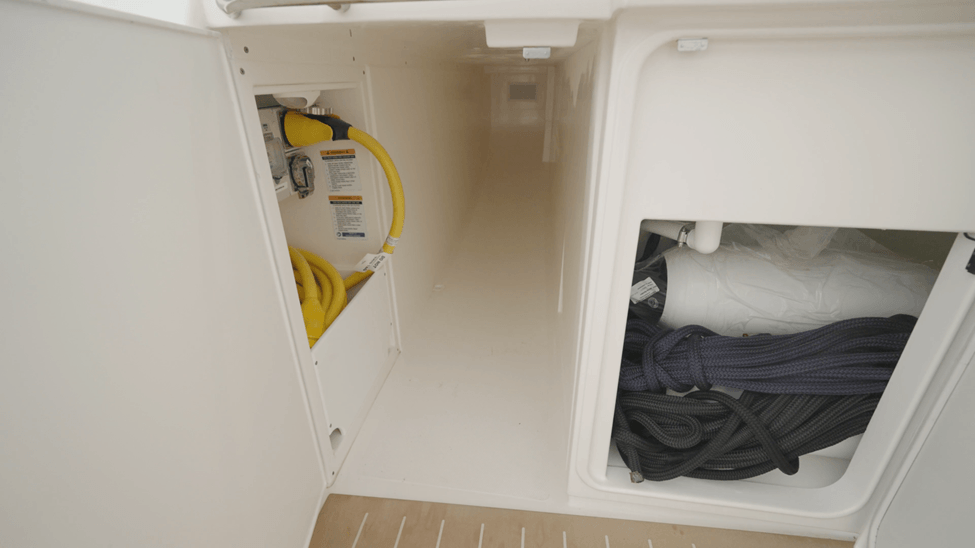
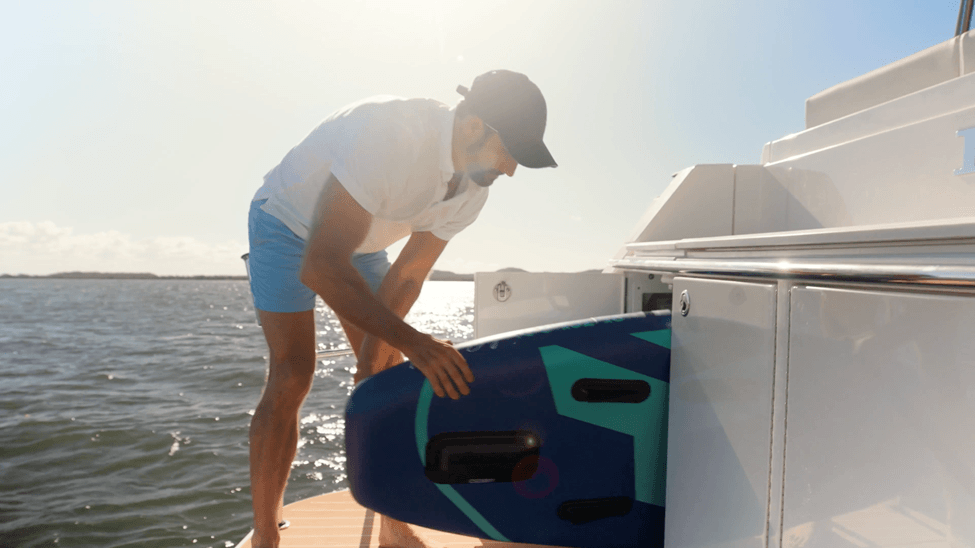
Then there's the storage cavity: a through-hull locker that runs roughly 10 to 12 feet back under the cockpit, deep enough to stow inflated stand-up paddleboards fully rigged. A hot-and-cold pressurized freshwater shower is close by, and the hydraulic swim platform carries and launches a tender, with a seat and cup holders that turn the lowered platform into yet another place to relax by the water.
Side Decks and Foredeck
The side decks are asymmetrical. To go forward under way, the port side is the easier route — the deck is lower and the side-boarding door lets you move through the cabin to midship and back out. A high bow rail and high gunwale add security up top.
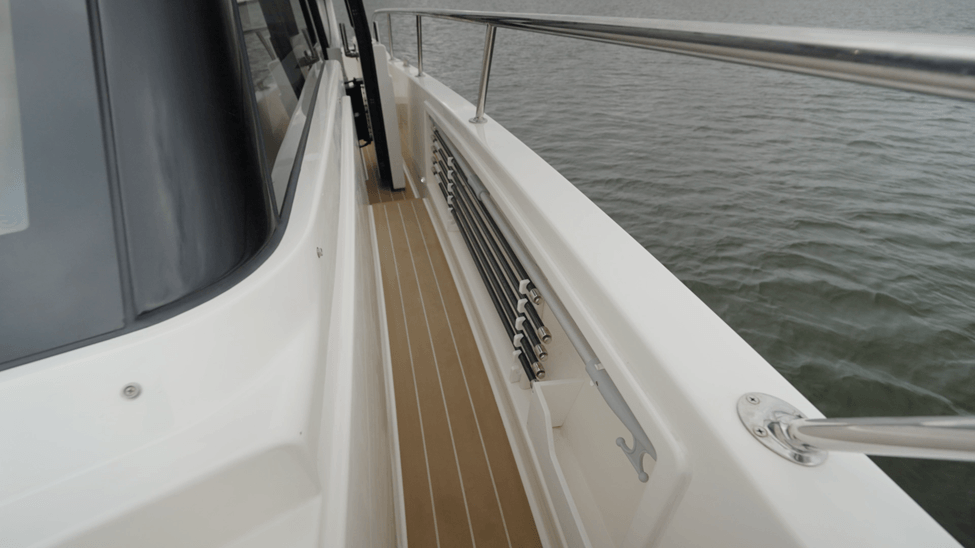
The carbon-fiber sunshade poles stow in dedicated storage tucked under the gunwale, with the shade fabric housed a few steps forward for fast setup.
Machinery Space
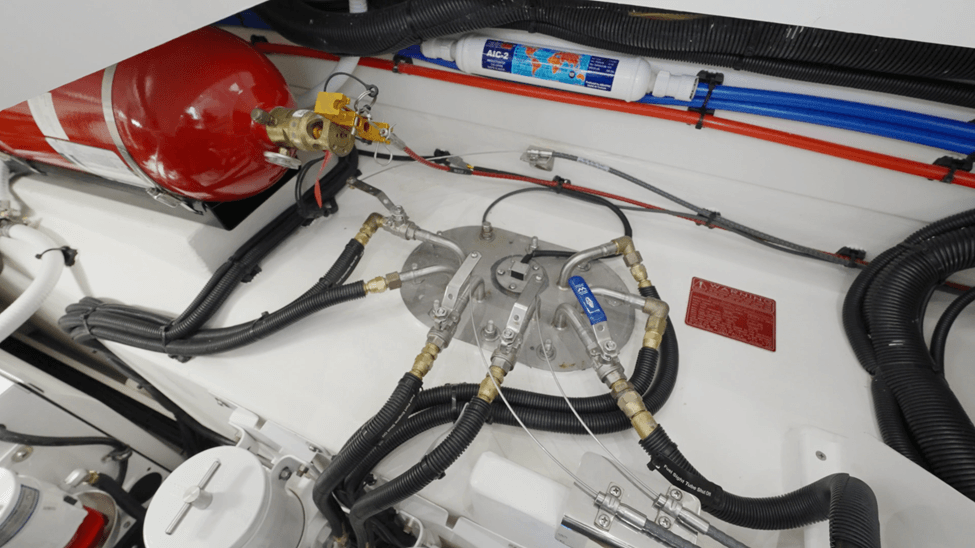
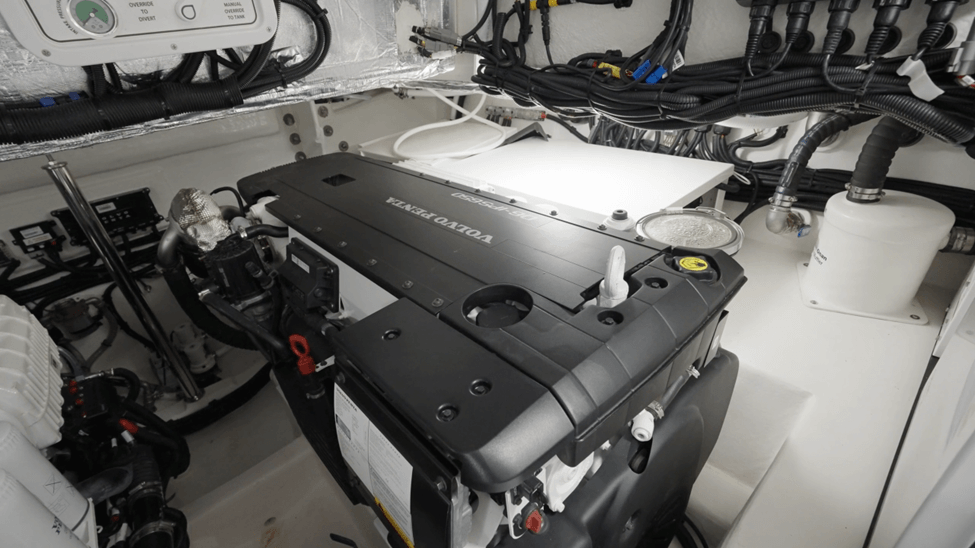
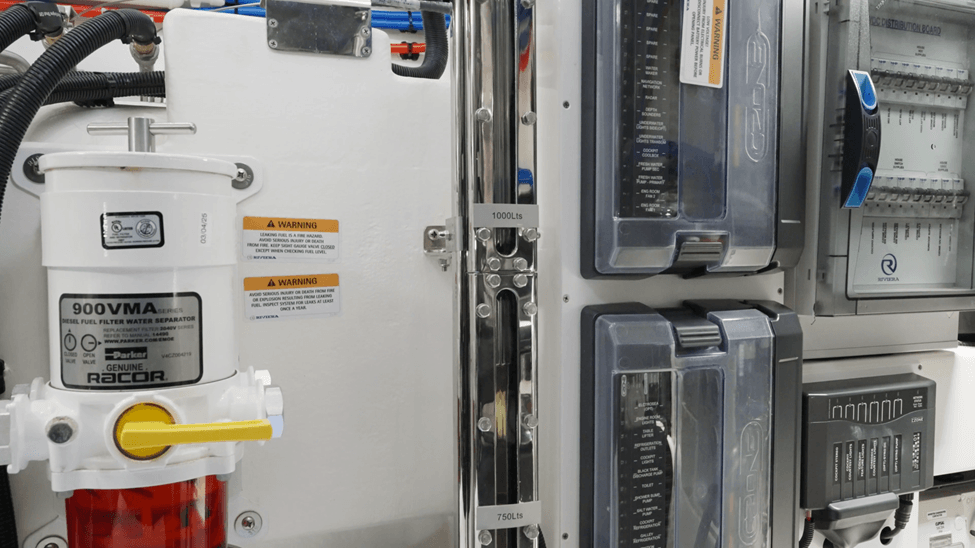
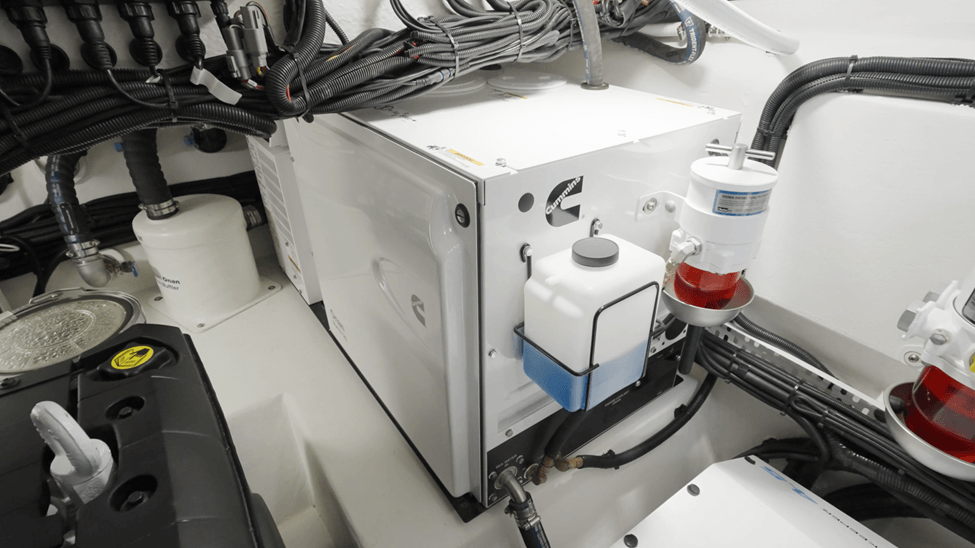
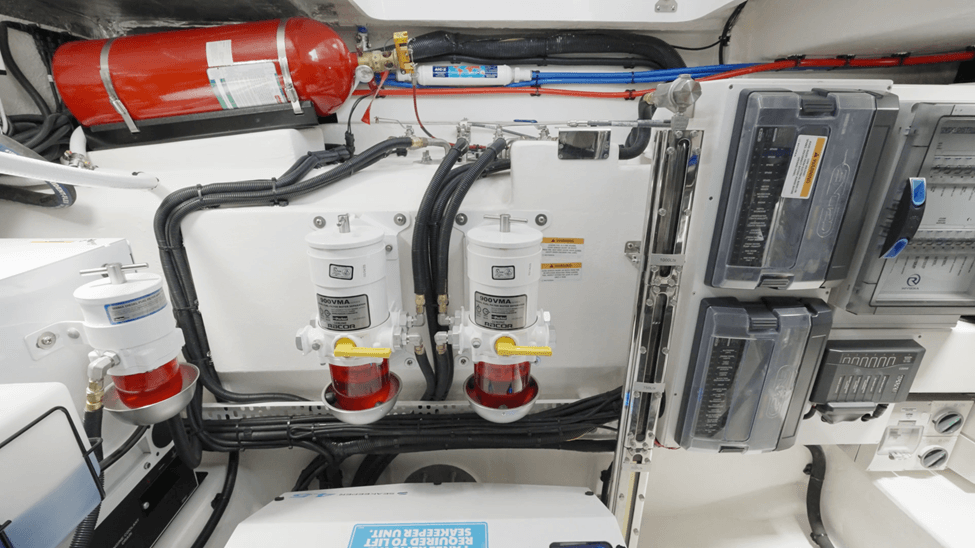
Accessed via a large hatch in the aft salon deck, and while not a stand up engine room, there is an easy access ladder down and a suitable sitting space from which to survey and get to critical maintenance checks and perform any necessary work. The first thing that stands out is the fuel tank. The valves on top are easily accessible. This is a fiberglass fuel tank built specifically to fit the space — far superior to the aluminum tanks often seen on boats this size, because it won't corrode and there are no welds to develop pinhole cracks.
Unusual for a yacht this size, a sight gauge lets you visually confirm how much fuel is aboard rather than relying solely on electrical sensors.
Daily checks and even some routine maintenance can be done without much trouble. The big reason is that 14-foot-7-inch beam: most other 43-footers in class run the same engines with 10 inches to 2 feet less beam and, typically, 2 feet less hull length
All-important items are easily reachable: ea cocks, sea and raw-water strainers, oil checks, water filters, the electrical system, and the generator — including its dipstick and an easily accessible fuel filter.
A Word About Performance
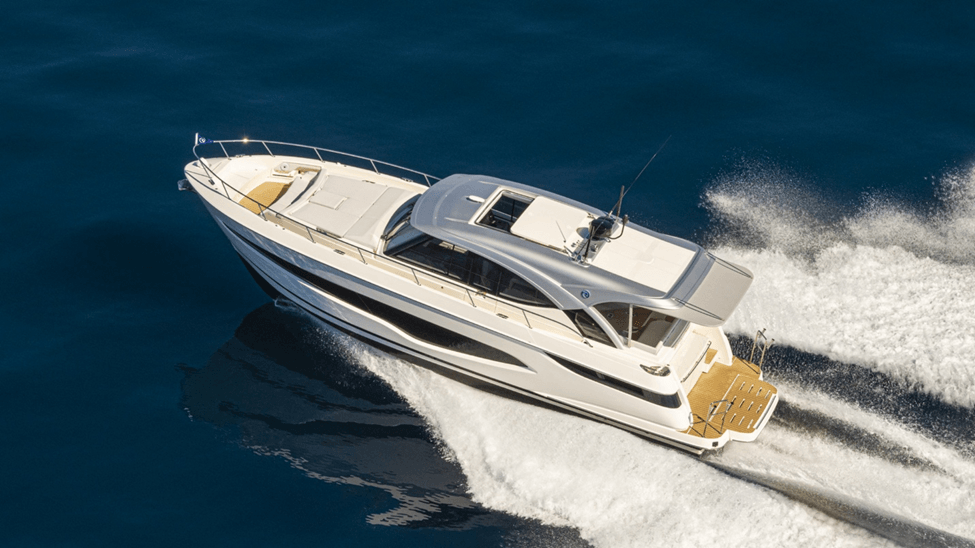
Sitting in the helm seat and taking the wheel of the Riviera 4300 Sports Express is like being in control of a powerful sports car. Balancing performance with economy, courtesy of a pair of optional 480-hp Volvo Penta D6 IPS 650’s, makes this model a superior choice for a hands-on cruising couple.
With trim assist engaged, our test boat easily came up on plane and while we did experience some bow rise, we never lost sight of the horizon. We also found that during all our maneuvers and speed runs, we experienced a quiet interior cabin due to the addition of superior sound dampening materials throughout the construction process.
Our test day saw calm wind from 5-10 knots with an air temperature at 64° and relative humidity at 69%. Test weight was approximately 37,317 pounds with 70% of the 316 gallon capacity of fuel on board. There were four people aboard.
The boat topped out at 33 knots with everything smooth and quiet in the cabin. Riviera packs a good amount of sound-dampening material into the engine room, and with the helm enclosure mostly buttoned up — the aft section was open a little — it stays quiet inside. The boat handles easily too; there's no fighting the wheel to hold a straight line, and it leans predictably into a hard turn to starboard, comfortable and holding its line.
The Performance Numbers
We saw our top speed come in at 33.2 knots at 3800 rpm.
Best cruise came at 3250 rpm with a 25.9 knot turn of speed and a 214 nautical mile range with a 10% fuel reserve.
During hole shot runs, we went from 0-10 mph in 4.5 seconds, 20 mph in 10.5 seconds, and 0-30 mph in 22.0 seconds. She tracked straight and true during our speed runs and was under complete control during turns and hard over maneuvers. During docking operations, and utilizing the joy stick with dock assist mode, we experienced a precise ability with no need to make any last minute moves or adjustments. In total, the Riviera 4300 Sports Express is a pleasure to drive and operate.
Docking
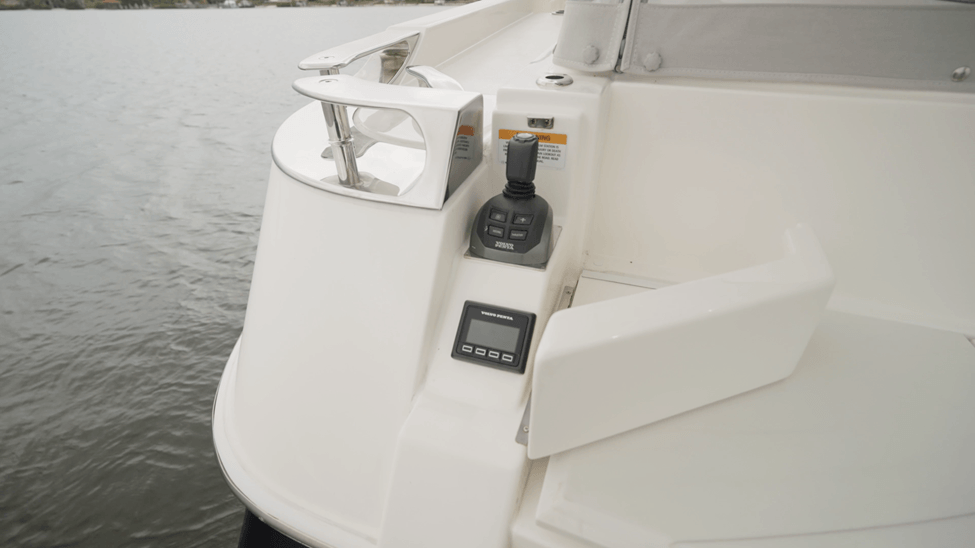
The 4300 is equipped with dock-assist mode, but the traditional joystick approach brings her alongside nicely — slow and parallel to the dock, backing off just enough to barely kiss the fenders before tying up. There's also an optional remote control station on the port quarter: this second joystick location lets you dock the boat and then step off to make fast, which is a real help when the helm sightlines aren't ideal for coming alongside solo.
The Bottom Line
Under way, the 4300 Sports Express delivers on the promise of its name — a genuinely sporty, quiet, easily handled express cruiser with the efficiency and reliability of diesel IPS power. But the details underneath the performance are what separate it: an honest hull length, class-leading beam that pays off in stability and a workable engine room, a fiberglass fuel tank with a sight gauge, and helm ergonomics built for long days. It's a boat that holds up to scrutiny well after the sea trial ends.
Summary & Observations
An Honest 43
When buying any boat, know exactly how big she really is. Most builders exaggerate length by quoting length overall (LOA) rather than the actual hull length, because they know buyers compare length against price. Traditional builders like Riviera don't do that.
The 4300 measures 45 feet 6 inches LOA, but Riviera calls her the 4300 because her hull length is 43 feet 6 inches — where the name comes from. Many other so-called 43s in the class are actually 10 inches to a foot or two shorter on the hull.
The Beam Advantage
One of the most consequential details on the 4300 is her beam: 14 feet 7 inches, which is 9 inches to a foot and a half more than most other boats in class. That extra width makes her more stable in a seaway and roomier both on deck and below — a theme that pays off repeatedly as you move through the boat.
The Riviera 4300 Sports Express, with its blue water heritage deeply rooted in the often challenging waters of Australia, offers it owners and their guests a sporty, performance-based yacht with luxurious surroundings. Perfectly balanced with Volvo Penta IPS inboard diesel engines, in either 440- or 480-hp, not only provides dependable service but economy as well when planning extended time away.
Couple that with a pair of well-appointed staterooms, large head with separate shower compartment, plenty of storage space, below deck salon, and exciting décor to satisfy any taste, a long list of standard and optional equipment, and the Riviera 4300 Sports Express is a personal yacht designed and engineered for all the right reasons. Her entertaining spaces on the main deck and bow, along with dining areas, add yet another dimension to her ability to provide a personal statement of ownership.
REMEMBER, LIFE IS BETTER ON A BOAT!
About the Reporting Captains
Experts and Boat Owners
What has set BoatTEST apart from the many video-makers currently on the Internet and Social Media is the fact that for 26 years, only USCG-Licensed captains and experienced boat owners have tested and written our reports and made our videos. We believe that to provide boat owners the information they deserve, only other boat owners – who know the challenges of ownership -- can accurately report on it. It is that level of expertise and ownership experience that goes into every video and Captain’s Report that we publish. Because we know what it is like owning and operating a boat, we can pass-on the information that prospective boat buyers need to know.
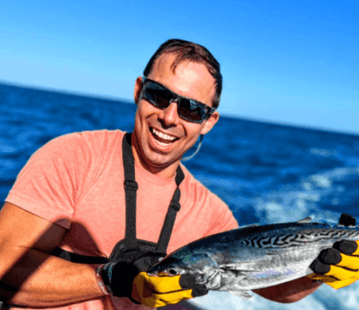
Capt. Trip Smith holds a USCG 100-Ton license and has 22 years of experience navigating various types of boats, such as center consoles, runabouts, wake boats, and cruisers. He now owns a 22’ C-Dory. At 36 years old, he is living the dream of escaping the typical 9 to 5 job and has become a popular boat adventure video creator with over 75,000 YouTube subscribers. Capt. Trip Smith's expertise is evident in his 434 videos, where he shares his experiences spearfishing, collecting scallops, cooking fresh grouper on his boat’s grill, and planning his next adventure. Capt. Trip has an impressive background as a firefighter, outboard engine mechanic, boat rigger, fiberglass repair and restoration expert, and kayak safety teacher.

Capt. Ken Kreisler is a well-known figure in the marine industry, with extensive experience testing boats for major boating magazines. He has held USCG 100-Ton License for 40 years and has served as a delivery and charter fishboat captain, project manager for two small passenger ferry catamarans, making sure every details met USCG build standards. Capt. Ken is an accomplished writer, having received several BWI awards and the John Burroughs Association certificate of commendation for his children's book, "NATURE SPY," published by Macmillan. He resides with his family on the Shrewsbury River in Monmouth Beach, NJ, where he enjoys boating on his 24-foot Grady White Explorer.
Features Video Transcript
Overview
The 4300 Sports Express is a new model from Riviera Yachts, designed for families who enjoy water sports, entertaining at home, and weekend adventures, and who want the benefits of inboard power and a high-quality build. Testing was conducted under overcast, gray conditions.
Stern / Swim Platform Area
The stern features a 12-foot wide open stern platform, described as free of outboard motors and exposed propellers, allowing safe swimming access.
Beneath the entry steps is a large storage area, optionable with a cradle and charging port sized to house a SeaBob.
Outdoor cooking station:
- Sink beneath the countertop
- Electric Kenyon grill
- Storage below, including dedicated trash can storage and an inflator for water toys
Additional stern storage: A storage cavity extending approximately 10.5 feet back, sized for inflated stand-up paddleboards or other water toys.
Additional stern features:
- Hot and cold pressurized freshwater shower
- Hydraulic swim platform, allowing tender deployment
- Seating and cup holders positioned between the cockpit and the swim platform, functioning as an additional water-sports-adjacent zone
Side Decks
The side decks are asymmetrical. The captain's assessment: the port side is preferable for moving forward while underway, as the decks are lower and a side boarding door allows passage through the cabin to midship and out onto the deck.
- High bow rail and high gunwale
- Dedicated under-gunwale storage for carbon fiber poles used to erect the bow sunshade
- Separate dedicated storage space forward for the sunshade material itself
Bow Seating
The bow sun pad is rated to lounge three, possibly four adults. The captain noted the sun pad's support structure specifically: "The backs of this sun pad and the support system is probably the most substantial system that I have seen on a boat."
Cup holders and grab handles are provided for passengers underway.
Recessed bow seating: Unlike most boats in this class, which offer only a sun pad forward, the 4300 includes recessed bow seating. With cushions removed, a table raises into position, converting the area into dining for up to six guests (three, possibly four, on one side, with opposing seating at the bow). The captain remarked this feature is typically seen on 60- or 70-foot boats rather than a 43-footer.
Additional bow features: JL Audio speakers, storage, cup holders, USB ports, and independent audio zone controls allowing bow occupants to set their own volume level separate from the rest of the boat.
Main Deck / Social Zone
A port-side entry door provides access from the foredeck to the main deck; the captain identified this area as the boat's primary social zone.
Wet bar (just inside the entry door):
- Ice maker
- Dedicated glassware and stemware storage
- Refrigerator finished to match the surrounding cabinetry (not exposed stainless steel)
- Rear storage suited to wine bottles or small items
- Dedicated trash can and sink
A separate cooler is positioned across from the wet bar.
Sunroof: Located above the helm; opening it increases natural light and ventilation in this area.
Seating: L-shaped seating with under-seat storage and USB charging. The seat backs lift via a raising mechanism; storage underneath includes an optional chiller plate function. At time of filming, this chiller compartment held canvas covers at 42°F.
High-low table (port side): Lowers via push-button control; with infill cushions added, converts to a daybed. In the raised position, the previously mentioned cooler can be removed to create additional table seating for larger groups.
Aft enclosure: A clear enclosure at the aft end of this space provides heat or cooling protection as needed. An overhead grab handle is present in this area, which the captain characterized as: "a sign of a blue water boat, and that is what Riviera is known for."
Captain Shelly's Supplemental Commentary
Captain Shelly, reviewing a sister ship, provided additional observations:
Air conditioning: "Riviera has overdone it with AC receptacles. Three at the windshield, four at the helm, three additional ones behind the helm for this space back here, and an additional two on the starboard side." Her assessment of enclosed performance: "I think this is the first time that I can confidently say that if you close all this in, it will probably get pretty chilly in here."
TV: Mounted above the L-shaped seating; noted as one option for an at-anchor evening — dropping the table, using a filler cushion, for outdoor movie viewing.
Below-deck cabin space: Captain Shelly's overall impression: "Down below, it feels more like an expensive loft than a boat... it just feels bright, open, and airy." She noted the upholstery choice (versus vinyl, common on comparable express cruisers) contributes to a "more homey," "more cozy" feel.
She also noted safety features on the companionway steps: multiple grab points and non-skid surfacing.
CZone system: Allows switching between "cruising mode" and "entertaining mode" via a single control, turning off non-essential systems (Garmin screens, VHF radio) while activating systems desired for entertaining, without manually operating individual breakers and switches. Captain Shelly specified: "It's important to note that the CZones are controlling the DC systems on the boat, not the AC."
Cabin dimensions: The boat is beamier and has higher freeboard than others in its class, which Captain Shelly stated results in greater interior volume, headroom, and width.
Cabin seating/berth: L-shaped seating with a high-low table that lowers and, with a filler cushion, becomes a large berth or lounging space — positioned near the TV and sound system.
Storage: Two pull-out drawers, a cabinet, overhead cabinet, and a companionway-adjacent compartment accessible from both the cabin and the deck above.
Galley (starboard side): Stove, microwave, and primary refrigeration. The lower refrigerator/freezer can optionally be replaced with a dishwasher. Lighting includes a hull side window plus recessed/hidden LED strip lighting paired with a mirror to enhance the sense of space. A dedicated trash bin is tucked beneath the countertop.
Head (forward, starboard side): Generously sized shower with a bench seat and a storage cubby for soaps/shampoo behind the bench. Vanity with a vessel sink, storage above and below, and a hull side window with an opening port. Captain Shelly noted a safety feature: "All the opening ports on this boat... have alarms. So if one of those is open and you begin to get underway or attempt to get underway, an alarm is going to sound letting you know, 'Go check those ports, because you're about to be getting water in the boat.'" She also praised the shower door engineering: "It opens and closes easily. It was engineered very well above and beyond. Oftentimes on a boat, I don't see the shower door working this well and being this beefy."
Forward Cabin (Main/Private Cabin)
Access is via a sliding wall that locks into place, closing off the cabin for privacy. Finish is walnut with a high-gloss option (matte also available).
- Hanging locker with cedar lining
- Second, larger hanging locker on the port side
- Four drawers at the foot of the bed
- Larger storage space under the berth (bow thruster location, if fitted)
- Padded upholstery surrounding the island berth
- Additional port side windows
- Recessed strip lighting, puck lighting, and reading lights
- Overhead hatch for natural ventilation
Aft Sleeping Quarters
One step down from the main cabin area. Overhead height is reduced somewhat compared to the forward cabin, though Captain Shelly noted: "When I'm seated on the berth, I have an adequate amount of space, so I don't feel totally crammed down here." The boat's beam contributes to a sense of openness in this space as well.
- Port berth is wider than the starboard berth
- Two storage drawers under each berth
- A shared side table spanning both berths, with a shallow drawer and USB ports along the side — suited for phones and small chargers
- Mirror and additional upholstered padding
- Additional port side windows
- Hanging locker forward
Privacy options for this cabin include a walnut-finished closure (as in the forward cabin) or, as optioned on the test boat, a curtain.
Summary Assessment
The reviewing captain's closing statement: "The 4300 is ideal for a young family and children will love this cabin... this luxury yacht is made for an active family to use as a water sports platform, a weekend getaway, or a movable vacation summer cottage with all the comforts of home."
Captain Shelly's closing remark: "Cheers to Riviera for yet again impressing me with your new vessel. And cheers to life always being better on a boat."
Performance Test Video Transcript
Power and Industry Context
The Riviera 4300 Sports Express is powered by twin inboard diesels — Volvo IPS650s. Captain Trip noted an industry-wide pattern: "All but one of the express competitors to this boat use exactly the same Volvo Penta D6 engines. That means the industry pretty much agrees that this is the most efficient way to power a mid-40s motor yacht. Only one other brand is outboard-powered."
Sea Trial Observations
- Cruising speed observed: 32 knots, climbing toward top speed
- Top speed observed during trial: 33 knots
Captain Trip's assessment of ride quality at speed: "I've never lost sight of the horizon from the standing position here at the helm. Boat comes on plane easily... Everything's smooth and quiet in this cabin. I really like that. There's a lot of sound-dampening material and stuff in the engine room... The boat handles easily. I'm not fighting with the wheel trying to keep it straight."
Trim assist was engaged during the maneuvering portion of the test.
Length Overall vs. Hull Length (Builder Transparency Note)
Captain Trip raised a general consumer-education point about builder naming conventions: "Most builders exaggerate the length of their boats by using the length overall, or LOA, instead of giving the actual hull length, because they know consumers compare length and price. Traditional builders such as Riviera don't do that."
Specific to this boat: the 4300 measures 45 feet, 6 inches LOA, but Riviera names it "4300" based on its hull length of 43 feet, 6 inches. Captain Trip noted competitive context: "Many other so-called 43s in class are actually 10 inches, a foot, or two foot shorter."
Handling in Turns
During hard-over turns to starboard, the boat was observed to lean over as expected while holding its line. Captain Trip's assessment: "Comfortable."
Beam
Beam: 14 feet, 7 inches — noted as nine inches to a foot and a half more than most other boats in this class. Captain Trip's stated effect: "This makes her stable in a seaway and roomier on deck and below."
Helm Seating
The helm seat bolster and footrest fold down; the footrest is padded. Captain Trip's assessment: "The footrest is padded. I didn't even have to look down. I could just feel it... That is something different."
He evaluated long-duration comfort directly: "One thing I always like to think about when I'm driving a boat is: What is this going to feel like in four hours, five hours, eight hours, a long day at the helm? And in this boat, I'm going to be very comfortable. It's not too loud. Everything's quiet, and I can see my surroundings safely."
Autopilot controls are positioned within easy reach of the seated operator. A secondary, unpadded teak footrest with non-skid surfacing is also available for quick operator repositioning.
Standing Visibility (Windshield Header)
Captain Trip flagged this as a key evaluation point for any express cruiser: "When buying an express cruiser, the very first thing you want to ask yourself is: Can I stand at the helm and see out without having to bend over to see out the windshield? That's a common failure on some Euro designs, which have low windshield headers not built to ABYC standards." His assessment of the 4300: "I'm happy to say that the Riviera is, and standing visibility is excellent."
Specifications (Test Boat)
- Length overall: 45 feet, 6 inches
- Beam: 14 feet, 7 inches
- Draft: 4 feet, 2 inches
- Test weight: 37,317 pounds, with 78% of the 316-gallon fuel capacity aboard and four passengers
- Engines: twin Volvo Penta D6, with IPS drives
Performance Numbers
- Top speed: 33.2 knots at 3,800 RPM
- Best cruise: 25.9 knots at 3,250 RPM, achieving 0.8 nautical miles per gallon
- Range at best cruise: approximately 214 nautical miles, with a 10% fuel reserve
- Hole shot (0–10 mph): 4.5 seconds
- 0–20 mph: 10.5 seconds
- 0–30 mph: 22 seconds
Anchoring
The boat allows anchor deployment and retrieval to be monitored visually from the helm, without needing to go forward. A chain counter is fitted. Captain Trip's account of use: "I know my depth. I know I need nine meters... And now we're at about five to one. Just put it in reverse and snug it up, and we're home set."
He emphasized the value of visual rode monitoring particularly on retrieval: "This isn't as critical when you're deploying the anchor, but it's going to be more critical later when we bring the anchor up so I can see my rode angle. That's going to be so helpful, especially if you're doing this solo or you may have guests on board, you don't want to disturb them... This is going to be a very handy feature."
Helm Electronics and Dash
- Twin 12-inch Garmin screens standard; 16-inch screens available as an option
- Four AC ducts on the dash
- Spotlight controls (mounted on the cabin top), Seakeeper gyro controls, joystick, and throttles positioned to the right of the wheel
- Garmin MFD controls within easy reach, allowing map zoom, waypoint entry, and autopilot adjustment without leaning forward to touch the screen
- Recessed cubby with USB charging
- VHF radio easily accessible, starboard side, below the main dash
Helm seat: Electrically actuated for height and fore/aft position adjustment. Captain Trip: "If I want a little bit more height while I'm underway, I can do that. And I can also adjust it fore and aft to get that sweet spot so I can be comfortable on those long days on the water."
Maintenance access at the helm: A compartment under the dash provides access to electrical fuses and control boxes. The AC system is accessible by unlocking and tilting forward the panel beneath the helm seat.
Docking Aid
An optional remote joystick control station is located on the port quarter, allowing the operator to dock the boat and then step off to tie up lines directly.
Deck Plan and Bow Access
The 4300 uses an asymmetrical deck plan, which Captain Trip states maximizes interior room, "making the most beam-y boat in class even bigger inside." A pantographic side door (a style Captain Trip compared to those found on megayachts) opens to port, providing passage to the bow seating and ground tackle. He noted this bow/anchor locker arrangement is different from what he typically sees on boats of this type.
Anchor locker: Hatch lifts via gas struts after latch release. Fitted with an electric windlass and all-chain rode, controllable via remote or from the helm. Fresh and saltwater washdown is standard.
Pressure washer (optional): Captain Trip noted this as a feature he had not previously seen on a boat: "I've never seen that on a boat before, but it's really pretty interesting, and that's just one of those one more step ups that Riviera offers." When optioned, hookups are provided at both the bow and stern for washing saltwater or muddy chain/anchor.
Additional bow storage: A deep starboard locker (suited to a large fender) doubles as primary access to the anchor locker/all-chain rode; a shallower port locker is suited to a few dock lines.
Engine Room
Fuel tank: Fiberglass, custom-fit to the space. Captain Trip's stated rationale for material choice: "A fiberglass tank is far superior to an aluminum tank, which we often see on boats of this size because it won't corrode and you don't have to worry about pinhole cracks in the welds." Fuel valves are accessible atop the tank, with an additional emergency-access hatch for manual activation.
Sight gauge: Fitted for visual fuel level checking without reliance on electrical sensors — noted by Captain Trip as unusual for a yacht of this size.
Fuel type note: Diesel, which Captain Trip noted removes the gasoline-fume concern relevant to gasoline-powered engine rooms.
Systems checked for accessibility: Seacocks, sea strainers, raw water strainers, oil check points, water filters, additional strainers, electrical system, generator (oil check accessible), and generator fuel filter — all confirmed as easily accessible.
Captain Trip's summary: "Everything that I need to get to on daily checks and even some routine maintenance things, I can do so without too much issue." He attributed this directly to the boat's beam: "The big reason for that is the fact that the Riviera 4300 has a 14-foot, seven-inch beam. Now, remember that most other 43-foot boats in class have the same engines but have from 10 inches to two feet less beam, and most have two feet less hull length. So the question begs, did it come out of the engine room or from the living accommodations?"
Fresh water rinse (engine room): Captain Trip highlighted this feature based on past personal experience: "The moment that you need this in the engine room, you're going to know, and you're going to really appreciate it being here. I've been in that situation before, and I like seeing this here."
Docking Demonstration
The boat is equipped with a dock-assist mode; Captain Trip elected to dock using the traditional joystick method instead. The approach was conducted slowly, parallel to the dock, with large fenders on the pylons providing margin. Docking was completed without incident ("just so that we barely kiss"), followed by tying off dock lines.
Features Walkthrough Transcript
Brand Mission (Model-Specific)
The reviewer stated the model's mission: "To be a versatile and luxurious escape for those who want to maximize every moment on the water." She characterized the target buyer as: "The family that loves to entertain friends, the couple who wants to explore coastal waterways, and the individual who appreciates a blend of thrilling performance, smart design, and absolute comfort."
Bow
Windshield: Full windshield with an elongated brow — a Riviera design consistency, per the reviewer, intended to keep glare off the operator inside.
Sunbed: Sized for four people. All backrests fold forward. Storage is located behind the seating, and a table pops up and out from the center — the reviewer specifically noted the seating configuration: "Not a loveseat, but a couch."
Seating height: Set down slightly so that guests seated here do not obstruct the operator's forward visibility.
Anchor system: Windlass and washdown hose access is located under the center hatch. The reviewer noted a design distinction from many express cruisers: "So many vessels and express cruisers, the anchor locker and the windlass is set down into a hold, so you have to reach down in — a la Riviera's take on this, so that it's easier to access."
Additional bow features: Speakers on both port and starboard.
Gunwale height: 26 inches — consistent with Riviera's typical high-gunwale design, per the reviewer.
Deck drainage: The reviewer noted a slight decline toward a small step, designed for drainage, all channeling into a large scupper.
Entry / Watertight Door
Access to the interior is through a watertight door, described by the reviewer as "hefty."
Salon Climate Control
The reviewer's first impression upon entering: "How much cooler it is in here." She detailed the AC receptacle count: three at the windshield, four at the helm, three additional behind the helm, and two more on the starboard side.
Comparative assessment: "A traditional express cruiser, they say that if you close it all in, that it'll be nice and air conditioned in here, but that's rarely true. I think this is the first time that I can confidently say that if you close all this in, it will probably get pretty chilly in here."
Helm
Large dual displays, standard mounting. The dash features upholstery and carbon fiber accents, with built-in storage for beverages and chart books. Diamond stitching on the operator and companion chairs contributes to what the reviewer described as "an elevated feel."
Ventilation: Manually opening side windows on both port and starboard, plus a large overhead sunroof.
Midships Galley
Ice maker, dedicated glassware storage, refrigeration, trash bin, deep storage basins behind, and a freshwater sink.
Cockpit Table
Stows to expose handrails for movement while underway. Opened on both sides, it is described as a high-gloss, heavy wood table providing substantially more usable space. The reviewer noted cup holders remain accessible in any table position.
Aft Platform
Storage: Beneath the boarding steps, a storage bay is large enough for underwater scooters or dive equipment.
Aft galley (second of three food prep areas on the 4300): Described as more of a summer kitchen, with an electric grill and fresh water.
Additional storage: Room in the aft cockpit for a pair of stand-up paddleboards.
Docking Station / Beach Club
An aft docking station provides full visibility down the side of the vessel while docking. Pressing and holding a button near the starboard boarding door lowers the hydraulic swim platform into the water, revealing what the reviewer called "a unique sea deck and beach club." A large step doubles as a seat — noted as good for kids during the day or for evening sundowners.
Sea Trial Note
The reviewer noted a distinguishing feature of the Cannes Yachting Festival: "Serious buyers can request sea trials." The walkthrough was paused so the 4300 could go out on a customer sea trial, which gave the crew a vantage point to observe the boat from outside as she moved in and out of the harbor. The reviewer's assessment of her profile from this vantage: "She really does have those distinctive [hull/style] lines."
Specifications
- Length overall: 45 feet, 6 inches
- Beam: 14 feet, 7 inches
- Draft: 4 feet
- Dry weight: approximately 28,660 pounds
- Standard engines: twin Volvo Penta D6 IPS 600 diesel, 440 horsepower each
- Optional engine upgrade: Volvo Penta D6 IPS 650, 480 horsepower each
Design Intent (Layout)
The reviewer characterized the boat's overall design goal: "Designed for maximum enjoyment and seamless flow between all entertainment zones. She features a versatile layout with distinctive living and socialization areas."
Return Visit — Cockpit at Sunset
The reviewer returned to film this vessel at sunset specifically to capture the space as it would typically be enjoyed in use.
Cockpit seating/TV: In addition to L-shaped seating on both sides, an overhead TV is fitted. One suggested use: lower the table to its down position, add the filler cushion, and host an outdoor movie night. Alternatively, in warm or buggy conditions without wanting to close the enclosure, guests can move below.
Salon (Below Deck)
The reviewer's characterization: "It feels more like an expensive loft than a boat. The open feel from all the way forward to the guest accommodations in the back — it's all tied in seamlessly. The lighting and the combination of the hull-side windows brings in a lot of light. It just feels bright, open, and airy."
Upholstery: Fabric rather than vinyl — the reviewer contrasted this with typical express cruiser overnight accommodations: "So many express cruisers and vessels that have overnighting accommodations have a vinyl couch. The upholstery gives it a more homey feel, more comfortable, more cozy. Sitting in here watching a movie, drinking a glass of wine, would be just as comfortable as it would be out on deck."
Privacy divider: A sliding door can close off the main cabin for privacy from guests. The reviewer noted the alternative benefit of leaving it open: "If it's just two of you on board, leaving this open, having this wide-open space is a unique feel for an express cruiser of this size."
Design Detail — Door Fit/Finish
The reviewer highlighted Riviera's attention to detail specifically regarding door matching and recessing: "Not only can you see that they tried to match the grain across these two doors, but this door has its own recess... Even the width of a door can make a huge impact on the space that you feel."
Master Head
The reviewer's assessment for the boat's size: "For a 43-foot boat to have a walk-in shower with a seat, wand up above, storage above, [a] pedestal sink..." She specifically noted the drain placement as a nice touch: an additional drain located outside the shower area, not just within it.
Galley/Utility (Lower Level, Additional)
Two fridges, a microwave, sink, trash receptacle, storage above and below, and easy access to CZone switches for AC systems, with DC switches positioned just behind.
Guest Cabin Privacy Option
A curtain has been added for extra privacy in this cabin. The reviewer offered a personal preference: "If I don't have guests on board very often, I would probably go for this option, but there will be an option to fully enclose it with the door as well."
Guest Cabin (Aft)
Described as offering less headroom than the forward berth, though still bright and open once inside. The reviewer noted it lacks enough headroom to stand and dress comfortably, though ample space for that exists forward.
Berth configuration: Double bed to port, single to starboard.
Windows/ventilation: Hull-side windows continue aft, with opening port lights on both sides. Consistent with other Riviera models, these ports are fitted with sensors that trigger an alarm at the helm if the boat gets underway while they remain open.
Suggested Design Improvement (Stairway Corners)
The reviewer flagged a specific concern regarding the stairway leading into this guest cabin space, since occupants pass in and out facing different directions: "I worry that somebody is going to hit their [head/elbow] on these corners. I would suggest maybe rounding them, but that's the nice part about Riviera, and most manufacturers out there — they listen to feedback like this, so I almost guarantee that hull number four or five will have rounded stairs right there."
Closing
The reviewer's closing remark, noting the setting: "It's quite fitting because here I am in the French Riviera." She noted the sunset timing and closed the segment with a personal toast: "Cheers to Riviera for yet again impressing me with your new vessel, and cheers to life always being better on a boat."
Related Boats
Riviera Yachts 445 SUV (2016-)
2 x 435-hp Volvo Penta IPS600
Riviera Yachts 68 Sports Motor Yacht (2018-)
2 x 1,550-hp MAN V12
Riviera Yachts 72 Sports Motor Yacht (2019-)
2 x 1,900-hp MAN V12
Riviera Yachts 395 SUV (2019-)
2 x 370-hp Volvo Penta IPS500