Access More Boat Tests
Already have an account? Login
Silent Yachts 62 3-Deck Open (2025-)

Brief Summary
The Silent Yacht 62 3-Deck Open is designed for ultra-long distance cruising at displacement speeds powered by electric motors energized by solar panels, with extended-range available from a diesel generator. The ship's massive battery bank stores energy for when it is needed. A rest, with a modicum of sunshine, the boat produces more energy than the house needs. Underway, depending on speed and conditions, the boat can be solar energy production/consumption neutral. At higher speeds, the range can be extended with the engagement of a generator designed for ultra-quick charging. Under normal island-cruising conditions with a mix of displacement cruising and anchoring, the Silent Yachts 62 can be totally self-sufficient.
Test Results

*The number of kiloWatts burned in one hour
**Newton Meters of Torque
***286 kWh capacity, reduced to 254.4 kWh to allow a 10% reserve
****Decibels on the “A” scale. Taken at the lower helm with all doors closed
Specifications
| Length Overall |
62' 19 m |
|---|---|
| Beam |
29' 5" 8.99 m |
| Dry Weight |
63,934 lbs 29,000 kg |
| Draft |
3' 0.93 m |
Captain's Report by Capt. Ken Kreisler

Vessel Inspection
In creating their vision for a 62-foot, open flybridge vessel that was all-electric drive, the Silent Yachts design and engineering teams looked at their 80-foot model and decided to scale down the big cat to accommodate a smaller vessel easily handled by an owner-operator. In doing so, they created a sensible, and practical yacht, that can travel as long as there's sunlight.
Upper Deck, 3-Deck Open


Main Deck w/ Front Exit to Bow

Accommodations


Bow
The excitement aboard the Silent Yachts 62 3-Deck Open starts on the bow. With her beam of 29.5’/8.99m carried fully forward, this space affords the kind of room impossible to find on monohull vessels of her size.
Upper Deck
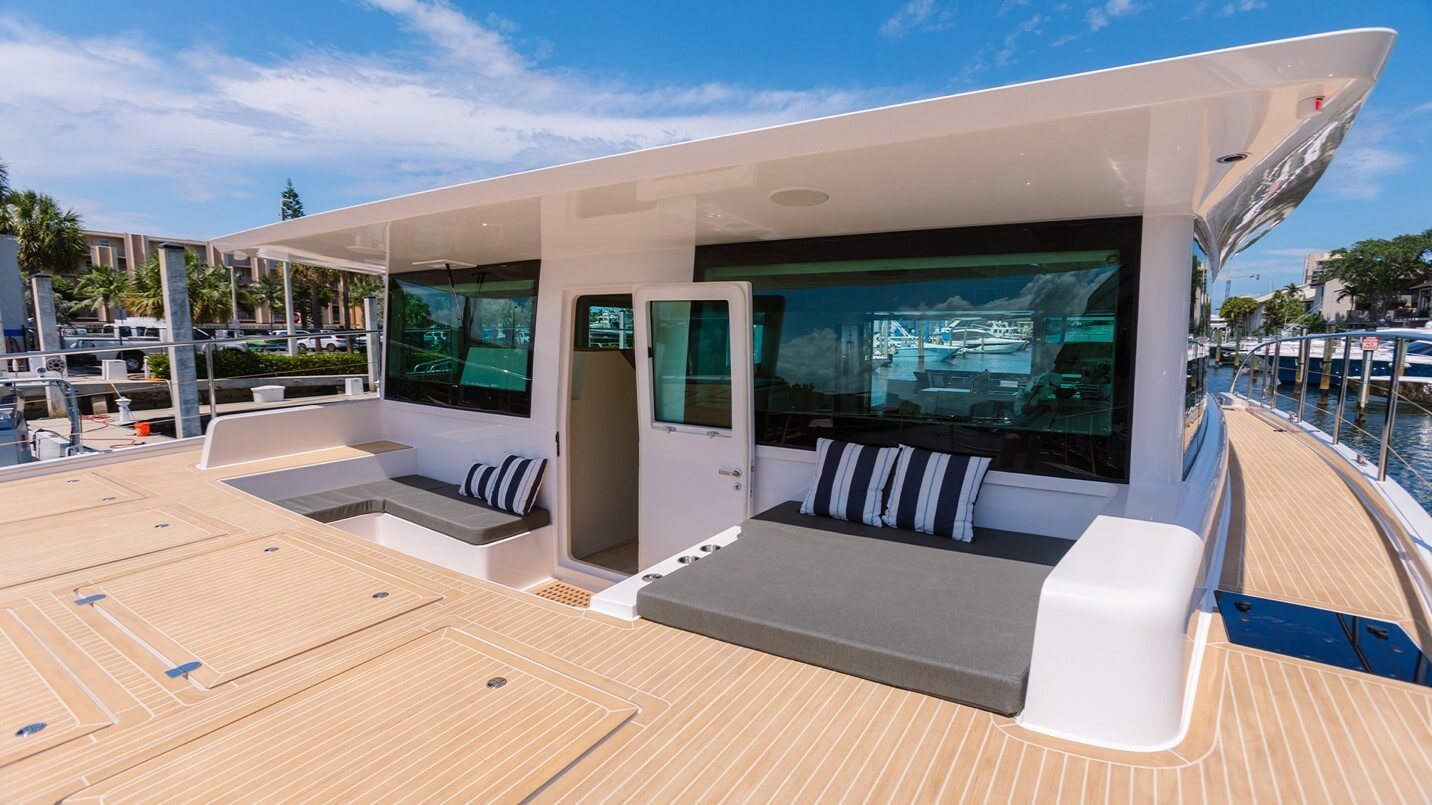
No matter where we looked on the Silent Yachts 62 3-Deck Open, we found wide open spaces designed and engineered for maximum use as entertaining and gathering areas. The upper deck proved to be quite impressive. And, with two versions, an open or enclosed bridge, further exciting options for its use are available, making this a highly personal yacht.


Main Deck Salon
Depending on which model you choose, entering from the bow forward or aft, the Silent Yachts 62 3-Deck’s main deck salon presents design and layout opportunities limited only by your imagination.


Living Accommodations
As we’ve seen, no matter where one looks aboard the Silent Yachts 62 3-Deck, and whether enclosed or open bridge options, excitement abounds. The living accommodations presents a four stateroom, four head layout, all in elegant décor and creature comforts.


A Word About Performance
For mariners who prefer to spend their time at sea aboard full displacement vessels going from six to eight knots with a fair tide and following seas, the Silent Yachts 62 3-Deck is heaven-sent. Moreover, with planning and careful management of energy, and some sunlight, the Silent Yacht 62 can go on an almost endless voyage around the world, with stops in all of the iconic locations, and ones that are better kept secret, to protect them from the hoards of adventurers to come.
The Propulsion System
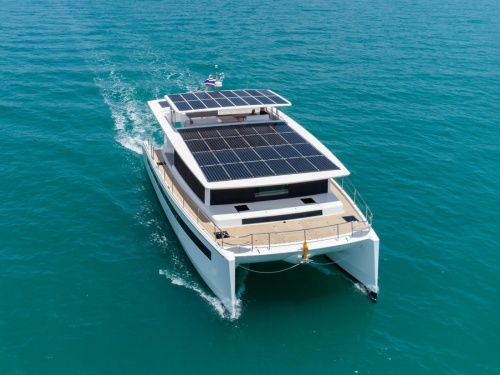
Our test vessel was equipped with solar panels that were fastened to the sunny side of the hard top and the coach roof brow. Together they have a maximum energy-producing capacity of just under 17 kWp per hour. Peak energy production depends on the angle that the sun's rays hit the panels. In a nut shell: when photons from the sun hit the panels they excite electrons in the silicon cells that flow in a specific direction creating direct current (DC) which flows into the ship's batteries. In the case of the Silent Yacht 62 3-Deck Open, the panels can produce about 100 kW per day, depending on latitude, angle of the sun during the day, and cloud cover.
The Silent Yacht 62 is fitted down the center line of the vessel with 34 Lithium-Ion battery packs in two rows of 17. The batteries are directly under the salon deck, which keeps them high and dry. This is an important design element of the system, not only because it keeps them far from the bilges in each hull, but also to make them relatively easy to trade out when they've come to the end of their 3,000 cycle life (8 to 10 years depending on use), or to trade out for newer, improved battery technology. The total capacity of the batteries is 286 kWh. That means in typical conditions it will take about three days for the photovoltaic cells to fill the batteries to capacity from zero.
The other source of power is a 143 kW Hyundai generator that is fed diesel fuel from a 524.5 gallon (2,000 L) tanks. The generator is operated at about 2600 RPM where it burns about 8.9 gph, producing 110 kW per hour which means it can completely charge the 286 kWh batteries in less than two hours. This fast-charge system is one of the reasons for the boat's appeal. In fact, under normal long-distance operating conditions, the boat is run for four hours on battery at 6.45 knots, then that charge is replenished with diesel-generated energy for less than an hour before topping off the batteries and returning to silent running.
The generator can run 58.9 continuous hours, which means following this regimen the vessel can travel over 1500 miles on one tank of fuel.
At about 200 rpm, with a power consumption of 1.5kW per motor, our test boat had a calculated range of 278nm with a 10% battery capacity reserve. However, looking towards the near future, with the next generation of the 60-line of Silent Yachts, advancing battery technology will increase the capacity by some 21% thereby affecting the range as well.
Our ideal cruising speed, at 450 rpm, resulted in 6-7 knots. When we turned around and ran a reciprocal course, we noted a 7.2 knot speed while burning 37 kWh, and our calculated range was almost 50nm. However, by running the generator for 1.5 hours, fully charged our battery banks allowing another four hours of running time at 7.2 knots. Of course, the large array of solar panels also contributed by feeding back into the system. Finally, knocking her down to 300 rpm resulted in an energy burn of 10kWh at 5 knots and a 128nm range.
Managing the power output with the energy input, using the solar panels and the generator, can make the Silent Yachts 62 3-Deck quite the long-distance traveler. And, there is one final energy source that can be added at no running cost, and that is the wind. The Silent Yachts' kite sail system is ideal for long-distance travel, say, across the Atlantic or Pacific oceans, when plying the trade winds. Downwind only, of course. This optional towing kite makes use of the wind without compromising the solar panels. Available in either 9m- or 12m-squared sizes, it can fly high enough to catch the wind and pull the boat at 5 knots, says the builder. The kite effectively replaces the generator as a "range extender."

Observations
As Odysseus, that age-old seafarer of lore and legend, was said by Homer to have mused, “an thélete na páte grígora, xecháste to!” In the language of ancient Greece, it loosely translates to: “If you are looking to go fast, forget about it!”
Using this new equipment entails an understanding of the electric propulsion system, batteries and energy storage, and renewable energy such as solar panels, and the generator. It's not difficult, and most people we know consider it a lot more fun than simply putting the boat on autopilot and burning through tons of hydrocarbons. The results are environmental sustainability, much lower operational costs, virtually no propulsion maintenance costs -- and considerable noise reduction. In fact, under battery power, the only sound you will hear is the rustle of the water as the twin bows cut through it.

Remember, life is better on a boat!
Delivery of a SY62 & a Fano Shipyard Update

On board the SY62 3-Deck Closed with Maryline & Toon
There are plenty of reasons to choose Silent Yachts. Maryline and Toon, from Belgium, chose the new SY62 3-Deck Closed, in the owner’s suite version, for three main reasons.
Silence was the primary one. After years of enjoying the ocean, Maryline and Toon sought an escape from the constant engine noise that disrupted their experience. The quietness of Silent Yachts’ solar-powered catamarans was the natural choice.
Spaciousness was the second reason. The generous volumes of the SY62 perfectly align with Maryline’s desire to have the whole family around, allowing her to talk with them while cooking in the main deck’s expansive kitchen surrounded by the ocean.
Independence was the third. Maryline and Toon love to explore remote bays, away from the crowds of busy harbors. Silent Yachts makes this possible, allowing owners to generate their own power and enjoy more freedom and quality time on board.
Leveraging Silent Yachts’ exceptional layout flexibility, Maryline and Toon selected the owner’s suite version for their seaside adventures. This configuration is ideal for those seeking the ultimate privacy. Here, the third deck transforms into an exclusive suite with nearly 360° panoramic sea views and a private terrace, the perfect oasis to relax and unwind.
Listen to Maryline and Toon’s story and discover how their newly delivered SY62 is a dream come true for year-round journeys at sea.
Full Speed Ahead at Our Fano Shipyard
Production is in full swing at our Fano shipyard, where we continue to craft fully electric yachts with meticulous attention to detail and unmatched shipbuilding mastery. Thanks to our shift to modular construction, we have enhanced both quality and efficiency, reaching a production rate of one yacht per month.
After the successful launches of the SY62 3-Deck Open and Closed, we’re on track to deliver additional SY62 units by the end of the year. Our talented team of 190 skilled employees is also developing the highly anticipated SY80 2-Deck prototype, which is set to debut at the 2025 Cannes Boat Show. With an enthusiastic and growing team, we’re committed to pushing the boundaries of sustainable yacht craftsmanship and innovation.
Next Ports
Palm Beach International Boat Show | MARCH 19 - 23, 2025
Experience the SY62 3-Deck Open firsthand. Stay tuned to book your appointment.

Singapore Yachting Festival | APRIL 10 - 13, 2025
Don’t miss the world debut of the Silent 62 3-Deck Closed. Mark your calendar to schedule a private tour.

Performance Review Transcript
Buyer Fit Framing
Captain Boomie opened with a direct positioning statement: "This may not be the boat for you. If you wanna do 30 knots and never miss a fuel dock, she's not your girl. If you want a monohull, she's not your girl. If you want to do something pioneering and innovative, this might be the boat for you."
Getting Underway — Silence
Captain Charlotte described a specific adjustment challenge: "One of the things that I find so disconcerting on this boat is that when we get ready to get underway, I literally have to go around and warn everyone what to expect, because that's me putting it in gear and you don't hear anything. It's very different, and it's a very weird feeling that it takes a while to get used to." She noted crew and dock hands often don't realize the boat is moving until it's already roughly 10 feet from the dock.
Tiller Steering
Both captains noted the boat's tiller (rather than wheel) steering as a novel experience, with Captain Charlotte remarking she hadn't used a tiller in years prior to this boat, and identifying the tricky part as knowing when to release it back to centerline.
Propulsion / Design Speed
Motors: Twin 280-kilowatt electric motors. The narration noted: "She is powered by 280-kilowatt electric motors, and under the right conditions, at about three knots, she could run forever by using less energy than she makes with an eight-hour day of good sunlight."
Design intent: "She's designed to go only at displacement speeds. So if you want a 20-knot cruiser, the Silent Yacht 62 is not for you."
Speed / Power Draw Data Points (Recorded During Testing)
- 200 RPM: 1 kilowatt total draw, 3.4 knots. Captain Charlotte noted this RPM is already much lower than a typical first-gear "click" on a comparable diesel boat, which is usually around 600 RPM and yields 4–4.5 knots: "Whereas with this you're getting three... it's just that extra bit slower."
- 200 RPM, retested: Twin 280 kW motors, consuming 1.5 kW per motor — resulted in a range of 278 nautical miles with a 10% battery reserve. (Note: battery technology is evolving; the next-built 62 is expected to have 21% greater battery capacity with a commensurate range increase.)
- 300 RPM: 6 kilowatts draw.
- 450 RPM ("standard cruise"): Both captains agreed this is the standard cruising speed, running approximately 6–7 knots while using relatively few kilowatts — described as "sustainable for quite a long range at this speed."
- Average on reciprocal runs at 450 RPM: 7.2 knots, burning an average of 37 kilowatts, for a range of 50 nautical miles.
Generator Recharge Scenario
By running the generator for just two hours, the batteries top off, allowing an additional four hours of running at 7.2 knots — plus whatever additional contribution the solar panels make during that time.
Solar Contribution (Observed)
At time of testing: approximately 6 kilowatts of solar generation while burning approximately 40 kilowatts at the higher cruise speed. Slowing to approximately 5 knots (300 RPM): burn dropped to 10 kilowatts per hour, with solar generation nearly matching consumption — Captain Boomie: "You'll see it makes a massive difference. And then you can pretty much run equal."
At 5 knots average (300 RPM): 10 kilowatts per hour burn, yielding a range of 128 nautical miles and an endurance of 25 hours, with a 10% battery reserve.
Solar-Sustained Cruising
Captain Boomie asked directly whether slowing down and managing solar versus motor draw could allow indefinite daytime cruising. Captain Charlotte's response: "A hundred percent, but you would have to slow right down — we are talking about four knots rather than six knots, so it's very, very slow. But if you did want to just cruise and not run the generator, not burn any fuel at all, as long as you've got sunlight, you can do that."
Two-day testing average: 4.15 knots, burning just 5 kilowatts per hour — 3 kilowatts less than the solar panels can generate per hour in Bahamian sun. At this rate, the vessel could theoretically travel for over two days at 4 knots even without sunlight.
Wide-Open Throttle Test
Captain Charlotte noted the different feel of monitoring an electric drivetrain at full throttle: "Without gearing, even RPMs seem arbitrary... I feel like I'm paying more attention to the power draw as my indication than the RPM, because the power draw will only go up so much. The RPM, we know max is out at around 800, but it takes a while to build — it's not like a normal engine boat where you put the throttle down, you see that RPM come straight up, you've gotta wait for it."
Wide-open throttle result: 843 RPM, power draw described as "vicious" — 140 kW on each side, totaling 280 kilowatts, at 11 knots. Captain Charlotte: "That's about an hour of driving... it does actually feel quite fast now, maybe because I'm so used to going [slower]."
Noted Software Limitation
Captain Boomie flagged a control quirk: pulling the single throttle lever back to neutral does not automatically disengage single-throttle mode to allow split-stick control, as is typical on comparable systems: "I feel like I'm having to work harder to engage what I want to engage." Both captains agreed this is likely a software fix rather than a hardware issue, notable given the boat's Starlink connectivity allows remote software updates from the factory.
Starlink / Remote Monitoring
The 62 comes equipped with Starlink, keeping the boat and operator in constant contact with the factory, which continuously monitors its vessels. Nearly all technical aspects of the boat can reportedly be adjusted remotely via telemetrics by factory technicians. Captain Boomie's assessment: "This feature would give me peace of mind on any yacht, and I predict in a few years it will become common on all large cruising [boats]."
Rough Weather Handling (Relayed by Captain Charlotte)
Asked about prior experience in heavier weather, Captain Charlotte responded: "It handles like any catamaran would handle in big seas. So we did have four-meter seas on the way up to the Cannes boat show, and it was uncomfortable, I'm not gonna lie, but it was manageable. We went through it at around seven to eight knots. We were running fast to get out of the storm."
Fuel Capacity / Range Context
The tested Silent Yacht 62 carries 500 gallons of fuel. With judicious use of diesel and solar generation, the vessel can reportedly make most passages of 300–400 miles at 7–8 knots. (Further detail referenced in a separate companion deep-dive video on the propulsion system.)
Intended Use Case
Captain Charlotte characterized the boat's design intent, particularly relevant in a relaxed cruising ground like The Bahamas versus a passage with a fixed schedule: "This is what this boat is designed for — island hopping. You're not in a rush to get anywhere. A couple of hours cruising every day, drop the hook, air con on, sunbathing, a few drinks in the back — and that's how this boat is designed to be used." Captain Boomie added: "I can't think of a better cruising grounds than The Bahamas for the Silent Yacht 62. But because of her sustainable energy supply, the world is her oyster."
Manufacturing Context
Captain Boomie noted this is one of the first Silent Yacht 62s produced under new ownership, with the model actively continuing to evolve. A complete speed/kilowatt-burn/range table is referenced as available on the Silent Yacht 62 page on BoatTEST.com.
Closing
Captain Boomie: "We're gonna do a deep dive into the systems onboard in the next video."
Features Walkthrough Transcript
Overview
Captain Boomie framed this as a dedicated systems video rather than a standard walkthrough: "She's so different that we're doing a different style of video to talk about just her systems and how they work. I need to dig deep into how they manage to make it possible for you to go cruising on sunshine." She noted this is her first experience aboard a full series-production all-electric yacht, distinct from one-off custom electric rebuilds she'd previously been aboard.
Power System Architecture
Steve Bell explained the dual-voltage design:
Low voltage system: 24-volt DC — powers lights, bilge pumps, low-voltage fridges, and navigation equipment, "no different to any other yacht."
High voltage system: 800-volt DC — runs the drivetrain, and inverts to 220/110-volt AC to run the "hotel load" (air conditioning, cooker, hair straighteners, etc.).
Redundancy: Both the high-voltage and low-voltage systems are split into two separate battery banks each. Steve Bell confirmed the purpose directly in response to Captain Boomie's question: "If you lose a bank, you're not dead in the water." / "Correct."
Solar (Photovoltaic) System
Panel allocation: 30 solar panels on the hardtop feed the 800-volt system; 12 panels on the coach roof/brow feed the 24-volt batteries.
Observed generation (at anchor, cloudy day, with Steve Bell): 3.5 kilowatts of solar generation against 2 kilowatts of yacht consumption at anchor — net positive.
Observed generation (later in the day, with Captain Charlotte): 8.3 kilowatts from the high-voltage cells, 1.2 kilowatts from the 24-volt cells.
Stated daily/peak figures (per Steve Bell, relayed by Captain Boomie):
- Expected daily solar input at this time of year in the Bahamas: approximately 80 kilowatts into the batteries, with 8–10 kilowatts observed the prior day
- Peak panel output: 17 kilowatts per hour
- Expected gain in these specific conditions: 13 kilowatts per hour
- With the sun directly overhead on a cloudless summer day: approximately 100 kilowatts generation
Generator as "Range Extender"
Steve Bell explained the generator's role: "Most people when they're doing cruising here in The Bahamas are gonna be doing two or three hours cruising every day and then putting the hook down... depending on the boat speed and energy consumption, we can cruise all day at displacement speeds."
Observed low-speed cruise example (at anchor demo): Running just shy of 200 RPM, twin electric motors using 2 kilowatts of power each, boat speed 3.9 knots (aided by 0.4 knots of current). BoatTEST's own performance testing showed 200 RPM typically produces 3.5 knots.
Generator sizing rationale: Steve Bell contrasted this with a conventional 60-foot motor yacht's typical 20 kW onboard generator: "That's 140 kilowatts [total capacity context]... it's specifically designed to charge these batteries as fast as possible to give you the minimum amount of time to run the generator."
Generator specifications:
- Fuel capacity: 524 gallons of diesel
- Typical operating range: 2,600–2,700 RPM
- Fuel burn at that setting: 8.9 gallons per hour
- Power output: approximately 130 kilowatts per hour
- Runtime on one tank at this setting: 59 hours
Case Study Cruise: Georgetown to Nassau (7 Days, ~120 Nautical Miles)
This cruise was completed entirely on solar and battery power, with no generator use, as documented day by day:
Day 1: Georgetown to Lee Stocking Island, 27 miles at 5 knots. Energy used from the 800V bank: 62 kWh. Solar gained: 28 kWh. Net use: 34 kWh. Batteries at end of day: 252 kWh (88% charge).
Day 2 (morning): Batteries down to 194 kWh (68%) after overnight AC use. Cruised 17 miles to Great Guana Cay at 5 knots, burning 40 kWh; solar gain 22 kWh; net burn 18 kWh. Anchored at 1 p.m., went ashore; additional solar gain of 28 kWh brought batteries to 204 kWh (71%) by end of day.
Day 3: Started at 140 kWh (50%). Crew took the day off to explore Great Guana Cay. Net solar gain for the day: 78 kWh, bringing batteries to 218 kWh (76%).
Day 4: Started at 150 kWh (52%). Traveled 15 miles to Staniel Cay (referred to as "Daniel Key" in the transcript — likely a mistranscription of Staniel Cay). Solar gain for the day: 78 kWh, leaving batteries at 198 kWh (70%) at lights out.
Day 7: Arrived at New Providence Island after a 40-mile cruise at 5.6 knots, taking 7 hours. Used 140 kWh en route, gained 40 kWh from solar, finishing with 76 kWh (26% charge).
Cruise Summary
- Duration: 7 days
- Distance: 120 nautical miles
- Usage: Air conditioning running most of the time; freezers and refrigerators running continuously; all other appliances used normally
- Generator use: None
- Total fuel used: Zero
- Total electricity used: 1,064 kilowatts
- Fuel cost: Zero
- Total emissions: Zero
- Total noise pollution: Zero
Single-Leg Passage Capability (Georgetown to Nassau, 120 Miles)
Per Steve Bell/BoatTEST performance data: the full 120-mile passage can be completed on a single battery charge with a 15% reserve, at 5 knots, taking 24 hours (currents/wind notwithstanding). At higher speed, the trip is faster but requires generator use to replenish batteries: 2 hours of generator use at 6.5 knots, or just over 4 hours at 8.5 knots. This chart is based on BoatTEST's own two-day performance runs on reciprocal courses, with the full chart available in BoatTEST's separate captain's report.
Efficiency Design Details
Captain Boomie asked what allows Silent Yachts to achieve range figures she hadn't seen matched by other electric or hybrid-electric vessels. Steve Bell's response: "I think when people look at electric yachts, they go electric motor, lithium battery and some solar panels — that couldn't be further from the truth." He credited proprietary software managing battery use and directing energy to the motors for efficiency and safety, declining to detail further specifics.
Additional observed efficiency measures:
- Cabins are insulated specifically to retain cool air and reduce AC load — something Captain Boomie said she'd never seen before on a yacht
- Solar panels are not glassed in but raised slightly off the surface (bolted rather than glassed), allowing airflow underneath for cooling and improved efficiency, while also making them easier to replace
Customizable Throttle / Drive Characteristics
Because the electric drivetrain has no gearbox (direct drive from the motor), Steve Bell noted the resulting feel: "As soon as I click forward, you get a thump, and you know you're moving." The throttle response curve is fully customizable per owner preference — in this case, dead slow was set to approximately 3 knots at 200 RPM, with much slower reverse response, though it could alternatively be set at 100 or 250 RPM.
Owner-operator relevance: Steve Bell noted approximately 60% of Silent Yacht buyers are owner-operators, and the company has designed the system to make handling as easy and safe as possible — including customizable bow and stern thruster response.
Thrusters
800-volt DC thrusters, rated to run at full power for 10 minutes without overheating. Steve Bell demonstrated confidence in using them for extended lateral movement (e.g., sideways to an adjacent mooring). He contrasted this with typical electric thruster limitations (overheating, breaker tripping) and hydraulic alternatives (requiring lines run stern to bow, prone to leaks, and slower): "That's really, really great for our customers that want to be able to use the thrusters. They're there for a reason — they're there to make your life as easy as you can driving the boat and take away any stress and strain."
Helm Steering
No wheel — a tiller is used. Asked whether owners request a wheel instead, Steve Bell confirmed: "You can have a wheel if you want."
Battery Room ("Engine Room")
Captain Boomie noted the unusual central, elevated placement of the battery banks — well above the waterline rather than in the hulls, given lithium's known incompatibility with saltwater exposure.
Battery management: A robust battery management system controls temperature and monitors individual cell voltage. A glycol cooling loop provides battery "air conditioning" if needed, circulating cold glycol through the cells — Steve Bell clarified this isn't continuously running: "It's a safety mechanism that you would get an alert on the system to say battery's hot, and you've got the choice to switch on the air conditioner [and] cool it. In all the hours that I've done on this in some pretty warm weather, never seen it, never had to use it."
Future battery upgrade: Steve Bell noted next-generation batteries (for the next boat built) will fit the same physical space but offer 348 kilowatts of capacity — 21% more — while being lighter. The centerline placement allows easy battery swaps as technology improves.
Remote Monitoring
Battery health and system data can be downloaded remotely via Starlink, allowing the factory tech team to run diagnostics, provide support, and push software updates remotely.
Generator (Physical Unit)
Located on the port side — a Hyundai generator developed exclusively for Silent Yachts. Design principle: the generator only charges the lithium battery bank directly; everything else aboard draws from the batteries. Captain Boomie noted the resulting consistency: "If I go plug a hairdryer in and add some load onto the system, it doesn't change the load that the generator is putting out. You get real consistency there."
Mechanical Spaces (Minimal Maintenance Area)
Captain Boomie noted this space requires far less routine maintenance than a conventional engine room. Contents include: the shaft connecting to the electric motor (no gears — direct drive), the stern thruster control box, and an emergency tiller — which, amusingly, takes the form of a small wheel. A separate hatch allows access to this space while underway, without needing to open the swim platform hatch.
At-Anchor Power Use Observation
After extended time at anchor running AC, refrigerators, freezers, and other appliances continuously, Captain Boomie checked the battery level: "We're at 93%, given the air conditioner, refrigerators, freezers, and other appliances have been running all day. That is precious little [draw]."
Related Content Referenced
Two additional videos on this vessel are referenced: a performance/operational video and a walkthrough video, along with a separate written captain's report on BoatTEST.com containing full performance stats and additional detail not covered in the videos.
Closing
Captain Boomie: "She really is a pioneer in this space, and it was fun to go through it."